I actually read that line in the Philadelphia Inquirer, what passes as a newspaper of record in my readopted home town. Having spent nearly forty years in Texas, I think I know B-S when I see it. I’m not here to tell you that isn’t really true, because you’re not an idiot. Or if you actually read my blog, maybe you are….and so am I. Who knows these days? As Pontius Pilate supposedly said to Jesus Christ, “What is Truth.” (John 12:38)
Of course, I’d probably hold much more firmly to these observations had I been here for forty years. But I haven’t been. Which is precisely the strength and weakness of much of what I will say. Driving around Philly through my old haunts is not in-depth study, and for sure, sorting out cause and effect, or what matters and what does not, well, you take your chances. But it is a bit like remembering Jack Kennedy. In my mind, he never aged. Cause he didn’t have the chance. But in the real world, if we have the chance, we age. As we age, we change. If we are lucky, the change is gradual, and you wake up in the last third of your life and say “How the Hell did this happen?” I’ve heard that from more than a few of my contemporaries. The honest ones.
I have gotten dropped back into a very different version of the city in which I grew up (born in 1951). Yes, it was changing as I left in 1980. And if you were to think about it, you could probably say–well, this was already underway. Because it was. My occasional visits home, some longer than others, were pretty revealing–in retrospect–but I was not in a mood to be absorb much. I had little kids with me, and my parents were aging. That was plenty. That Philadelphia appeared to being going to Hell was really not my concern. So if that observation really annoys you (and it will annoy some people), read no further. Cause this is only likely going to get worse.
Maybe I should wait until I have been here at least a year to say some of this stuff. But by then the shock will have worn off and for all I know, I may not be around then. You know, like a guy said to me, “At this age, don’t buy green bananas.” Point taken. Reluctantly.
It is not obvious to me, at least from the data, that Philly is any poorer than it was when I left. The poverty rate has fluctuated, and lately, believe it or not, it has ostensibly fallen. Ok. I cannot pick and choose among facts like a squirrel looking for nuts in a forest. But some nuts will look more enticing than others. That’s life. Objective truth is hard to find, no? At least that’s what we are all told–which may be part of the current problem. “Tell me your truth?” Right. You might as well say “Lie to me as you best see fit.” Even a stat book I’ve used says “Say I have found a truth.” That is not the same as “I have found the truth.” But I am not qualified to discuss such esoteric matters, so I leave you to the philosophy guys. There are some pretty good ones around Philly.
There are some things I do hold pretty firmly too. Nothing (or almost nothing) is free. Free means someone else is paying. So when my Democratic friends start tossing around free health care, free child care, free love–heh, heh. I keep silent. I hear, but I do not listen. There is no such thing. If I take an afternoon, voluntarily, having a good time horsing around with kids whose mental age I probably share, it is not free. I could be doing something else. That something else might be limited to working as a checker in Whole Foods (I see lots of old dudes there), but the chain will compensate me. So what I get out of providing child care gratis must at least make me feel as good as if I got the $50. If not, slavery in some form aside, why would I do it? Like it or not, the Econ reason that way, and I don’t have a problem with it. Your football coach in high school who taught economics wrote TINSTAAFL in sold caps (not cursive, please) so you would thenceforward think any further training in economics was superfluous. Maybe so. A lot of people evidently don’t get that, especially in public life.
Where to begin? How about West Philly? The definition of West Philly is pretty elastic, but I’d say that’s where I spent the first decade or so of my life (along with an ample dose of South Philly). I’m struggling to convey how much West Philly has changed. And, really, how little I suspect it actually matters. Since 1990, the population has flipped, from being mostly white to mostly black. That of course, strikes anyone who grew up around there in the 1950s. And you will find any number of knuckleheads who will explain virtually any change in living conditions by that fact. But really, is it so different?
Technically, I grew up in Overbook (although the library branch was called Haddington). You know, Wilt Chamberlain graduated from Overbook, so anyone who tells you that blacks in West Philly are a novelty is full of it. Will Smith came from a parish on the edge of West Philly. Let me put it this way.
I can imagine the Welsh (as in Haverford Ave) who lived out in what was then West Philly around 1900–rural, for sure, as the Italians slowly made their way out to the distant fringes of the city (then known as Blockley) They must have been thrilled with their swarthy new neighbors, their exotic foods, weird lingo, and their penchant for settling differences with a knife (at best). There goes the neighborhood, you know. Yeah, I know. A matter of perspective. We were the undesirables then. And, if you look back on payroll records from the early twentieth century–from Philadelphia–Negros and Italians were not individually named. A residence for workers at Dennis Kelly’s mill in what is now Ardmore Junction (on Cobbs Creek) basically said well the place has got lots of people, Italians, Negros, whatever. If I have to dig these things up, I can. But I have a PHD, so trust me (hah).
Two things impress me about Philadelphia. The poverty and the violence. There is no point in denying either. Last night I was entertained by watching broadcast news pointing out (in between the Phillies screwing up the ASG big time) there had been 28 homicides in the last month, gun violence, and, at times, seemingly random. Yeah, someone got shot while mowing a lawn–and not by ICE, for a change.
There are some people who will say these are inseparable, poverty and violence. They may well be. But the way they try to prove it in Philly is not so convincing: the association between redlining and gun violence. Look. You’d have to be blind, or stupid, or simply dishonest not to see the association, but, as my stat colleagues always say, correlation is not causation. And, apart from that, there are also significant parts of the city that were redlined (pink) in the 1937 map where there is not so much gun violence. If you know the city, you’ll say, yeah, nobody lives in Tinicum marsh around the airport, so unless you have armed geese, the odds are low that you will find much violence there. But it is also the case that in some parts of the city that were redlined, population is now not as dense as it was when the redlining maps were drawn. And they are still pretty violent. Or maybe they weren’t as violent in the past as they are now.
Hmm. Can you say “Guns don’t kill people, people kill people.” Yeah, but people with guns use guns to kill people. C’mon, be realistic. In 1937, there were about 0.35 guns per person, as far as I can tell. Today, today the number is 1.2 to 1.5 per person. Dude, that’s 4 to 5 times as many. Strictly speaking, it doesn’t prove anything, right. Ok. But if you do some kind of thought-experiment where guns didn’t exist, no one would die by gun-related crime. Yeah, I know. Cain and Abel and the righteousness of the Lord before the Flood (“I ain’t happy with these people so I’m gonna drown ’em all; Genesis 7 if you are keeping score) People use what they have at hand to whack other people, and guns are a lot more effective than shovels (I had an ancestor who had to split town because he crowned his Boss with one “back in the the day”: I have no idea how that turned out) You want to strangle someone. People resist. You want to shoot them. How far can a good shot be from a victim armed with a Glock? So easy, even a child can do it, God forbid.
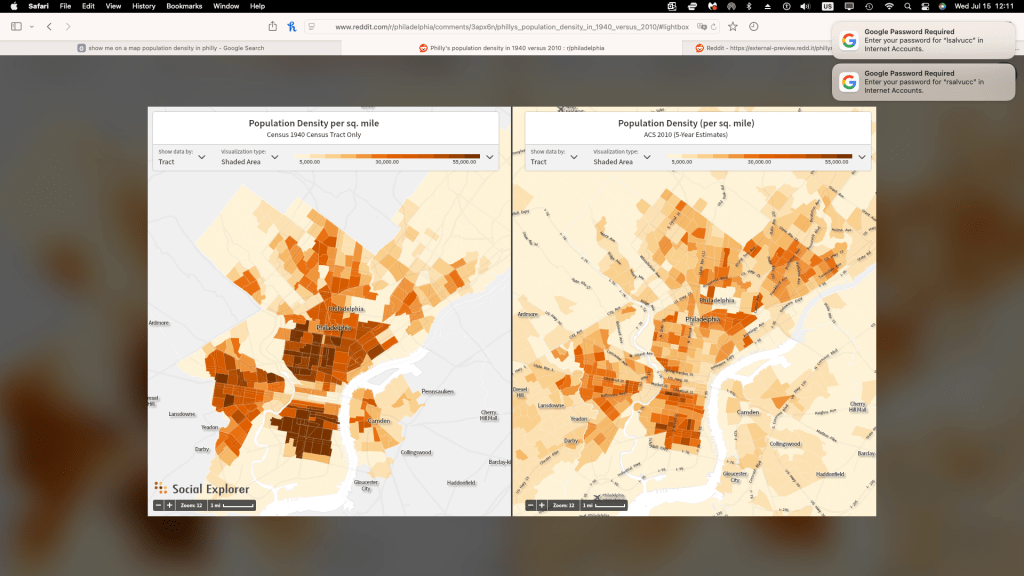
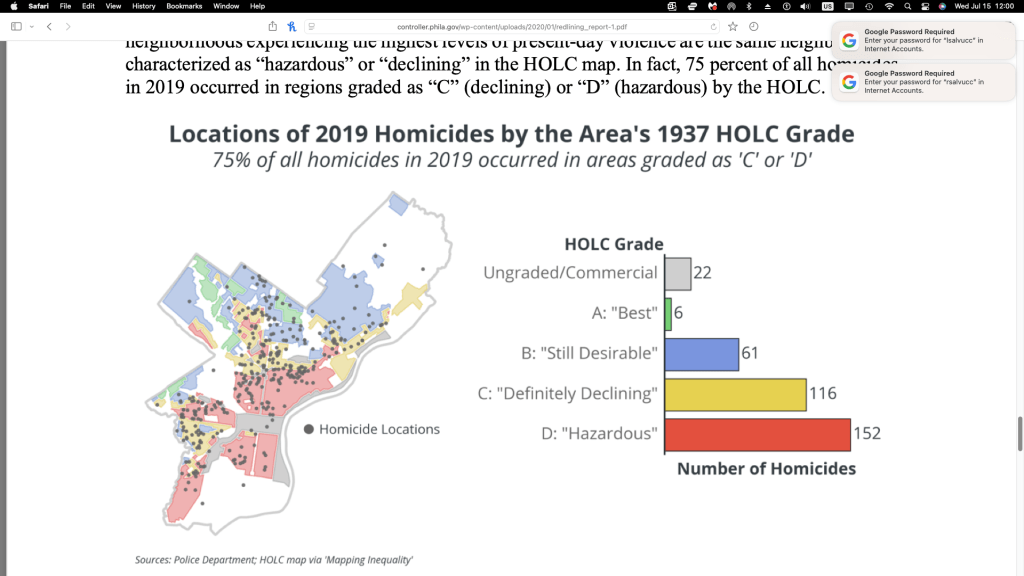
Tell you what. At the risk of attempting the impossible (and of oversimplifying the connection between race, class, income, national economic policy–Hell, even geography–) let’s try to look at this in a slightly less loaded way. Ultimately, the question may come down to some form of what the Econ call Granger-causality: does income chase race or does race chase income. I can’t give an answer to that. No one can. But maybe I can point out a few points to give you pause, especially if you’re the type to think “Hey, it’s THEIR fault,” whoever you’re THEIR of choice might be. I got to do with some numbers, and for that I apologize, but you can’t really avoid it. If you are asking why poverty is so widespread, well, you are asking why a particular measure of welfare is what it is. Like Augustine said, you can’t “ask was there time before time” without sounding like an idiot. And, sadly, many of my colleagues, especially in my own field (Latin American Economic History), regard standard economics, basic statistics, all of it, as boring as Hell at best, and the Devil’s work at worst. That’s my problem, true; but because it leads them into saying so many demonstrably idiotic things, it’s their problem too.
Ok. Let’s looks at a few things. Real income growth, the dollar, and manufacturing in Philadelphia in the 1970s. In Philly, according to the statistics I can turn up (and God knows if they are reliable), from 1940 to 1970, real per capita income doubled. That tells us that the the average annual rate of growth was about 2.3 percent. In 1940, about a third of the city’s output and employment was in manufacturing, and immediately after World War II, if anything, that share grew. That healthy growth in local income pulled manufacturing along–not the only source, for sure, but not trivial. I remember the new subway cars in Philly in 1960, because at the age of nine, I asked my Grandmother to wait for a new train (God love her, she did). Those cars were built by the BUDD Company in Philadelphia. which also built for other rail lines, like the Reading Seashore Line. Believe it or not, we built stuff then, and Philly built a lot of it. They even manufactured textiles in Philly then: not a lot, and nothing like it had been back in, say 1910, but it was something.
By the 1970s, alas, making stuff was all on the way out, sealed by the end of something called the Bretton Woods Agreement 1971. I won’t bore you, ok, but previously the dollar had been convertible into gold. That ended, and when it did, the dollar’s value was supported by supply and demand, not by the price of gold.The net effect on the US dollar was a decline in its purchasing power (why: because there were too many dollars floating around and nobody wanted them as much anymore). From 1970 to 1980, the dollar lost about a third of its value in terms of foreign currency. And that was a lot.
Normally, you’d say, but doesn’t something like that help domestic industry–Philadelphia–by making imports more expensive: technically, a depreciation of the home currency? Yeah, but that is only a part of the story. Remember–or look up–what happened to the price of crude oil in 1973, which, priced in dollars, meant that the oil-producing countries got ticked off and got together to raise the price of crude. Unless you were Texas (you can boo here), this was not a good thing, for it immediately pushed up the cost of energy to domestic manufacturing, which is basically, the cost of doing things, cause no energy, machines stop. And raw materials prices, which is the facere in manufacturing. In 1973, no surprise, we went into a savage recession, which means demand and employment dropped. The recession hit Philly especially hard, because manufacturing was hit hard, and Philadelphia’s trip into the great wasteland of deindustrialization in the 1970s was on its way. You lose an industrial. base, you don’t regrow another one overnight, if ever. And you lose jobs, residents, tax base, you name it. The air goes out of the balloon. Fast.
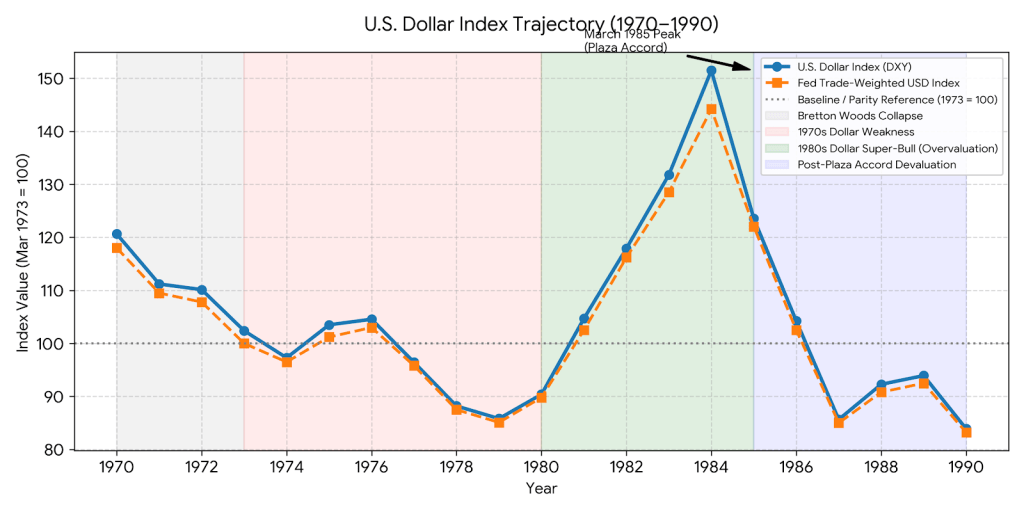
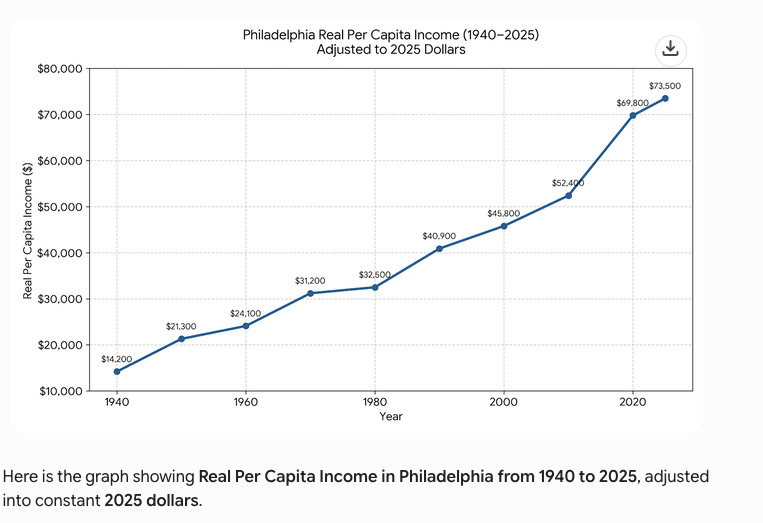
Look at both graphs, 1970-1980. Remember, correlation isn’t causality, but it ain’t chopped. liver either. Notice something? You win the internet today. The 1970s weren’t good for the dollar, or for Philly’s per capita income.
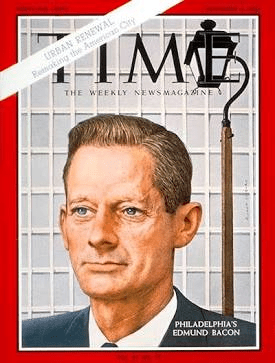
There was other stuff going on too. Like urban removal–I mean renewal. We all remember Kevin Bacon’s dad (Ed Bacon) as reinvisioning downtowns. Philly got Society Hill, Market Street East, Love Plaza, and the demolition of the Chinese Wall. It also got the demolition of any number of viable neighborhoods and degraded the stock of affordable housing. Man, Society Hill is nice, but Remember when the Towers went condo around 1980 and a small unit went for $50-$75 thousand dollars, if not more. You think a working stiff from Oscar Mayer could afford that? No. They went to Thorofare, New Jersey. And then there was the Schuylkill Expressway, which got going out in the great beyond in the early 1950s and hit the city around the time I was growing up in the late 1950s. It finally hooked up to….New Jersey around 1960 (I think). So you could make it easy, for people with car to get in and out of Philly from the suburbs and Jersey, leaving behind the folks who could at best afford mostly marginal housing and could not migrate–maybe because they couldn’t afford a car. Can you say poor people? Especially poor people without access to capital markets (redlining). Can you say minorities? I think Poverty sort of Granger -caused minorities in Philly, but that’s only an intuition, not a rigorous econometric exercise as required by The American Economic Association. Still, sort of makes sense.
I forgot about I95, alias the Delaware Expressway. Or the Crosstown Expressway that never was. I leave the proof of the exercise to the student (translation: I’m too lazy to do it myself). Or the Schuylkill Expressway. Or the Vine Street Expressway. Hell, they all destroyed viable neighborhoods or made it easy to work in the city and then get out. Which is just what happened. The fact that Philly had a wage tax was the straw that broke the camel’s back. You didn’t have to live there. Just work there. The rates were different, but nobody was gonna live in a deteriorating city when they could have a Leave-It-To-Beaver experience of a white picket fence which was easily reachable. You tax something, by the way, you tend to get less of it. The only part of supply side economics that strikes me as remotely true.
The city tax base crumbled and so did the public schools. My parents, religion aside, would not have let me within a mile of a public school–probably for my own good. But if you think they were teaching the virtues of deferred gratification, self-discipline and good citizenship to their clientele, you are an optimist. Survival skills, really. If that. The people behind charter schools in Philly were minority. Go figure (sarcasm). The kids in parochial schools wearing uniforms are minority. Go figure. The public schools are now a disaster.
So here we have modern Philly. Supposedly a bit on the upswing because when you hit bottom, you attract–bottom feeders. And Penn has decided to do penance for University City, whose construction wiped out another viable West Philly neighborhood. So Parkside and Mantua and even parts of Southwest Philly, are now a place for investment. As the Brazilians say, money whitens.
Meanwhile the bad stuff that happens when people get priced out of their existing neighborhoods is slowing making its way into Delaware Country, which is getting scary in places. I’d go into considerable detail about which neighborhoods used to be tranquil but are in transition, but I’d simply try your patience and probably get into trouble by saying “What do you expect?” People gotta go somewhere and Southwest of Philly is the path of least resistance. Does the observation make me a racist. No. It makes me a realist. Although I am certain to have readers who use the term “racist” lightly. I can imagine what Philly and its suburbs are going to look like 50 years from now. But I can’t make any money off of being right or wrong, so who cares what I think? I do know one thing.
We had better learn tolerance and nontribal ways of thinking politically in this damn country, or human relations are only going to get worse. And I am not optimistic. We have not learned much in the last forty years, believe me. That’s what I have learned since coming home.
PS I am obviously talking about West, North and South Philly. NOT Chestnut Hill, Germantown, Mt Airy, Roxborough or Manayunk. That’s another world, and doesn’t even feel like Philly.

