I’d tell you the names have been changed to protect the innocent. But there are no innocent parties. So I name names. And I’d tell you that the following is a true story. And it is, although some of it hasn’t happened yet. But just wait. As sure as my name is Richard Joseph Salvucci, story is bound to happen. And remember. I always say you can’t make this stuff up.
Any event, we flew to Philly via United Airlines. It was uneventful, thank God. At the behest of United, we rented a car from Avis, from whom I had sworn forty years ago that I would never rent a car again after they refused to abide by a contract. And until now, I had kept that promise. Now I have new reasons to avoid Avis entirely. I will, in due course, treat you to some of them.
I recent took a flying trip back to home. Home, as my faithful readers know, is Philadelphia. Linda and I went to help a friend celebrate her fiftieth wedding anniversary. This was very pleasant. Linda saw some of her old friends. We did the old-fashioned Catholic thing and tended our parents and relatives graves in Sts Peter and Paul Cemetary (known to the locals as “Two Guys” after a a defunct discount chain). We hit Murray’s Deli which is, as they say, Old School. We went to Termini’s bakery on our way out of town (it is in South Philly) to get real Eyetalian cookies and stuff. And we visited some parts of neighborhoods where we thought we might be able to escape if Felonius Punk (aka Agent Orange), God forbid, gets reelected. You never know. Never bet against the stupidity of the American people. There are friends and relatives we both wish we had seen, but time was short and we just had to make choices. No offense to anyone, if anyone is offended. I can’t imagine why anyone would be, but people seem to get offended a lot nowadays.
So we have this reservation for what passes as a modest vehicle. It was not the model I wanted, but I know you can’t expect to get that, especially if you are traveling peasant class. So we get to the office here and we have to sweat a line–not too bad, really. None of this run out to the lot, choose your car, and go! That’s only for dudes like Joe Buck.
When we are attended, I pull out all the required documents, including proof of insurance! I decline all the crap they want to add on. Then I wait. And wait. And wait. It takes like fifteen minutes to get my card approved. I wonder why, since this is one bill that gets paid religiously. They say, well, this happens when we have a lot of people renting cars. I thought that sounded odd, but what the Hell. Another customer was fighting with them over why she had to have a credit card, so why make things worse? So we wait, and wait, and finally, we get approved with the usual caveat about how much Avis will block on the card. Like I have a choice? Fine.
So now we get to go to our car, right? Wrong?
“They will bring your car to the door.” So we wait. And wait. And wait. And there is another couple waiting. And waiting. And waiting. After at least half an hour, the Avis types bring the other folks their car. Still dripping wet because it was just washed–because it was apparently just returned. Because they don’t have any cars available. Oh. Yeah, they cut their fleets back during Covid, Linda says. Oh. Blame Biden. Sure. Why not? But he wasn’t President then, was he? No, Trump was. But people blame Biden. They think Trump will do a better job of handling the economy. On what grounds? Who knows? Cause some bot on FB told them so. Makes sense.
In the meantime, the other couple–also Golden Agers–are getting out of their freshly washed car because they say it is dirty. So they want another car. Picky. Picky. So as they wait and hold up the works, we continue to wait. And wait. And wait.
Finally, these guys get something they can live with. So we are told to wait for a gray Mazda. Ok. I have no idea what a gray Mazda looks like other than it is gray. Finally–and it is now going on an hour since we hit Avis–someone pulls up in some low slung gray thing that is also dripping wet. Because it was just returned. Last in, first out. We double check with an employee. This one? Grunts affirmatively.
Then we try to figure out how to open trunk because we have luggage. God knows. No indication so I shanghai another Avis type and nicely ask how to get the #$%^& trunk open. Dude obliges. Not very roomy, but there you go. After my usual trying to figure out how the damn car operates, we try pushing off. But there is this persistent low frequency kerchunk noise. And it ain’t stopping. I pull over in the lot and listen under the hood. Nothing. Linda looks at me and says something like I bet it’s the radio. So then we go through the “which button, slider, dial, icon, whatever” do we manipulate to turn off the radio, if it is the radio making the noise. Random search finally shuts off the noise. See. Logic, right? This has consumed another fifteen minutes, so when we finally get through the exit security, we are free. Just like the old commercials. Smiling, tanned and beautiful, we hit the open road.
Right.
Actually, we try to figure out where the Hell to go because the signage out of PHL is about as helpful as the signage out of SAT, which I swear is useful only if you already know where you are headed. We sort of do, but you know, I am never sure to go North or South on I95 because we are headed out to Radnor Township and then Chester County. My sense of direction is that of a hopeless left-hander, which means I always head the wrong way. I assume if I think it is the right way, it is wrong; and viceversa. So we have an amicable difference about where the Hell we are going. We head South, and just as I am certain we’re gonna end up in Maryland, we hit I476 (known as the Blue Route over the nimby battle that occurred half a century ago about where to site the evil concrete beast, which actually sat only partially completed for years as a drag strip) and went North. Lost??? Don’t worry. We were headed out to Villanova, and as graduates of that illustrious house of studies, we know the way, eventually. You can always find ‘Nova. Look for the Wildcat holding a beer.
Any event, we get to our destination, which is where our friend’s wedding anniversary party was held. Man, I do not know many–if any couples–who have made it that far, because our generation pioneered the “divorce is good for everyone” stuff. At our table, alas, were two of Linda’s friends who were widows, already. They didn’t get to make the Big 5-0. So you feel good for the ones you can, empathy for the others, and vaguely guilty about yourself. Here I am, happily married 50 years, in apparent (save for few glitches) good health. And the rest of the American Dream. After our Happy Daze at Euphoric State, I should be grateful. Texas may not be anyone’s idea of a dream destination, by after learning the ropes at Whattsamatta U, well, I know there’s worse.
We did spend some time looking at real estate, in case we have to apply for asylum in the event that Felonius Punk gets reelected. Linda’s friend Eileen lives in a hilltop home with a No Fascism banner in front of it. Coolest damn thing I have ever seen. In Texas, it would invite a Christian RPG squad to take your libtard ass out. There are certainly reactionaries in that part of the world, but at least along the Main Line, they appear to be part of what people in Latin America used to call the “civilized right.” They don’t drool over dinner.
We saw some nice places and made it down to Bala Cynwyd PA and Murray’s Delicatessen and drove by Flat Rock Park for old times sake. It is still by the Schuylkill, and unspoiled. Remarkably even by Philly standards. And safe. Linda was feeling not so good, and we stopped there for her to take a COVID test. She still felt dreadful, but tested negative, so off we went. The one really disconcerting moment was when we were on Montgomery Avenue out by Bryn Mawr, Baldwin, and Shipley–real high dollar educational venues for the young and privileged (of any ethnicity, thank you. This is a Liberowl Paradise.).Some dork pulled up in a, well, pickup with a cut-out of Trump riding shotgun. Man, we hadn’t even seen that in Texas, so it threw us into the grass is always greener mode. Literally, cause it still rains around Philly. The sheer shock of seeing Agent Orange around Bryn Mawr instead of New Braunfels sort of brought us back to reality. He’s everywhere. Sort of Like the Anti-God.
Paradise Regained: Where the Brisket is Good, but the Corned Beef is Better
So, missions accomplished. We both knew we can’t go home again. Home no longer exists. We left in 1981 and 43 years is long stroll. Lots of ghosts of Christmas past, but what feels good also feels bad. Make any sense? You see your friends after 43 years and wonder if you look as awful to them as some of them do to you. Life just beats people down, and some of these guys have had a difficult ride–so the there that’s there really isn’t there other than in memory. Well, that’s abput as deep as I get. Not very.
Time to take our car back to Avis. Now it really gets, well, surreal. When we figure out the directions to rental car return, we get to Fortress Avis. You know, tire-piercing spikes greet you if you back up and there ia a security wall that would do the White House proud. But wait. There’s more. As you ease into the facility you realize that there are at fifty or more equally anxious returnees jammed up in a long, chaotic line. We weren’t cutting it close, so just sitting in an ever-growing cue didn’t so much upset us as astound us. WTF? Not only could you not get a car, but you couldn’t return one? Even for modern America, this seemed sort of dysfunctional, not to say dangerous. Cause sure enough, the cars behind us are spilling out into the airport highway loaded with a lot of ticked off, increasingly frantic travellers. Hey. I got a plane to catch. And I can’t do it from here, right? Right.
Linda tells me that something similar happened in Austin, Texas a few weeks ago and people just abandoned their rentals by the side of the road. Avis, of course, has neither a sense of humor or responsibility, so they have been apparently been sending out letters with humongous fines to the derelict owners who just wanted to make a plane, even if they had to waalk with baggage to a distant terminal. I admit, this is a new one to me. I know nothing really works correctly in America these days, but this one was kind of astounding–not to mention scary. Well, why scary?
You know damn right well that in this situation, it’s every customer for him or herself. Sort of logical. You want to get out of a burning building, everyone heads for the door. No one gets through. And people die in heaps at the exits. Hell, you want to be first. It’s rational. It’s also deadly. And since Avis had seen fit to send no one out to the line to reassure the ansty folk that someone would assist them shortly, well, folks start to take matters into their own hands. You see people get out of cars, looking around, pulling out luggage, kids and stuff, and then craning to see someone, anyone. Or no one. No one really talks it over, right. Hell, no one makes eye contact. You think, oh my God, this is Philly, and this will get ugly very quickly. Sort of like the crowd at an Iggles’ game. You realize some people are trying to edge their rentals in front of you even if they came in later. Your first instinct, right, yo! what you think you’re doing bruh? I was here first. And then you say, wait, do, road rage. Or Rent Rage. Damn, some of these people are probably carrying. And the only way to find out is to encourage confrontation, which is definitely a bad idea. So what do you do? Welcome to Trump’s America.
So as you begin to contemplate how to protect your spouse from some nut from a Red State, an Avis employee finally shows up. It’s been about 25 minutes and people are leaving in droves. Ms Avis don’t care. “Leave the key in the car. Leave the motor running. And thank you for renting from Avis.” Dude, we got baggage. Tough. Cars are blocking the way. Tough. Where the Hell is the bus to the terminal. Go find it.
So you watch people jostling past each other and struggle to somehow get to a terminal to make a flight. You think, oh Lord, is this like Texas or Florida? Do I stand my ground? And because I am unarmed, risk getting shot over a car rental? You think this stuff, and then push it out of your mind. Today is not a good day to die, to quote Worf, and damned if it’s gonna be over a car rental.
Well, we got out in one piece. We were shaking our heads all the way home. And once we landed in San Antonio, we had to wait for over an hour before United Airlies retrieved our bags. Hell, we didn’t make it home until 2AM. But that would be a whole ‘nother story. And you really don’t want to hear it, right? No you don’t.
So, look, bring food and a sleeping bag the next time you plan a short trip to a domestic destination. It beats carrying a gun right? You remember all them great rental commercials from the 1960s? God almighty. Let Hertz put you in the Driver’s Seat? This one would be more like an episode from the Twilight Zone. You remember? “Willoughby, this stop is Willoughby?”
Yeah, God help me, I feel like getting off here.
Night
PD As a student, I remember reading a short story by Julio Cortazar called “El Autopista del Sur.” If memory serves, a huge traffic tie up somewhere in the fantasy wilds of Argentina becomes the occasion for the local populace to come out and attack the idled motorists. Why does this story come to mind after going through this idiocy?
No. That’s not what you think it means, if you think it means anything at all. And this otherwise adolescent recollection has a serious point, especially with the way political life in the United States is evolving. I suppose I’m going to come across as a complete reactionary, but it’s not as if I care any longer. I am in the process of accepting my fate.
You must remember that the events I am recounting stretch back to the Dark Ages, AD (ok, CE if you feel better) 1967 or so. They involve the sensibilities and humor of adolescent males at an exclusively male Catholic school. In case you haven’t guessed, sensibilities change. While I still find some of this deeply amusing, you had to be there, I suppose. And the point I want to make is, again, serious. You may disagree. That is your privilege.
I had started one of these “bare, ruined choirs” things, but dropped it. I figures no one really cares what happened to the Church I grew up in unless they are at least 70, and maybe 80. And even then, I don’t know many who actually care. So instead I will simply say that love of the Latin language, amor linguae latinae, has been one of the apparent casualties. Oh, yeah. There are some schools where it is still taught–I insisted my son study Latin in high school, which I am sure did a great deal for male bonding, especially when some of his friends insisted on telling him it was “a dead language.” That is not only facile, but incorrect, as any educated person knows. The common figure is that 60 percent of words in English are derived from a Latin root by borrowing, if not direct descent. Which explains why we tended to crush the English SATs back then in a way that the publics (US version) did not. Their loss. And that is trivial. But education is in a bad way in USAmerica, so to Hell with it.
I would have studied Latin no matter where I went to high school, cause my Mother wasn’t about to see me run wild with the heathen (not to mention heathen women) at Lower Merion HS. So it was Catholic one way or another. And in those days, that pretty much meant Latin. The only questions I think was how much and at what level.
Now may Dad, God rest his soul, graduated from West Catholic High School in Philly in 1937. That was no some fancy ass place, and he had his Latin war stories for me. His favorite was “E et noli reddire.” This was to put me in my place when failing to translate “Go and do not return” satisfactorily, as he once did. Yes, imperatives, negative imperative, weird irregular verb form, all that stuff. I’m sure he never said that to anyone flying a B-17 in 1941, but it was what it was. I remembered how obnoxious quoting Latin could be when Robert Oppenheimer apparently said to Lewis Strauss before his security clearance hearing, “Nos morituri te salutamus.” which Strauss supposedly didn’t understand. Supposedly the Roman gladiators addressed the Emperor (really, te?) before the fun and games in the Colosseum (artist’s conception, below) If you haven’t read the transcript of the security committee or seen the Sam Waterstone TV series (I haven’t bothered with the recent movie) you’ll have to look it up. Heh. Maybe it’s apocryphal (more Latin). Anyway, Strauss didn’t much like Oppie, and this, if it happened, didn’t improve things.
Latin was the lingua franca of the Pre-Vatican II Council (1962-1965) church and even if you spoke it badly, you were expected to get by on formal occasions. I heard amusing stories about whitebread Philly types getting around in the Belgian Congo in the 1950s by using some Latin with a priest (Habes-ne uxorem? Olim, sed non nunc: roughly, “Are you married. Not any more.”), and I know until quite recently you could still go to Rome and study Latin with an American priest in “boot camp” form (he has since passed on). There is still a Pontifical Academy for Latin (https://www.pontificiaacademialatinitatis.org/) although, hah, hah, its text is in Tuscan (Italian). But in those days, even as the Roman Catholic Church was losing its Roman Imperial soul, you could still expect to do Latin in a Catholic high school. I knew people who did it in college at Villanova, but I opted for Castillian (Spanish) as, perhaps, a shade more practical. Or, as we said, “relevant.” As an Anglo doing Mexican history, “cultural appropriation” is now more fashionable than “relevance.”
So, here we were, fourteen years old for the most part, and beginning our journey in Latin with the Piarist Fathers at Devon Prep. I doubt any of them were trained classicists and we never got the reconstituted Classical Pronunciation. It was, well, ecclesiastical pronunciation, of which which I thought Keewees Romanus Sum (Civis Romanus Sum) was some sort of put on. So, for the real toffs (I didn’t know any Harrovians then, thank God), we weren’t for real. And, to an extent, our first two years were sort of watered down. Oh, we learned the basic grammar and all that, which was quite enough, cause Latin is, like modern German, an inflected language–the form of the word would change with case, number, gender, that sort of thing. And of course the damned adjectives had to agree, so the possibilities for screwing up even basic stuff were numerous. My first sentence: “Livia puella est.” Followed by (I think) “Livia pulchra est.” Ok: Livia is a girl. Livia is a pretty girl. Hey man, it was 1965. What do you expect? This was an all boys’ school and the priests figured they had to hook us one way or another. The life and adventures (chaste) of pulchritidinous Livia beat talking about Roman plumbing. Cause we all were immediately trying to figure out how to hit on Livia. In Latin. Use your imagination and pretend you are a fourteen year old guy. And so it went. Until Year III.
You didn’t have to go on after Second Year, but I think maybe between 5 and 10 of us did. And all of a sudden, Livia the Hot was gone. In her place was some guy named Cicero and another one inauspiciously dubbed Cataline. Very bad news. We had gotten watered down Caesar in our Second year (“Gallia omnia divisa est in partes tres?), but not in the original. All of that suddenly changed.
My first two Latin teachers were Piarist fathers nicknamed Stubby and Dizzy. The nicknames were quite appropriate, Stubby was a Polish priest with an unpronounceable name (to us) who was short, squat, and gentle. I never saw him get angry–and it wasn’t as if he had no provocation from us. I think it was because all of us realized–even the idiots–that he was something special and endearing. His name was Fr Soczowka, Sch. P. He was followed directly Second Year by Dizzy. Stubby, then Dizzy.
Diz, of course, was another matter. He came by his moniker honestly.
He seemed distracted, addled, occasionally made no sense when he spoke, and was kind of crazy. By name, Fr Julius Olszewski, Sch. P. he was generally placid enough other than for his enigmatic sayings (“Make round on 29”–I have no idea) and occasional eruptions when we were screwing around (always) (“I will give you such a kick that your head will turn around and you will never suppose”). He also took great exception to being called Dizzy, which is understandable. We did get as far as De Bello Gallico, at least a watered-down version. It proved useful in providing names of various barbarian tribes into which we divided as teams playing pick-up basketball (I never got beyond the Suevi, who stunk), so there was that. Also, iacta alea est and crossing the Rubicon and, well, that kind of literary thing. No one got hurt and we learned ablative absolute and subjunctive verb forms Besides, we were reading both volumes of Brinton, Christopher and Wolff in two years of Western Civ, so we had some idea of what was going on. Two years. Literally Plato to NATO. I’m still working off some of that from half a century ago. No regrets, by the way. In any event, there was once a jock strap war in his class. Yup. I’ll leave it to your imagination.
Latin II with Diz
In Latin III, the fun came to a halt, for a while at least. First, we got a stone serious teacher. His name was Stanislaus Swiatek, Sch.P. He didn’t screw around. He was genial enough, but nobody messed with him. He was, colloquially, Stan, although no one dared call him that to his face. He was wiry, medium height, curly hair but balding, fingers stained by nicotine, and a raspy smoker’s voice to accompany it. He radiated “no bullshit”, and lots of stories circulated about his exploits in 1956 when he may have eaten a few Russians alive in Hungary. I could–and can–see it. He was a tough central European customer down to the soles of his feet. And then came Cicero and Cataline.
We got a serious text, none of this schola bona est crap. Uh uh.
“Quo usque tandem abutere, Catilina, patientia nostra? Quam diu etiam furor iste tuus nos eludet? Quem ad finem sese effrenata iactabit audacia?”
A colloquial modern informal translation of this might be: “Dude. Cataline. How long do you plan to torque us around?” That’s not strictly accurate, of course. “How long will you abuse our patience, Cataline. How long will this madness of yours continue to make fools of us? And to what end will your unbridled arrogance be on display?” That’s a little better, probably not for purists, but you get the idea. Cicero (106-43 BCE), a famous Roman statesman, consul, and source of adolescent nightmares second only to Calculus, was here denouncing his rival, Cataline, whom Cicero claimed was part of a plot to overthrow him as consul. And Cicero (Kickero to the toffs) saw Cataline off, as in put to death. I think that appealed to Stan, cause he grinned wickedly when he worked through the speech with us. And he emphasized (I realized in retrospect), that Cicero was going for the kill by insisting that “nos eludet” should be rendered as “make sport of us”. For a guy whose native language wasn’t English like Stan, that was something, because the root of the Latin verb “eludere” was “ludus” or game. So if you wanted to be coarse about it, there was a sense in which Cicero was accusing Cataline of “screwing around” with a central Roman institution of governance–disrespectfully–, you know, playing cat and mouse with the Roman Senate. I remember venturing (as if it were yesterday) that “mock” would be a better choice. Stan wasn’t having it. “Salvucci. He is brigand (yeah, Stan used that kind of vocabulary and diction).” As if to say, “Kid, you may may mock me, but Cataline was toying with someone well above him. He had it coming.”
See, what you got, even as a dense kid, was some idea of the power of language to shape reality. In a way, to create reality. While your Mother may have crassly seen Latin as a means to a 730 in the English SAT (yeah, our class had an 800, but it DC, not me) you were getting a far more subtle lesson. And, yeah, the idea that a traitor was going to be held responsible for his actions–big time–rubbed off too. You may not have gotten all the details, but slowly, there was an accretion of the notion of responsibility, especially public responsibility. You know: “Salus populii suprema est lex.” The Highest Law is the Good of the People. Oh, yeah. Lessons from a dead language. You think Trump or his henchpeople (there, better?) ever learned them? I doubt it. And then there was subjunctive mood (now largely lost to English), tense sequence, periphrastic, deponent and, mirabile dictu, other horrors. And don’t tell me this stuff didn’t stick. It did. It has
Oh man, you are too serious, as one of my less beloved classmates informed me a few years ago. Yeah, well, that’s life. Some are. And some aren’t. But if you think all it was was Sallust, Livy, Nepos, and Pliny the Elder (and, on my own, with assistance from the Assistant Head, Fr Magyar, or “Wheels” as he was fondly known, for part of senior year, Tacitus, Germania, guess again. This was high school and we were, well, never lost for creative ways of messing around. You had to let off steam somehow, because in those days, it was all steam. A different world, believe me. Everything was punishable by expulsion. And our Head, an austere Hungarian we called “Nose” (guess why), didn’t mess around. And we knew it.
Well, Stan was not in the best of health (he died from heart problems in 1971), and at some point in the year, he was replaced by Father Kalman Miskolczy, Sch.P., a tall, lean, red haired guy with a distinct bump on his forhead which produced the cruel but universally held (even among the lay faculty) nickname, “Ripple.” (Dizzy got similar deference: the then current pop-song saw to that.) There was also a cheap sparkling wine of that name in those days, so I guess that helped, although most of us looked for beer. Oh boy. Ripple was something else, and he was comic relief (inadvertant) to Stan’s intensity.
********
Some of this is hard to explain, and we certainly didn’t sound very serious. But you try reading Pliny the Elder, Historia Naturalis. If I’m not mistaken, Pliny the Elder met his end investigating the eruption of Mt Vesuvius in 73 AD, so he is regarded as a serious classical scholar. The work is one of the largest surviving extant classical texts. In a way, it was a bit odd. Pliny the Younger (his nephew) actually provided extrabiblical evidence for the existence of Christians (and historical existence of Jesus Christ) in his Epistulae (as did Tacitus, Suetonius, and quite a few others) , but I guess the textbook got his uncle, the Elder and the natural history, and so did we. On very rough inspection–now years removed–it looks a little easier to construe than some of the stuff we were doing. But, I mean, having teenage boys reading long passages on Roman flora and fauna, or, for God’s sake, clouds, was almost certain to result in wandering minds. Wandering minds, then, led to mischief. And mischief, with Ripple, usually led to catastrophe.
“Pinaster nihil est aliud quam pinus silvestris minor altitudine et a medio ramosa, sicut pinus in vertice. Copiosiorem dat haec resinam quo dicemus modo. Gignitur et in planis. easdem arbores alio nomine esse per oram Italiae quas tibulos vocant, plerique arbitrantur, sed graciles succinctioresque et enodes liburnicarum ad usus, paene sine resina.”
Ok, I thought I’d take an honest pass at this without looking at a translation to figure out why this particularly passage set off the wildest convulsion (there were several) in Latin III under Ripple. I’m not going to do this literally, but basically, it is a description of a type of pine tree. Y’all remember, The Pines of Rome, and justly celebrated they are. Older Philadelphians may remember that Respighi’s theme was the sign-off music that WFIL-TV used in the 1950s back in Philly, back when television was “a vast wasteland,” unlike now, unending font of cultural metaphors it has become. But that obviously wasn’t what flipped us.
Qvam Pinus!!!
“Pinaster is nothing other than a variety of wild pine, somewhat less bushy than usual in the middle than at the tip top. Let us say, it gives off a copious resin.”
Oh, oh. I’d say use your imagination, but since you’re well beyond juvenile sniggering, I guess I better help out, because I am not well beyond juvenile sniggering. “Pinus”, of course, bears a deadly homonymic resemblance to the English word “penis.” (NOT in Latin, of course). And if you want to start a riot in an all male Catholic school of the 1960s you might think of a discussion of the penis led by a sort of out-of-it-Hungarian who was a figure of fun anyway. Add to that “bushy” (Oh my God) followed by, do you believe it, “copious resin.” Surely, you don’t require any more assistance? Oh man, we were, and I remember this vividly, off to the races.
I can still hear the voice of one of my classmates (initials RH) shouting out, “Aw, father, quam pinus.” And Ripple smilingly obliging with “Yes, qvam pinus!” Followed by another, shouted somewhat more brazen (initials JS), “Hey, Father, heh heh, are you quam pinus?” “Yes, Yes, qvam pinus!” Followed by an explosion of laughter, grinning and shouting of “quam pinus?) directed at each other, inevitably followed by–you knew this was coming–“copious resin.” I do think Ripple lost control of us for at least ten minutes, as we accused each other of being “quam pinus” “sine resina”. You had to be there, believe me. This was a class which ended up with several National Merit Scholars of various degrees, all of whom were dissolved in laughter, with poor bewildered, befuddled Ripple trying to figure out what the Hell was so funny. And finally losing it too, realizing something was going on , and he had to put a stop to it. “Quam Pinus, Father!” Yup. Devon Preparatory School. Pietas et Litteras. Anno Domini 1967. Laudetur Iesus Christus.
It’s a shame, really. At that point, at least some of us could pretty much read medieval Latin texts on sight. You know, descriptions of kids skating, festivals, which was nothing in comparison to what we had been basically compelled to do. We might have been able, but we were silly kids and did silly kid stuff. I didn’t know–how could I–that there was a huge body of Latin literature–mostly of a religious nature, such as sermons from the Spanish Empire in later centuries, that nobody, to my knowledge, had really worked through for any reason. Then.
But wait, let it never be said that while on I was on right track, I followed the wrong train. Or maybe that’s just what my career about. Check this brand new volume out. OUP, no less. Like Marlon Brando, I followed the Econ, my Rod Steiger, a one way train to Palookaville. Had I followed Stan, I could have been a contender. Congratulations Professor Laird. You wrote the book I should have written, not something about debt, woolens, or–God forbid–the importance of factor endowments in Mexican economic history.
Quam pinus, Salvucci. Better, as they said on the walls of Pompeii, Magister spado es.
The nice thing about a blog is you can do what you want. No pain-in-the-ass referees or editors. No academic brownie points, but no mindless annual reviews, H-indexes, or gruesome get-togethers that academics call “conferences,” “congresses,” or some such either.
What brought this entry on was an acute attack of thought. Too bad it doesn’t happen more often, but there you have it. While cooling my heels to see how a cake in the oven turns out, I entertain myself reading. Some is work-related. Some of it is the grim state of our world. When one genre starts to depress, I switch to the other. This is what the Econ call maximizing at relevant margins.
I’m back to Mexico again, which never depresses for long because it is too damn interesting. So right now I’m reading into the local history of the state of Veracruz, but I’ve also read a couple of interesting academic biographies too. It all connects up, at least in my aging brain.
Two of the biographies I’ve read have famous anthropologists/archeologists as their subject: Tatiana Proskouriakoff is one and Zelia Nuttall is the other.
So who were these characters, and why should anyone care? Actually, you don’t have to care, because both were interested in relatively esoteric matters. Proskouriakoff was a pioneer in the study of the Maya in Mexico. Nuttall worked in Mesoamerican studies more broadly and was present at the creation. They were vastly different personalities: one, Proskouriakoff, very attractive, the other, Ms Nuttall, not so much. Both were very smart, a fact of which Ms Nuttall seemed intent on reminding her audience regularly. Proskouriakoff, a Russian emigre, grew up in Lansdowne, PA, a streetcar suburb of Philadelphia, more genteel a century ago than it is now. She was secure enough to let those surrounding her come to terms with her brilliance, which they inevitably did.
Nuttall was a product of considerable wealth in Northern California and determined to make a mark in Mesoamerican studies, which she did. She played for DH Lawrence in The Plumed Serpent (1926) what Ottoline Morrell did for Aldous Huxley in Chrome Yellow (1921) We are not always lucky in our memorialists, but we get the ones we deserve. To be sure, Nuttall made pioneering contributions to understanding the Mesoamerican sidereal calendar and its monumental artefacts. But she also pioneered linking the Phoenicians to the cultural base of the Americas, a substantial assertion–quite mistaken–of which her biographer conveniently makes no mention. As a result, her biography has a sort of ‘you go girl’ quality that makes it less convincing and amateurish in its way. Such are the joys of contemporary scholarship.
Proskouriakoff’s biography, a product of a more restrained time just twenty years ago, is considerably different in tone, just as its subject was in her approach to life and professional development. She trained as an architect at Penn State (talk about being alone in the world) and eventually turned an encounter with the Maya into pathbreaking work that lead directly to decoding Mayan glyphs. She had an uncanny ability to examine ruins and– by dint of hard work, her savvy, and her training–envision a reconstruction of the form and appearance the original must have taken. She also had to put up with some of her colleagues in the field hitting on her incessantly, in case you wondered. They were different times and female professionals dealt with the harassment as their background and temperament permitted. You end up admiring her rather than wondering how anyone could have tolerated her. I never met her, unfortunately. We were both cigarette smokers.
Even though Proskouriakoff’s biography was brought out by a far less prestigious press, it is a much more compelling (and better edited) book. A variety of factors are at play. For one thing, Proskouriakoff was a contemporary figure (1909-1985) and basically familiar. Nuttall seems Edwardian, if not Victorian (1857-1933), and just oddly remote and unsympathetic, even though she had a tougher time in life than Proskouriakoff. I suspect, historicism apart, the ability of the authors to evoke a life in some sense reflects their familiarity with the subject. Nuttall emerges from documents, basically. That is always a heavy lift, dependent on the historical imagination, and even deep familiarity with the peculiarities of time, place and mores. Proskouriakoff, whose life was sketched out by a long-time assistant, might have been a figure out of the Bolshevik Revolution, but she only returned to Russia once. She was, all told, a slightly exotic kid from Lansdowne, (where her family settled) a Philly suburb not unlike mine–and honestly, I went to a sort of cosmopolitan secondary school that had its share of people not far different from her. I never heard Russian on my school bus, but Hungarian, Spanish, and even the occasional Italian. So, part of the reaction is, well, yeah, I surely knew people like her.
Nuttall, unfortunately, however remote she may seem, reminds me of any number of academics, both male and female, thank you very much. Maybe it was just my sojourn in Northern California as a “Latin Americanist” that did it, but it is a personality type, perhaps more acceptable to men in men, but I found it insufferable in either gender. And in a 1955 essay on originality in Economics, George Stigler nailed virtually every aspect of it, starting with “Read my work because I am a genius.” Quite. Nuttall may have had few rivals, but, alas, she has many peers, and gender is the least of it. Proskouriakoff may not have had much time for Linda Schele’s controversial work on the Maya, but she never seems to have taken a personal dislike to her, much less try to do her down. No comment.
From personal experience, it’s tougher to write about a person who scholarship involves an unfamiliar field, either through lack of training or experience. Writing about someone who did heavy lifting in Mesoamerican studies demands any number of linguistic and technical skills that you don’t pick up casually. I never learned Nahautl because I was too intent on learning economics. That was my choice, and it does put limits on what I will try to do. I learned enough paleography to get proficient at reading documents from New Spain 40 years ago. I’d have to relearn now, and I have neither the time nor the patience to do so. You can’t read every book, and you can’t be proficient in every discipline, even though we encourage undergraduates to double (or triple) major, therefore displaying impressive ignorance in more than one field.
Which, at last, bring us to back to Veracruz. I’ve long had a side interest working on a family firm based there, a group of people known collectively as The Lizardi. Part of what got me interested in these people was their little known ascent in international business and finance in the nineteenth century. I always wondered why these guys and not so many others, since Mexico was full of entrepreneurial merchants in the late colonial period who could have just as easily moved their assets abroad (and some, for sure, did).
My naive hypothesis was that the elder members of the Lizardi group were just prescient, you know. One of them said, in the 1820s, “God forbid we get into a war with the United States,” which I took to be pretty, if not uniquely, clear sighted. I figured that the family was spooked by the Adams-Onis Treaty of 1819, which brought the boundary of the United States via Louisiana cheek-by-jowl with Texas, which was still a Mexican colony. Well, we know how that turned out. The Lizardi could read the handwriting on the wall and decided to get out. Seems reasonable. And probably is.
But it’s the kind of gross kind of Anglocentrism that someone who really doesn’t understand what was going on in the Mexican countryside, particularly around Veracruz, that was perhaps of more immediate concern to them. Stay with me briefly: this has both an end and a point.
A lot of us, out of sheer habit or laziness, focus on the Insurgency in the Bajio. That was where the action was, and where Hidalgo was. And that’s not incorrect. In fact, the Lizardi did a lot of business with a big merchant named Cayetano Rubio based in Queretaro. We know their ability to sell, remit payment and vice versa was heavily impacted by the fighting there. Merchandise, if it could move at all, moved under convoy, and it was slow, insecure and expensive. But that was hardly the end of it. Hidalgo’s successor, Jose Maria Morelos, was already active in Veracruz (around Orizaba) in 1812. The Lizardi did nothing but complain about the guerilla bands in Veracruz, probably loosely associated with Morelos, who were active in Veracruz well into the late 1810s, if not later. They were violent, bloody, and also tended to bring internal trade to a halt. If you were import-export merchants, as were the Lizardi, this regional turmoil was probably as bad, if not worse, than what transpired in the Bajio, which simply compounded their misery. I’ve read the letters–it’s there. And frankly more of an issue than what went on elsewhere. The Lizardi were a Veracruz-based operation. As long as they couldn’t count on functioning normally in their home base, they might as well go looking elsewhere. Previous business in Louisiana and Great Britain suggested this was where opportunity lay–and they seized it. Manuel Julian Lizardi became an American citizen in his quest to find a future: money has no smell, right? God forbid there should be a war……God forbid. I’ll become a citizen.
So I’m beginning to understand why the family was anxious to get out of Veracruz–and Mexico–for greener pastures. Yeah, Manifest Destiny was on their mind. But their money was in Veracruz. We care about Manifest Destiny. The Lizardi didn’t.
Long story short: it’s taken years of poking around in lots of local documentation and historiography to begin to figure this out. How on Earth are you supposed to divine the complexities of pre-Conquest Mesoamnerican history and its earliest practitioners if your motivation for doing is basically sisterhood. That may be a necessary condition for getting the story straight. But, take it from me, it will never be sufficient, however well intentioned.
No, this is not a play on Bertrand Russell’s “Why I am Not a Christian.” For obvious reasons, I wouldn’t dare. And for at least one less obvious reason. Russell argues that a Christian, among other things, had to believe in God. He did not. And that was that.
What do you have to believe to be a jazz critic. I don’t think someone saying “I don’t particularly like Louis Armstrong” would disqualify them. For all I know, they are plenty of people who listen to jazz who have never heard Armstrong’s “West End Blues” or “Weatherbird Rag.” Even as an aspiring trumpet player, it took an obscenely long time for me to hear Armstrong’s earliest recordings. For all I knew in 1964, Armstrong was a famous player from another era who made a comeback with “Hello Dolly.” Awful, right? I doubt I was the only one. But, you see, that’s just it. Ignorance is a Hell of a foundation on which to build a career as a critic who presumes to judge the artistic merits of a musical work.
I was doing some research into the career of the celebrated jazz drummer Shelley Manne. Manne, who died at the premature age of 64 (no drugs or alcohol) was widely respected as a player, leader, you name it. I won’t say no one ever had a bad word to say about him, but you got to look pretty hard.
In any event, I came across a very early review of a commercial jazz station in Philadelphia, WHAT-FM. Since I was a compulsive listener as a teenager–it was one of the first all jazz stations in the country in 1958–I was, well, curious to hear what the reviewer had to say. I am accustomed to reviewing as a blood sport, both from my academic background and from an interest in female jazz vocalists in the 1950. Most of the stuff I’ve read was seemingly motivated by misogyny, although it was another time. But the review of WHAT was, well, plus ultra. The reviewer had a right to his opinion–he was more than qualified. That said, wow. Talk about a whiff of odium scholasticum. It would have done an academic journal proud. Maybe because the reviewer was an academic. He knew the moves.
Ok. Who really cares? This is something that happened 60 years ago. So some guy with a fancy degree and a fancy sincecure called a now-defunct radio station, well, a purveyor of middlebrow trash. So what? So what if he basically said “were I in charge of this station, you would get an education in the music, and not just some predictably mediocre commercial experience.” I’m sure he was probably not far off the mark (with apologies to the late Sid Mark, then WHAT-FM’s program director). He would have programmed something other than Bill Evans (I like Bill Evans)or Jimmy Wisner (who?). Fer sure. Academic snobbism posting as an arbiter of advanced taste is something I don’t much care for. If, in this case, the critic wasn’t simply being obnoxious, he was, to put it mildly, obtuse.
What really stuck in this guy’s craw was WHAT’s playing Jimmy Wisner’s “Blues For Harvey” “unmercifully” day after day, although the writer conceded this was a minor point. Well, what was the point? “The real failure was in the lack of authority in presentation.” Meaning? Well, if you listened to WHAT enough (and sample size does matter), you’d conclude, said the reviewer, only one of the 5 DJs at the station played anything but the “latest sounds.” That presumably included Sid Mark. In other words, Sid didn’t play “Weatherbird.” I guess that explains my shameful ignorance at age 13 in knowing more about Maynard Ferguson (whom Sid indeed adored) than Louie Armstrong. Hmph. A devastating observation. Only one guy at the station passed muster with the writer–and, to be honest, I never heard of him. And meanwhile, the host publication really clobbered Jimmy Wisner (a Philly guy who had one novelty hit in his career) in a separate review of the album in which “Blues for Harvey” appeared. Well, better pianists than Wisner had gotten their clocks cleaned in this estimable publication, so, who cares?
Problem is, there is a backstory here. This was not a review. It was a hatchet job, as were so many jazz writings in the 1950s and 1960s. If you’ve ever wondered why a lot of musicians say they don’t (or didn’t) bother with jazz critics (or plainly detest them), this may give you some idea why.
As it happens, “Blues for Harvey,” to which our erudite friend objected (albeit as a minor point, said he) was written in honor of a radio personality, promoter, and pretty much of a pioneer named Harvey Husten. I have written at length about Husten elsewhere (https://www.allaboutjazz.com/harvey-husten-presents-jazz-in-jersey-the-red-hill-inn), so I’ll spare you the details. Husten wasn’t just any dumb dj. He was a Cornell graduate, Phi Beta Kappa, I believe, and the guy who created a series called “Jazz in Jersey” at the Red Hill Inn, just over the bridge in Pennsauken. The Red Hill Inn was legendary–as jazz writer Kirk Silsbee explained to me–the East Coast equivalent of a famous LA jazz spot named The Crescendo. This meant the big leagues, and, by extension, Harvey was too. Husten, in turn, had been mentor to Sid Mark, the Program Director at WHAT-FM, who did an apprenticeship at the Red Hill Inn to the “Jazz in Jersey” series. Sid was no dope either. He may have ended up as Frank Sinatra’s Uber-Fan, and a bit much on The Kid from Hoboken, but Mark knew his stuff. He spotted Nina Simone as a pianist in Philly and pushed her on the air as a singer. Hard. What have you (or I) done lately?(https://thisgameisover.com/2022/04/20/sid-mark-the-mark-of-jazz/)
So when our friend called the people at WHAT-FM ignoramuses with questionable taste, he was wrong. And, since he was based in Philly (there was no internet radio in them days, remember), and held court at the Halls of Ivy, it’s hard to believe he didn’t know who Harvey Husten was. Or why so many jazz musicians literally idolized him. Billy Taylor–Dr. Billy Taylor, if we’re counting degrees–said he knew of no one who had done as much for the music and the musicians as Harvey Husten. He said this after Husten’s untimely death in 1957 at the age of 37. Husten had given classes on jazz history in Philadelphia in the 1950s. Anyone who claimed to be a jazz savant in Philly surely knew this. You get the picture? Do I need to spell it out? If you think professional jealousy is bad among musicians ( it is), you ought to talk to your local PhD professor of humane letters. It has been known to destroy a few careers in the Academy. And is particularly obnoxious when directed at someone who is (a)dead and (b)not some buffoon.
But, believe me, this is how many jazz critics made their bones in the 1950s and 1960s. So, as Bertie Russell said, sort of, I am not a jazz critic. Not if this is what it takes. And certainly not disguised as some sort of thoughtful consideration of what one would like to hear on the air or coming out of the end of a horn. Apart from needing to know your stuff, you need to know your place. I guess someone thought Husten didn’t.
What makes this particularly poignant for me is that I was talking to a well-known fusion musician today on a vastly different subject. He is now, as am I, in his 70s, and was calling from an airport waiting for a flight home after a gig. I was expressing alarm that he was touring at an age when most of us are looking for any excuse to avoid work–he had been awake since 4 AM and he sounded it. We got to talking about why musicians endure–and “endure” is the word–life on the road. Obviously, as an aging Woody Herman once put it, “I have an extreme need to make a living,” so, yeah, money is always an issue. But then my friend said something that struck home. I will paraphrase. “I like to play music. Playing makes me happy. And, thank Heavens, it seems to make a lot of other people happy too, which is why they come out to hear me.” Imagine that. I make people happy. As someone who taught economics and history for a living, I really had few opportunities to say that. I got the impression from some of my students that I was put on Earth to make them miserable. I think a sizeable chunk of our political class lives to make people miserable, especially if they are, well, a bit different. Some vocation.
So when a music critic–not just a jazz critic–gets off on tearing someone down, think about what is going on. Most jazz musicians are not millionaires. Their presence or absence at the Super Bowl is not the object of breathless fascination by our idiot media. Some of them are doing this out of, guess what, love of the art. Does that mean they are all equally proficient, talented, enjoyable, or even worth hearing on a particular day? No. Are some of them just going through the motions? Well, aren’t we all sometimes? It’s called being human. Humans get bored, tired, disgusted, disillusioned, pissed off–and, occasionally, inspired. Look for the good in people’s art. And don’t pretend you’re doing something else if you’re not. Hypocrisy stinks, in print or otherwise. At least try to be constructive. Any idiot can be a critic. Take it from me.
Pa todos mis amigos de Mexico, sin rencor y sin politica, pero sí con mucho amor.
Let me make it clear from the outset. I do not regard this as any more than a glorified opinion piece. It is not an academic study. No one has reviewed it. And I, as much as anyone, am aware that my conclusions my be quite mistaken. Still, when someone asks me a question of interest, I can rarely resist trying to answer it. Like Sly Stone said, sometimes I’m right, sometimes I’m wrong, my own beliefs are in this song. And these are my own beliefs, buttressed by some very elementary international financial accounting, whatever statistics I could find, and curiosity. Please do not construe these as findings. Because that would be to give them an status they do not possess. OK? We clear? You quote me (or anyone I cite) at your own risk.
I’m going to state my conclusions first, so that no one is wondering what is going on. And I am going to simplify matters, as much for myself as for you. Recently, there has been a great deal of speculation that Andrés Manuel Lopez Obrador (AMLO), the President of Mexico, has been actually reducing poverty there. And if that is so, it is a very, very big deal.
It is a very big deal because Mexico is a middle income country, but given profound inequalities in the distribution of income and wealth (a bit like Texas), average figures, like per capita income, may be somewhat deceptive. For the most part, the standard view of Mexico is that about half of the population, arbitrarily measured, is poor. When I first went there in the 1970s, that was the estimate you always got–closely related to another figure, that 40 percent of the population subsisted on beans and tortilla. If you were living, as many of us were, in urban areas (like Mexico City) and were ensconced among middle class people (we lived in Roma Sur, in the DF, as in the movie, Roma, if you’ve seen it) and our friends were mostly middle class. Not affluent, but not really hurting either. If you went looking, especially in the countryside, the deprivation of many people, essentially landless peasants in a society in which land was still an important marker of wealth, then you could start to see the poverty. And see it some of us did, in trips to Jalisco or Michoacán or Guerrero or Puebla. Seeing was and was not–to some extent–believing, because what you believed depended on what you saw. And what you saw was what you wanted to see.
It is also a very big deal because, to put in plainly, since 1980, the Mexican economy has not done very well. Especially when you consider that in 1970, Mexico was hailed as a model for the rest of the developing world, and the beneficiary of some sort of “Mexican miracle.” Since I am writing a book about all of this (which, God willing, will see the light of day soon), I’m not going to drown you in details other than one. According to Tim Kehoe, an economist at Minnesota, between 1950 and 1980, real GDP there grew by 6.5 percent per year. Between 1981 and 1995, the figure fell to 1.3 percent per year. Yup. You got that right. Starting in 1995, real GDP grew by 3.7 percent per year. Overall, if you want to conclude Mexico fell off a cliff, go conclude. Why, believe me, is a complicated matter. Brutally complicated, That it happened, no doubt. Ask any who is really familiar with the case–and please, not someone who just spent a week in Cancún or took a trip to Monterrey and came back impressed.
The reason this matters is that the best cure for poverty is economic growth. If you want fewer poor people, create opportunity for them to work, consume, save, and invest. In other words, grow. You cannot get rid of poverty without economic growth, although it is entirely possible to limit the part of the population that benefits from growth–another essential part of the Mexican story. Again, the causes are brutally complicated. Complicated is no fun. Brutal oversimplification is much, much easier. Much easier to proclaim “They are poor because we are rich.” Believe me, under various labels, this is about as far as it gets among many right-minded historians, sociologists, and political scientists. An even simpler way of putting is “Capitalism did it all.” Sure, whatever. This is not a discussion that anybody resolves in some blog post. If ever.
So, before this really gets rolling and very messy, I want to state my conclusion: AMLO has reduced the number of people living in poverty in Mexico. Whether, given the means taken, he or a subsequent government of the stripe of MORENA (his “party”) can continue to do so is unclear. My gut says “no,” but then again, there is a question of short versus long term. Mexico has in the past shown itself willing to do the wrong thing for the right reason if some future government has to pick up the pieces of a resulting catastrophe. If this strikes you as cynical, look at the United States. We are no different, really. It is a question of political costs and benefits. We reap the benefits now. The future is someone else’s problem. We have “high rates of discount.” Give it to me now and the Hell with the future. Still, reducing poverty in Mexico is no small feat. The question is whether the means of doing so can produce permanent results. I think the answer is no.
Let me give you a really stupid explanation. Suppose you are wearing trousers with two pockets. In one you have $20. In the other you have $80. A poor pocket and a rich one, ok?If you decide to move $10 from the rich pocket to the poor one, you are, on the whole, no better off. You have $100, just as before. But, for now, the poor pocket is better off, because it has $30. The rich is a little worse off at $70. Now how long can you do this? Well, obviously, the limit is $50/$50. It’s not as if you’re creating any new wealth. You’re just transferring existing wealth from one pocket to the other. In theory, at least, you can make the poor pocket rich and the rich pocket poor. What have you accomplished? On balance, nothing. Maybe you make the left hand feel wealthier for a while, but only at the expense of the right. That is what a transfer is all about. The only way you are really better off is by going out and earning more. Then you can decide which pocket gets it. And don’t kid yourself. There are plenty of ways of seeing that one pocket or the other ends up with a larger share, mostly through tax laws that it takes a CPA or PhD to fathom. No, it isn’t just the “magic if the market.” If that were true, the United States since the late 1970s would look considerably different. And better.
Now, you my say, Lord, that is a terrible oversimplification. And it is, no doubt. But you get the message. If you move wealth around without creating anything new, so what? Some people feel better off. Some feel worse off. The net result is zero.
From what I can tell, what Andrés Manuel is doing in Mexico is more or less this. He’s is moving money from one pocket to the other. He is not really creating much if any new wealth. So this can only go on so long. It is, as we like to say in English, smoke and mirrors. Smoke and mirrors can work for a while, but not forever.
For the moment, let’s forget the politics of all this, although you can clearly see the “residents” of one pocket will be ecstatic. The residents of the other, Not so much. Is there any convincing evidence that this is what is going on. Well, honestly, yes and no. Enough to make me suspicious, but not enough to convince me. So if you said, well is Andrés Manuel (which is what Mexicans fondly call him) making Mexico better off, I’d be agnostic. Is he making some people better off. Sure. And they adore him. Is he making others worse off. Sure. And they detest him. Here, have a look-see. These are AMLO’s ratings since 2018……(approval is green)
Right now, AMLO’s approval ratings are 70 percent. They may have been higher 4 years ago, but Joe Biden would love to have a 70 percent approval rating. Practically speaking, this probably means that AMLO will have a big voice in who succeeds him. That would be Claudia Sheinbaum, 61, also of MORENA. Don’t bet against her. The opposition, such as it is, is composed of what Mexicans tend to call the PRIAN, an amalgam of the old PRI governing party, and the opposition PAN party from which presidents Vicente Fox (2000-2006) and Felipe Calderón (2006-2012) were drawn. Neither has much of a following these days. Obviously. Calderón is one of the most detested figures in Mexico for setting the military against the narco-cartels (and maybe melding them too). The Council on Foreign Relations estimates 300,000 people in Mexico have died from drug-related violence since 2006. The narcos’ record-keeping is, understandably, a little spotty.
But let us get back to the matter at hand. Why think that AMLO is playing some kind of shell game in Mexico and winning big? Well, in the United States, the Council on Foreign Relations (CFR) and The Atlantic Monthly (David Frum, Anne Applebaum) ran very hostile pieces on the threat that Andrés Manuel represents to democracy in Mexico, although aside from Shannon O’Neal of the CFR, I don’t think much of the credentials of the people running him down in the Atlantic. They are very smart, but don’t know beans–forgive the pun–about Mexico. And they are coming at things from the side of political institutions. They may well have a point about AMLO’s authoritarian tastes, but that is not what interests us.
We are going to have to go at things indirectly. There have been critical analysis of AMLO’s economics, but I’d prefer to draw my own conclusions, however flawed they may be. You can go out and read other takes on this, and probably should.
First: it takes economic growth to eliminate poverty. There has to be more stuff–goods and services available–and people with the means to purchase them. For years now, economists have been getting away only-GPP/head measures in favor of a much broader “capabilities” definition, and in Mexico, CONEVAl (Consejo Nacional de Evaluación de la Politica Social) has been a pioneer in using such indicators as education, health and basic services to frame the dollar estimates. Because I am one person, and not CONEVAL, I am going to stick to the traditional “poverty line” estimates knowing full well that the broader measure is better. By all means, go to the CONEVAL (https://www.coneval.org.mx )site and judge for yourself. Summarizing the report in the Washington Post, with poverty defined as $244 a month in urban areas and about $175 in rural areas, in 2023, CONEVAL said that 56 million Mexicans lived under the poverty line. That’s about 44 percent of the population, which is well down from the customarily quoted 50 percent. About 33 percent of the population were too poor to buy the basic food basket, so celebration may strike you as premature. Celebrate, nevertheless, AMLO did: “I can die at peace.”
To be sure, I do not doubt CONEVAL’s figures. I do not think anyone has cooked the books. My principal question is whether the reduction in poverty was achieved by sustainable means. And by that I mean by higher, sustained growth–not just moving money from one pocket to another, which is how we will crudely define transfer payments. Now your inclination may be to say–and I half agree–who cares? The money spends all the same and reducing poverty in a poor country is clear Priority One. So what’s to complain about?
Well, I have already hinted that transfers have their limits, because in themselves, they create no new wealth (and yes, you can think of ways that transfers could, in principle, create new wealth by raising investment in physical or human capital). Whether that is what is happening in Mexico is unclear, but my gut hunch and some of the data say no. We can come back to this point in a bit. If you have followed debates over Social Security in the United States, you’ll already have some feel for the discussion. You got to have enough actively productive people to support the ones who are less productive (not necessarily unproductive), or the burden of the scheme on the working (or saving) population becomes intolerable. You can’t get blood from a stone, especially when there are no stones. So, why doubt that AMLO’s project is any less than a roaring success?
Well, for one thing, growth in Mexico is nothing to write home about, and has not been since the Miracle days prior to 1982. According to the OECD (Organization for Economic Cooperation and Development)–and I cannot but think this is probably the best I am going to get–per capita disposable income in 2021 was about 12 percent higher than it was in 2018 (technically, parity prices). That’s about 4 percent per year, even if we figure COVID kicked in in 2020 and really depressed things (it did, of course). How does growth which was clearly inferior to what was registered during the years of the “Mexican Miracle” reduce poverty when poverty stood at 50 percent of the population and growth rates were much higher? Again, I’m not saying that AMLO has not reduced poverty or people in poverty in Mexico. What I am saying is that it is dubious, to put it mildly, that this is coming through economic growth when growth is really no better now than it was 20 years ago, and Vicente Fox was promising to raise it to 7 percent a year–which did not happen.
Of course, you could say, well, AMLO said he was going to govern in the name of the poor and that is exactly what he has done. Which is precisely why his approval is sky high. There are fewer people living in poverty in Mexico now than before, whatever the growth rate says. Period. Ok, but I am going back to my original question. If poverty reduction is not coming from growth–and it probably isn’t–then there aren’t many realistic alternatives.
Well, what about all the Mexicans now living in the United States? Don’t they always talk about immigrant remittances? Well, absolutely, and according to Jazmin Rangel of the Wilson Center (a very reputable shop) https://www.wilsoncenter.org/article/infographic-remittances-mexico-reach-historic-high in Washington, DC, 2021 was a record year for Mexican remittances (and the trend has continued) from the United States, which account for about 4 percent of Mexican GDP, and flowing mostly to Michoacan, Jalisco and Guerrero, states where poverty is endemic. Technically, I do not think remittances would show up in Mexican GDP (GNP may be another story, but I won’t swear to it), so you really cannot say the AMLO is getting manna from Heaven, even if he is. No doubt an injection that size into the Mexican economy has knock on (“multiplier”) effects of some magnitude, but in the absence of any attempt at measurement, I’d have to say your guess is as good as mine what it might be.
Of potentially greater importance is a boom in foreign direct investment in Mexico, particularly in 2022 and 2023. The source of much of this is sometimes called “nearshoring,” which essentially means moving investment from places like China to Mexico for a variety of reasons that range from political factors to supply chain management. Mexico’s figure for direct investment has risen at least 30 percent in 2023 to over 33 billion dollars. While that bodes well for the future, no doubt, it really has no short term effect on poverty other than perhaps indirectly through the exchange rate. Between foreign remittances and direct investment, the Mexican peso has risen over 20 percent against the dollar over the past two years, which is substantial. In fact, if we look at the real effective exchange rate again the dollar, the peso is above its 30 year average. And if you consider a parity rate, the peso is closer to 40 percent above it if figures from the Dallas Federal Reserve Bank are to be believed. This is another thing I want to come back to, because it is a double-edged sword. Forgive my clumsy transfer, but I am no WordPress maven. I assume 100 is parity (that is, a unit of currency can buy the same good in either country). So 140 means the peso can buy 40 percent more in dollar terms. Back in the day, we would think that wildly “overvalued”, but, oh brave New World.
Remember we said back in the beginning that there was a, well, right way and a wrong way to eliminate poverty? That the right way was growth, and the, well, smoke and mirrors way was moving purchasing power from one pocket to another. Well, since we pretty much eliminated growth as the way AMLO was working this new miracle, we’re sort of stuck. We said direct investment is promising, but rarely a quick fix (although a very good thing!). Remittances from Mexicans living in the US might be helping AMLO out, but it would be hard to say exactly how much, other than it’s probably not trivial. The peso has been driven way up above its “parity” by these two things (at least, because dollars gt exchanged for pesos). That may , or may not be a good thing. Politicians usually love strong currencies because they equate them with, well, you know–size matters. And a lot of Mexicans, from what I can read in the social media, have the same idea. It’s wrong-headed, but who cares, for now?
Well, what about the magic pocket movements? That is, in effect, a sort of economic shell game, but then look how many people want to play–and there is no more Mexican game other than dominoes. Guess what? You want my best guess as to what AMLO is doing? I’ll translate the Spanish for you. This is from a presentation called “Poverty in Mexico” by by a gentleman named John Scott, who is affiliated with CONEVAL, among other things. I don’t know him, but I wish I did, because he is no one’s fool.
The chart in Spanish is a breakdown of the source and effect of transfer payments in Mexico under AMLO. Look at the left panel, ok? These colored bars are transfers as a share of GDP, and the colors show the categories under which the transfers occur. First, since the beginning of AMLO’s six year presidency or sexenio in 2018, the share of GDP going to transfers has doubled. Now, you might say, big deal, to 1.4 percent. Immigrants remittances are more than twice that as a share of GDP, so why not say this is Mexicans helping Mexicans out of poverty, not AMLO transferring Mexico out of poverty? Well, for one thing, AMLO can’t take any credit for the fact that so many of his people have left that they are effectively bigger than his antipoverty program. But, well, you could say that if you were so inclined, no? Why not? Now the nature and the distribution of the transfers has changed significantly too, and that has been very controversial and not to everyone’s liking (one of the reasons the bars change colors). But we’ll leave that aside, even if it isn’t inconsequential. It just makes an already complicated picture even more complicated.
Now in a graph that I don’t reproduce, Scott shows that the proportion of the population in poverty during AMLO’s sexenio has indeed fallen, and that in the most recent years, maybe 7 percent of the entire reduction in poverty (“Marginal impact of transfers”) comes from transfers. Well, what about the rest? The honest answer is I do not know, because there is no obvious source (growth, or more technically, productivity change) to explain the reduction.Because we know how big growth has –or has not been–in Mexico. Even if, at the margin, immigrant remittances were more important, we would be far from accounting for the entire reduction of people in poverty. It has to come from somewhere. So until someone, so to speak, places his or her hand in the wounds, I remain at best agnostic as to causes. Again, I don’t think there is much doubt that AMLO has done what he says he has done. But transfers account, at most, for a part of what we can see, so the entire subject remains a bit mysterious. I have no doubts about the professionalism of CONEVAL. Mexico is not Argentina, Turkey, or worse.
So now what? Where do we go from here? Well, for one thing, it is clear that AMLO, his vaunted allegiance to something he called “republican austerity” notwithstanding, has loosened the purse strings. The fiscal deficit of the central government (with the exception of a blow up in COVID years) has run about 5 percent of GDP under AMLO (that is, the excess of government spending over revenue), which is actually somewhat looser than his recent predecessors. So government spending relative to revenue (relative to overall production) has actually gone up. It is conceivable that this is why poverty has fallen under AMLO–not just transfer payments, but good old fashioned Keynesian deficit spending. I don’t have any good simulation software for Mexico at hand–and no, if I were so inclined to do that, I would publishing the results in a more, well, formal outlet. But it is not outside the realm of possibility, as far as I know. If you disagree, please, by all means, let me know. Although, again, I am not sure why this would not show up in the growth figures that Mexico and the OECD provide. I do know that other analysts have made somewhat alarming pronouncements about Mexico losing control of its hard-won fiscal stability, The highly reputable Wilson Center being one of them. https://www.wilsoncenter.org/article/mexicos-2024-public-debt-surge-defying-prudence-cause-concern I’m really not sure this is called for, but, face it, when Mexico lost control in the 1970s, the beginnings of the deterioration in the late 1960s were imperceptible at the time. Even after the colossal disaster of the student massacre at Tlatelolco in 1968, nobody saw what was coming. If you don’t believe me, go back and look at the Foreign Relations of the United States (FRUS) for Mexico after 1968–the diplomatic chatter we generated.The overall verdict was sanguine, the heavy handedness and brutality of the government of Gustavo Diaz Ordaz notwithstanding.
We also know that Mexico’s current account is in deficit. What this means, plainly, is that Mexico must be borrowing (either public or private), because the country is consuming more than it is producing. This is foreign borrowing, because that is the only way you can get someone else to give you their stuff to consume if you are not making enough yourself. In a way, given how high the Mexico peso is (since the currency floats, I won’t say “overvalued”, because open markets don’t overvalue, right?), the deficit is hardly a surprise, but having both a fiscal and a current account deficit is, well, not good economic juju, particularly for a country like Mexico whose fiscal implosion in the 1970s and 1980s is hardly ancient history. No one–and I mean no one–wants to go back to the good old days.
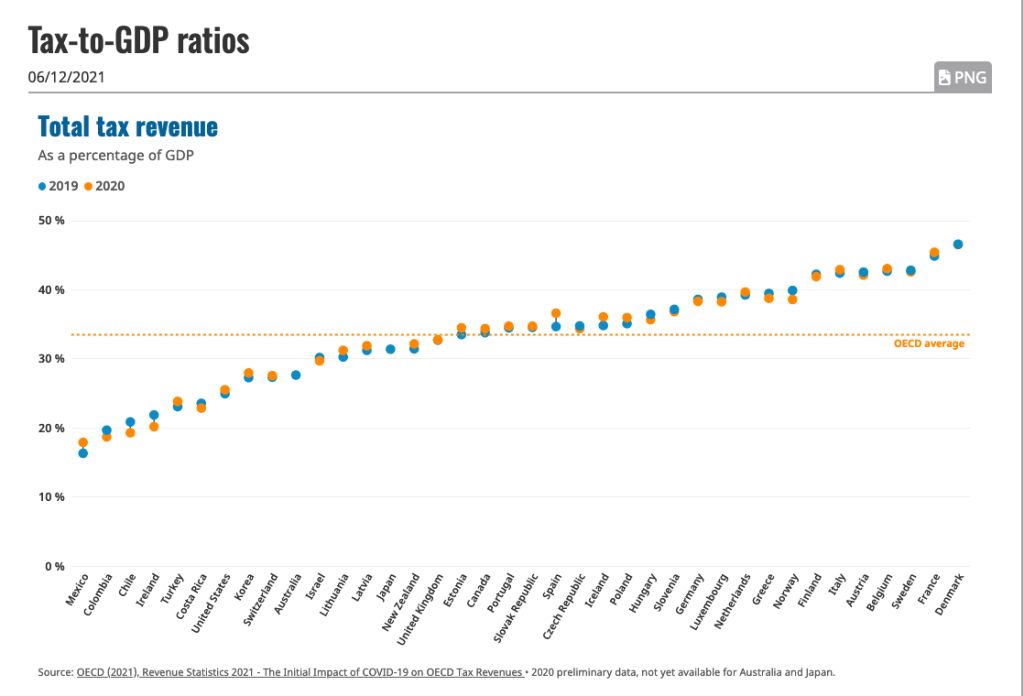
So, what is the answer. Do you simply say you have to tolerate social injustice because that is good economics? I have friends who say stuff like that and I roll my old eyes when they do. Mexico still ranks dead last in the OECD in the share of GDP taken as taxes (see below) so what does that tell you? If Mexico were only average by OECD standards, it would collect a great deal more tax revenue (one of these days I’ll back-of-the-envelope how much), and then
imagine what the government could do. Without borrowing. But many know that tax reform in Mexico has been a touchy subject since the British economist Nicholas Kaldor went there in 1960 and wrote a report on reform that was never (to my knowledge) published and was written in hugger-mugger somewhere outside Mexico City. In any event, while MORENA may build airports, trains and other pharonic monuments to AMLO’s restless ambitions, I haven’t heard anything about tax reform.
Whatever Andres Manuel is, he’s no fool. No one wants to be in the rich pocket when there are still an awful lot left in the poor one. And AMLO, populist or not, leftist or not, knows that.
It never goes away, and it probably never will. The independence of Texas– secession if you will–was the means whereby Texas migrated from one Empire to what would arguably become another. And if matters had gone differently in the 1860s, Texas might have been part of and not simply, a whole ‘nother country. Talk of Texit comes naturally to folks here. You can’t really blame them.
Alas, as the party poopers in economics are accustomed to saying, there is no free lunch. If we secede, it will cost us something. According to Taxes of Texas: A Field Guide (Texas Comptroller of Public Accounts, 2024), Federal dollars contributed 37 percent of total state net revenue in 2023 (p.5, if you’re checking). I would understand that to be net of taxes paid to Uncle Sam, so there is an issue here. If you want out of The Land of the Free and The Home of The Brave, you have a rather large hole in the finances of independent Texas. That’s a fact. If you are historically minded, you may well recall that this was a problem for the Lone Star Republic the first time around, so here we go again.
It would take a great deal of fancy statistical modelling plus even fancier assumptions to think the matter would just rest with a busted budget. That’s because it can’t. Economists also use a term “structural adjustment” to pretty up the belt-tightening that must accompany such a problem. It would be a matter of speculation here to say exactly how much tightening it would take, but previous experience in the 1980s in our buen vecino, Mexico, can give us some sense of how things would work. The situation is not wholly novel.
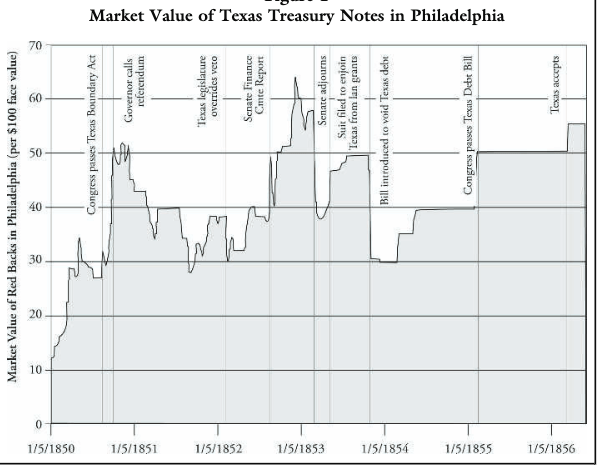
Lots of things would have to happen for an independent Texas to make a go of it. The first is that Austin would probably have to go out on the international market and borrow–and remember, a lot of those money center banks will remain in the United States in places like, excuse me, New York. Don’t expect much sympathy for reasons most of us already know. Even if we could borrow a fast 70 billion, it comes with strings and interest rates. How much and what? Who knows? But never fear, whatever currency Texas is going to issue will probably depreciate (fall in value) quickly, if history (that Lone Star thing again) is any guide. Don’t take my word for it. The economists Gary Pecquet and Clifford Thies have published a series of papers on Texas Treasury bills and the Texas debt in The Independent Review. They make it pretty clear that, for the most part, Texas debt obligations (money, bills, etcetera) were not worth the paper they were printed on. (This is their graph, as low as 10 cents or so on a dollar in 1850)
Of course, a worthless currency is cheaply purchased, so, our exports are going to become more competitive. That’s good, because a lot of what we currently consume is what is going to have to be exported to raise the money to pat debt service. Again, ask one of our friends in Mexico how that works. You turn your domestically consumed goods into exports by making them cheap enough to be sold overseas. This is no fun because the domestic standard of living has to fall–you consume less, silly patriot. How drastically? In Latin America, the 1980s were called The Lost Decade. Mexico, to be blunt, has never really gotten its mojo back. You lose a generation of consumption here and there, and pretty soon, you end up poor. This same movie is showing in now playing in Argentina, in case you doubt me.
Just scare tactics? Are you feeling lucky? A fiscal implosion is, sorry to say, no fun. Freedom is not free, even if talk, especially big talk, is cheap. And in Texas, talk is cheap.
Three years ago I started to write a blog once in a while. I had sworn I never would, but after getting thrown into Facebook jail for alluding to Trump as a fascist (“hate speech”), I figured I needed another venue. Guess what? The world had caught up. Now if you’ve ever read a book about fascism (trust me, there are lots: I can make recommendations), you know Trump is indeed a fascist, quotes Hitler, and still pulls a third of the American electorate with him. Surprise! Within the sound of your voice, you’ve probably got a fascist sympathizer, if not an outright fascist-in-itself. Lucky us. We get to see what the Greatest Generation fought against before we forgot why Nazis aren’t Nice. But I digress….
My first post was about Christmas music, which was fun, if a bit naive. I said everybody had a Christmas album. Little did I know. I should have said everybody has at least one. I have quite a collection. That bespeaks a certain fondness for the season, right? Yup, I still like Christmas (I’m not into Festivus, Kwanzaa, Eid or anything else. I don’t care if you are: Merry Christmas) But I can never approach the day without mixed feelings, because I have very clear memories of Christmas past. They most involve people and places I’ve written about over the past three year. Family, Philly, Harrogate Road. Mostly, they are amusing, which is why I find them poignant. Sorry, I had a happy childhood.
If I go back to West Philly, it’s like an old movie. On Haverford Avenue, our front porch sort of became magically transformed into a Christmas cave from one day into the next. None of this 12 days of Christmas crap. Boom. One day it was a front room with some two chairs and a little sofa, a couple of knick knacks. Next day there was a tree, a real one, festooned with old fashioned glass decorations (man, do I wish I had some of them), incandescent lights, tinsel (remember tinsel). It sat on an old fashioned base that took water, and the whole thing was set on a green platform with snowy-chimney crepe paper bordering it. This clearly happened overnight, thoughtfully engineered by Santa before he took off for Thailand. I mean, like who else? Dude the whole thing was magic. No wonder I miss it. I guess nobody but me got much sleep Christmas Eve, God bless my family. True, there were a squad of them there, but Grandmom was probably pulling kitchen duty, but the Christmas Day dinner was better than anything Dickens could have conjured up. With all the brothers and sisters there, presided over by John Facenda and Channel 10 (the TV was on all day), sneakily injecting some religious programming (no, not Perry Como, but fare like Amahl and the Night Visitors). Como came a bit later.
That photo is probably from 1956 or so, but you can see the platform and me firing away at some Nazis (why do I think my childhood prepared me Trump). There was an American Flyer train (which I still have, rescued from my parents’ home) which I guess my Dad got. It was a total surprise to me. Nothing elaborate. It went in a circle around the tree and puffed some acrid smoke. I dug laying tinsel across the tracks and watching the fireworks–which was a no no, but I was incorregible even then. God only knows how many hours I spent there between Christmas and New Years. Never got bored. And with the family around, it was inevitably a party, Christmas Day or no. We used to know how to do it, even if there were rifts between x or y or z. Somehow we canned it for the day, something I wish people could learn to do all over again. A valuable skill, believe me.
What renders that setup even more incredible was the night before (Christmas Eve) I was usually ensconced by the front window (that same porch) looking for Santa. Yup. Nothing there. In fact, one year I remember a flat bed truck with some lights and a loudspeaker going by with one of Santa’s “helpers” giving a shoutout to the locals on Haverford Avenue. Boy was I ever excited. I mean the Christ Child and Bethlehem and the oxen and that stuff were cool and everything, but here was The Man (probably worked for the Philly Streets Department) validating our true faith: in Santa Claus. I liked Jesus and everything, but he never brought me a howitzer. More likely socks. First thing first.
All the rituals that went on in that extended family around Christmas were cool, and there was a lot of visiting, eating, and otherwise enjoying the life of an immigrant family. You know, it was what I’d call a good ghetto, and I think the ache I often feel when I look at photos from them (or run movies in my head) is hearing them blackened by someone like Trump, or even some of my “friends” who never tire reminding me of my privilege. Yeah. It was a privilege to have a caring family who managed to sustain the illusion that life was good even when some of them were dying inside. Or getting crap at work. Or having to take a sabbatical from life every once in a while to cope. You want to know why they remain my heroes? Well, there you are.
Christmas did lose something when we moved out into Montgomery County and Penn Wynne in search of the great middle class dream. Readers of this blog know that I wasn’t exactly nuts about life in the suburbs, or some of the other riffraff escaping from the city to lord it over their less fortunate paisans. But today I pass over the cafones in silence. I’m sure they had their own Christmas. Tacky. With aluminum trees and color wheels. And spray on “snow” in the windows. Never had a Hell of a lot to do with them.
It was in Penn Wynne that the run up to Christmas became more a part of the ritual, maybe just because I was getting older. The great markers were always the Como Christmas Show, maybe Disney (less so in my home), and by high school, Dean Martin. Hey. Don’t laugh. I knew good things were coming when Perry and Dino started warbling White Christmas, because in those days, you might actually get one.
Peggy Fleming wanders in around 9:35. WE were all in love
This is from a bit later, but when Como told you was Christmas, it was Christmas.
Not White Christmas, but this was when the Itais ruled the airwaves. Tough. Remember Frank was in the mix too. And you wonder why I miss this. Vafff……
Anyway, my Mom, who was never big on stuff that made a mess, like live trees, opted for this acquamarine thing set on a white sparkle base that she decorated with gold balls and put out in the alcove where the Dutch windows were facing the street. I’ll be damned if it didn’t actually look nice, although I think my aversion to artificial trees must have started then. And I can remember trimming it with her, usually with some Christmas music in the background–one year Sammy Davis Jr (grin). These rituals were usually punctuated by runs to 69th Street or to Korvettes in Springfield to buy some kind of late gift or something. Cause, you know, Upper Darby half a century ago was a different place, and you didn’t have to duck live rounds if your were off to visit Santa. There were also Gimbels and Lit Brothers, all trimmed for the season and ready to provide you with stuff on something called a lay-away plan. In retrospect, they were probably attempts to get around Pennsylvania’s usury ceiling, but who knows?
Anyway, Christmas midnite (modern spelling) Mass was a big deal. The altar boys missed plenty of school learning the moves and driving the various prospective celebrants crazy by taking a wrong turn in the sacristy. But the girls got to practice singing the mass in Latin–which provided a nice opportunity for socializing under cover of piety. By the time we got to Christmas Eve, somebody usually had a new hearthrob (or lost one), and everyone was stoked for a service that actually began at 12:00 AM. By my recollection, we usually got home around 1:30 in the morning and, if we had been good, got a late supper of Silver Star ravioli from Springfield, PA. None of this Seven Fishes crap. You got pasta or something, and it was a kick. Christmas Day for my Mom was a turkey. She was not really into cooking, but she somehow always rose to the occasion for Christmas. I’d sneak into the basement with a beer, that was the extent of my misbehavior.
But, dammit, it was ritual, and family ritual especially was comforting. If it was cold, even better, and snow (you remember snow) was literally the icing on the cake. I usually enjoyed every damn minute of it, and was always sorry to see the season end.
So here I conclude on a purely personal and honest belief. I remember this stuff as being very nice and comforting and enjoyable because it was. It was comforting and enjoyable and nice to have relatives around in those days, especially guys like Stan the Man and my Mom’s parents, who were lovely people. You don’t believe me? I don’t care. It was better then, for me, at least, and I wish I could bring some of that back for my kids, so they can feel a little naively what America was before it really ran off the rails, a process that was underway even then. Remember the Christmas Moon Launch? I do.
Yup. A 76.8 million dollar buyout is a lot of money for a college football coach. Especially one who slinks off with a winning, albeit mediocre record. We’re talking Jimbo Fisher at A&M, that seat of the intellect in College Station, TX. Let you in on a secret. I’ve lived in Texas for thirty years. I’ve been to Abilene. El Paso. Junction. Plano. Texarkana. Johnson City, Laredo. But I’ve never been to College Station. Not once. Not even tempted. I mean, like, why? What am I gonna see there I could see anywhere else in Texas? Well, maybe some bizarre rituals involving, you guessed it football, but Hell, I could walk up the street on a Friday night where I live and see that at the local high school. Big deal. It’s not like we’re talking USC and the –heehee– Trojans (could you think of a better mascot for SoCal than a brand of condom?). That’s a real spectacle, with the Captain from Castille and all that. And mine eyes have already seen that. In Berkeley. Never mind. I’ve been around.
But let’s get to the point. 77 million or so is big bucks. How big is big? Well, that depends. You know, the Econ like to tell us that we always need ask compared to what? Or, put just little differently, what’s the next best thing you could do with the money. This is known as opportunity cost. It’s a weird econ thang: you say what something is worth by looking away from at rather than directly at it. Actually, it makes all kind of sense, but since I no longer get paid to make sense, I will just get to the good part. Basically, what else could you do with 77 million bucks in Texas?
Funny you asked.
I have a few ideas. And if you don’t like them, come up with your own. For that matter, start your own blog. It’s a free country, at least until Trump gets reelected. So let’s get started. I’m not doing this in any particular order. Just grabbing low hanging fruit as they appear. Ok. We’re off.
The Texas Legislature is spending $6.6 million over the next two years to cover the cost of breakfast for students who qualify for reduced-price meals. The new funding is going to benefit about 1,800 students in Austin ISD. So our Lege, in its infinite wisdom (sarcasm) is going to spend 6.6 million to cover breakfast who qualify for reduced-priced meals. The following is coming from http://www.benefits.gov
Children may be determined “categorically eligible” for free meals through participation in certain Federal Assistance Programs, such as the SNAP, or based on their status as a homeless, migrant, runaway, or foster child.
Children enrolled in a federally-funded Head Start Program, or a comparable State-funded pre-kindergarten program, are also categorically eligible for free meals.
Children can also qualify for free or reduced price school meals based on household income and family size. Children from families with incomes at or below 130 percent of the Federal poverty level are eligible for free meals. Those with incomes between 130 and 185 percent of the Federal poverty level are eligible for reduced price meals.
Household Size*
Maximum Income Level (Per Year)
1
$26,973
2
$36,482
3
$45,991
4
$55,500
5
$65,009
6
$74,518
7
$84,027
8
$93,536
These are before taxes, by the way. For a household of say, three (single parent, two schoolchildren), that $45,991 is just about the cut-off level for reduced priced meals (I don’t have the free meal figure handy). So, think of it this way, a family of three is going to be pulling in less than $46,000 pretax to qualify.
Now, I’m a scholar, so I’m used to getting my head blown off by my friendly fellow scholars when I screw up (I have reviews and referees reports to prove it). So don’t hold back if you think I’m way off base. I looked up the median salary for a custodian (janitor) in the Austin, TX, ISD. That’s around $36,000 a year. So, suppose that lady cleaning up after school has two school age kids and no husband (yes, I know, moral laxity, but it happens). Chances are that her kids qualify for at least reduced price meals at school. Maybe more.
So, if you take ole’ Jimbo’s buy out, by my back-of-the envelope calculations, you could probably feed 20,000 school kids (like the custodian’s) for two years up in Austin. Yeah, its an order of magnitude, but actually, since there are 3.65 million schoolchildren in Texas eligible for the program, 20,000 is as drop in the bucket. You’d have to buy out most of the college coaches in Texas to feed them suckers. So, depending on your point of view, Jimbo’s buy out is either too much or too little, depending on whether or not you’re into football or hungry children. Life, as the economist likes to point out, is about choices and scarcity. You are free to choose. You can’t have everything. TINSTAAFL. If you took economics in a Texas high school, undoubtedly taught by the football coach (dude, take my word for it–I’ve asked), Coach has written that imperishable acronym on the board THE VERY FIRST FREAKING DAY OF CLASS. There is no such thing as a free lunch. Got it? Yeah, a free lunch may cost A&M a football coach, dadgummit. It will at least coast Jimbo some fancy lunches up there in College Station. You got that? Good.
But why stop at eating? Hell, don’t we all have to think about what we would do if we got sick? Yes, I know. Prayer is the answer, and I do quite a bit of it. But Jesus never seems to want to pay the bills, sort of like an absent father (deep philosophy here): ” Vere tu es Deus absconditus” and all that jazz, but never mind. We’re doing econ, not theology (you say there’s no difference? Shame on you). So let’s talk Medicaid in Texas. Again, this is from the benefits.gov website.
To be eligible for Texas Medicaid, you must be a resident of the state of Texas, a U.S. national, citizen, permanent resident, or legal alien, in need of health care/insurance assistance, whose financial situation would be characterized as low income or very low income. You must also be one of the following:
Pregnant, or (about abortion, don’t ask. You can get a posse after you in Texas)
Be responsible for a child 18 years of age or younger, or
Blind, or
Have a disability or a family member in your household with a disability.
Be 65 years of age or older.
For all intents and purposes, those income eligibility limits you already have are close enough for our purposes, so let’s take a look at what Jimbo’s 77 million could do. Now this is the medical system, so you know virtually anything I write is a gross oversimplification. I don’t want to mislead anyone, just establish some rough comparisons.
Medicine in Texas–the financial part at least–for low income people in particular, is a nightmare. Texas’ income limits for Medicaid are relatively low. Even a lot of poor families with children are above Medicaid income limits. And Obamacare–you know, the ACA–forget it. Texas does not have an ACA Expansion for Medicaid, which creates a sliding scale of subsidies for poor families. Why? Bless your heart. Greg Abbott, our crypto-fascist governor, doesn’t want Texas to get, I think, some 10 billion dollars in federal funds because, according to him, it’s the best way to vote for a tax increase (you gotta ask him). He says if you want health insurance, get a job. Well, gotta tell you, even when I was working that was problematic, because my university-funded medical coverage was very expensive–actually it stunk out loud. And we were not poor. let alone have children for whom we had no medical insurance because we couldn’t afford it.
Subject to a whole lotta qualifications (and I mean a lot, so this is a very rough figure which will yield generous results–this is if you’re under 65 and basically healthy (I think)) the average Texas medicaid expenditure is around $8,500. Well, ta, da, you could fund about 10,000 average Medicaid expenditures, which, yup, ain’t much–and which is why Abbott’s refusal to do anything even remotely humane is disgusting. Even Jimbo’s buyout would be a drop in the bucket in this arena. If you figure that you might get an ACA policy for $2,400–I’m looking around on various plans–you might say Jimbo gives you 40,000 people. When you consider that there are 1.5 million uninsured Texas adults–yup. According to another site I’m ransacking “Texas Medicaid does not cover adults in poverty without dependent children, unless they have a serious or permanent disability, are elders in poverty, or get temporary maternity coverage that ends 2 months after the birth. The Affordable Care Act (ACA, or Obamacare) directed that all 50 states would offer Medicaid to US citizen adults, but a 2012 Supreme Court Decision ruled that states that did not provide that coverage could not be penalized with loss of federal Medicaid funds. As of May 2020, Texas was one of only 14 states not providing Medicaid to adults in poverty.” Bless yore heart. Y’all got that? I ain’t real sure I do. Go to this link below if you really want to get your hair curled.
So here we are again with Jimbo’s too much or too little question. It seems like a shagload of money to most people, and it is. But when measured on a scale of social need like Medicare or Medicaid, Lord, it’s a pittance, honestly. So by all means, hate on Texas, hate on college football, and, if you must, hate on poor Jimbo. But he is an optical illusion, folks. Sort of a mirage of potential public wealth if we can only get our–well, “values” straight.
And besides, you think Jimbo was the only one with a sweet deal. My Lord, when I look at college football coaches financial packages, at least the D1 variety, I figure I need a CFA to explain most of them to me. Nick Saban (Alabama): Saban’s eight-year deal is worth $93.6 million and includes yearly escalators. In the first year of the contract last year, his salary was $10.7 million, but that number will go up to at least $12.7 million by the time the deal expires. Dabbo Swinney (Clemson) Swinney agreed to a 10-year deal worth $115 million over the offseason, making him one of the nation’s highest-paid head coaches. A two-time national champion, Swinney’s deal would keep him with the program through 2031. Lincoln Riley (USC to get away the South, for God’s sake). Lincoln Riley turned USC around right away after leaving Oklahoma, taking the Trojans from a 4-8 record in 2021 to an 11-3 mark in 2022. He also received an impressive salary when he arrived in Los Angeles at $10 million per year. But don’t spend it all, because SC just got beat by UCLA and is having a bad season. The doyennes of sports journalism in SoCal are already saying Riley may be history.
So it’s everywhere, and, therefore, nowhere, as far as big time college football is concerned. You local D3 coach, however, is not to be mocked and spat upon. He’s probably not grossing much more than you Primary Care Physician. You are going to have to look it up. Enlighten me.
College football at the big-time level is merely the cesspool of the adjoining university. For those of us who have been around big time academics, a certain numbness sets in after a while. We know what goes on. Teaching. Research. Getting ahead. It disgusts a lot of us. Sooner or later, we burn out, get out, or retire out (or all three!). It’s like, hey, you got the game on? You headed out to the fabulous feed your alumni group is putting on? Better look in the mirror. Cause, just like with our political system, if you aren’t part of the solution, you’re–as we used say, part of the problem. We have done this to ourselves, step by step, over the past 50 years. Ain’t no one else to blame. Not Poor Jimbo Fisher, at least. He’ll cry all the way to the bank, for sure, tears of laughter at what knuckleheads USAmericans are.
By the way, years ago, I read a great book by a guy who wrote for SI, Rick Telander, called A Payroll to Meet. It was about the antics of the SMU alums in the era of Eric Dickerson, stuff that got the poor Mustangs the “death penalty” in football back in the day. Check it out. I bet it has aged very well.
Ok. Right off the bat I lose 80 percent of my readers. That’s ok. I expect it. You aren’t missing much. All ten of you.
And if you were sort of hoping for personal yarns about experiences, good and bad, I’ve had in Mexico over 40 years, sorry. Not this time. Walking the streets in Roma Sur in Mexico City in my pajamas after a particularly wild party will have to wait. Besides, we were all young once. Even me.
Much more prosaic goal here. I’m trying to work out the last part of a revision of a book on the economic history of Mexico. This mostly concerns something that is not my strong suite, which is the twentieth century. That is exactly why I am writing this down. Nothing forces you to say what you think (or think about what you are saying) like writing. This is, frankly, an easier way to get some of my friends in Mexico to read this. Or not. No one has enough time to be looking at someone else’s work, and if someone does not, that’s just fine. I’ll take what I can get. I know damn right well that colleagues in Mexico know a Hell of a lot more than I do, so, I, at least, have nothing to lose. This is not an academic post. No one has refereed it or pointed out its many inadequacies. This is me, trying to think out loud about a series of problems that I have to simplify to grasp. You, if you are a reader, are a guinea pig, and I thank you. Seriously. Just let me hear from you.
The post is inspired by a recently published book, edited by Soledad Loaeza and Graciela Marquez (I’m gonna not worry too much about accent marks, ok–since WordPress is tough enough). It is called Raymond Vernon in 1963. Los dilemma de entonces y de ahora del desarrollo mexicano (El Colegio de Mexico, 2023). Boy, what an eye-opener for me. Where to begin? Well, the title means, more or less, Raymond Vernon in 1963. The Once and Present Dilemmas of Mexican Development. I’m not going to go into a long thing about Vernon (1913-1999) himself other than he had a long career in the private sector, the government, and in education, specifically, at Harvard Business School. He was not what we snottily call in the trade “a Mexicanist” which means he didn’t spend his life immersed in the minutiae of either Mexican history, business, or the economy. This alone earned him some very negative commentary in Mexico, including a famous review entitled “El Retorno de Quetzalcoatl.” (The “Return of Quetzalcoatl”) by a Mexican economist, and not just any economist, Ifigenia M de Navarrete. Ok.
The Quetzalcoatl, for the curious, is a reference to the plumed serpent Ur-deity of Middle America, who split for parts East after the usual fratricidal deity-battle beloved of the myth genre, but was widely expected to return and reclaim his rightful throne. Some enthusiasts will go as far as to claim that the leader of the Aztec empire, Moctecuzoma, thought that Cortes, the leader of the European party in 1519, was in fact the legendary Quetzalcoatl himself, which led to a certain ambivalence in how to treat the fair-skinned, bearded strangers, thus contributing to the demise of the Aztec state. Well, be that as it may, likening Ray Vernon to Quetzalcoatl was clearly nor intended by Sra. Navarrete, one of Mexico’s most eminent economists, a Harvard student herself, and a pioneering woman at Mexico’s National University, as a compliment. So, you get the picture: not everyone in Mexico was thrilled by Vernon’s opus, and said so.
But what exactly did Vernon say, and why should anyone care then, let alone now, sixty years later.
Do you believe in miracles? No? Not born Roman Catholic, obviously. I am fashionably, sniffily agnostic on the matter, as in “how can I, an educated person, believe in supernatural forces acting outside the scope of history?” But this isn’t the apparition of the Virgen of Guadalupe in 1531 we’re talking about. It was instead, a sustained period of rapid economic growth in a country whose growth history had exhibited few, if any such periods. Since this was realized, no less, under the guiding hand of a usually suspect Mexican government, well, if that wasn’t a miracle, what was? Even people there used the term “milagro (miracle).”
To put matters in perspective, I doubt that the average annual growth in nominal (i.e., not price-adjusted) GDP from 1820 through 1880 reached even one percent per year. But from 1954 through about 1976, (nominal) Mexican GDP grew at about 6 percent per year). Big difference, right. One way to think about it is to say, look, at the rate things were going in the earlier interval, it would have taken (at least) 150 years for the size of the economy to double. That’s, by standard accounting, about 5 generations. In the latter period, it would take about 12 years for the economy–basically the production of goods and services that people could consume or use to produce other goods–to double. That’s a decade, and people typically lived a lot longer in the latter period than in the former. In plain English (or Spanish), a person living in Mexico could go a long time–a lifetime–in the early period without seeing much if any economic change. Bluntly, live much better. Nor would that person’s children. By the 1960s, that was hardly the case. And people showed they sensed the difference by the way they behaved especially in the late 1960s. You are more or less talking the Middle Ages versus the Modern World. There are a lot of qualifications to this gross generalization, obviously. Lots and lots. But for our purposes, this is enough.
So what did Vernon say? Or what did he say to get himself compared to an invader who would divide and conquer what had been a prosperous indigenous world (another argument for another day, believe me). Simple. Vernon said it couldn’t last. Not without changing course dramatically. The miracle was, well, sort of smoke and mirrors. He didn’t say that, to be sure, but you could have read Vernon that way if you so desired. Hence the “dilemma” in the title of Vernon’s book. What to do? And, maybe just as importantly, why was he correct (or, as Ifigenia de Navarrete complained) dead wrong. Buckle up. This is not going to get technical or anything, but it does require some serious thought. And it may get a bit long. Sorry.
If you suffered through an econ course or two, you know that as economies grow (produce more goods and services), their structure (the composition of what they produce) changes. If people get richer–assuming they do as an economy grows (which isn’t inevitably true), their consumption changes. The conventional explanation is that as you get richer, you may change your diet or move into a nicer home. But you can only eat so much and only live in one place at a time. So the demand for food and shelter (and clothing) begins to lag behind the overall rate of growth. So, you answer, well, maybe I want to buy a car, assuming cars exist. Well, yeah, but how many cars can you drive at once? Even that has its limits. And somehow, in the process, somehow has to be building a car. Which, of course, requires, sheet metal. So you need some way or making that. And, oh, yeah, tools to shape the metal–I know, this is not very deep. Point is, there comes a time when people start to want industrial goods–of all kinds. Not just cars. How about sewing machines, if they exist? You can’t grow them in the backyard. Someone has got make them, preferably in a factory that turns them out cheaply and quickly. You expect to see a process of industrialization occur. And that is part of what we mean by modern economic growth. Not all of it, by any means. But if you get the impression people start to want a greater variety of more complex goods as income goes up, well, correct. You might even want someone else to grow your food and deliver it to your doorstep, but let’s leave services and commercial agriculture out for now. The argument in its essentials still holds.
At this point, the argument starts to get complicated, a little tricky, and, alas, ideological, not to say metaphysical (yes, metaphysical).
Suppose you’re happily farming away. You like farming. You are good at it. You can make money doing it (profits, yes, are central to the argument). How you gonna get a car? Well, you can build one. Yes, you can. If you are sufficiently skilled, you could build one, but then you’d have to give up farming. So how are you going to eat? Buy food! Oh. Suppose we rule that out for the moment? Well, I’ll go buy a car! Sure. Great idea. You’re a farmer. You sell your surplus crops for money. You save your pennies (or pesos) and go buy a car. You trade, basically. You specialize. Technically, you are now in a commercial society characterized by specialization and exchange, as well as by a market in which to trade. But the market doesn’t just appear like some weed. You need courts to enforce contracts, police to keep law and order, financiers to grease the transactions. A market economy is not a simple thing, even in itself.
To make matters worse, suppose you do “decide” to industrialize. Well, where do you start? You start by identifying the market for industrial goods–like cloth, for example, Where are you getting cloth if you’re not already making some of it at home. Well, look at your imports. There’s a bunch of things like cloth there, the products of what is termed “light industry.” The imports reveal the market. So all you have to do is replace the imports with stuff you make domestically. You engage in what is fancily termed import-substitution industrialization (ISI). If your country decides for any of a number of more or less persuasive reasons (there are dozens, ranging from the symbolic to the substantive), that’s where you start.
And that’s where Mexico started. Indeed Mexico started before the term ISI existed, in the 1830s. Strictly speaking, Mexico had industry even before then, because, as Adam Smith observed in The Wealth of Nations (1776), you can’t import everything you need. Ok? So we’re off. We’re going to pursue economic growth and modernization by ISI. And here’s where Ray Vernon came in.
Nothing, even the Universe, is forever. And, just as obviously, there are logical limits to the expansion of physical processes. Take road-building (the diagram is from a 2017 World Bank Research Paper). Over the 35 years from 1985 to 2016, the growth of the network of, for instance, divided highways (blue) and multilane divided highways (red) increased in absolute terms–Mexico added more and more. But unless they were intent (like Texas) in paving over the entire country, the rate of increase would have to slow down. Sooner of later, the potential for building roads that make sense is exhausted. No infant grows at the rate of a newborn forever: we don’t have brontosaurus-sized adults.
Well, think of ISI the same way. At some point, you suppose, you got all the textile industry you’re ever gonna want. How much cloth can anyone buy? And besides, you probably had to do something to limit imports from people who had already gotten the knack of manufacturing things like cottons, or shoes, or blue jeans and could do so cheaply. You
could license imports (you can only import things if you have permission), or you could tax them (called tariffs by the Econ), or you could place a bunch of silly regulations and rules that restricted imports of shoes to those made with Tanzanian leather (I dare you). They all have different effects, but they permit you to go about your business. You may or may not eventually get to do the thing as well as as some competitor (notice: we have suddenly introduced a world economy for the sake of making a point), but odds are it will cost you more in the beginning. You are less efficient, so you use more resources, or waste some, or just don’t organize as well. That’s life.
But someone has to pay the price. You think the manufacturer will? It could happen, but chances are you want to keep these people happy so they will keep producing and “creating good job” in producing “strategically important goods” which are “necessities.” So they got to make at least as much as they could doing anything else. Ah, but what about consumers or workers? Eeh….how much choice do they have? They pay a little more, or they do with something less durable or well made. The same jobs they work in are somewhat less remunerative because they end up consuming the higher priced goods they make. So they live a little less well. Or maybe a lot less well. The result depends on a lot of considerations. And maybe they have less to spend on other goods–because they have less to spend, period. So some other part of the economy cannot grow as quickly. It all has to come from somewhere and go somewhere.
Are you starting to get the picture (much, much oversimplified, to be sure)? For one thing, this is why most Econ trained in the Anglophone world are free traders at heart. They get this stuff pounded into them from the days of Econ 1. Now, you would also hope they’d get a lot of the serious ifs, ands, and buts about this story pounded into them as well, but don’t hold your breath. Especially in some institutions and rather large swathes of the country. There are a lot of devils in details (real or assumed, logical or otherwise), but we can’t argue about that now. At the very least, finding an economist trained in the United States who is some sort of unreconstructed advocate of restraints on trade–at least until the Trump administration managed to scare up a minyan–is not easy.
In part, this was a source of unease on Vernon’s part about ISI, although perhaps not a conspicuously large part, according to the terrific Mexican volume I’m looking at. There may have been more of a sense of “this can’t work indefinitely” in the first sense discussed, although even there, with the rate at which the population was growing in Mexico in the early 1960s, it is hard to believe that Vernon thought the internal Mexican market was going to stagnate all that soon. You know, the famous short versus long run–and we don’t worry much about the long run since most of us don’t think we’ll live to see it anyway (the most abused line from Keynes, maybe). Vernon surely knew that Mexico was in the midst of its “demographic transition” in the early 1960s, and that population growth wasn’t about to slow. And more subtly, there were large parts of the country where the adoption of “Western” style of dress was far from complete–part of being a mestizo nation (mixed race, basically) is that you don’t dress like an indigenous person. Believe me, in the mid-1970s, Mexico was in the midst of a polyester revolution that would have blown the plaid mind of Herb Tarleck on WKRP. Those polyester fabrics were made in Mexico.
So if we grant, at the simplest level, that Vernon could not have possibly thought the ISI model would soon prove unworkable for those economic reasons (there are plenty of others–complex ones involving finance and trade that I am simply ignoring), then whence the “dilemma?”
Again, I beg your indulgence for going on at length. I’ll try to be brief.
The other part of the dilemma was political, and to that I would add, agricultural. We have to discuss these together under the head of “agrarian reform,” which, admittedly does not make hearts go pitter pat. The Mexican volume really does not make much of agrarian reform, but it does fix on Vernon’s analysis of the Mexican political system. I suspect this is what got certain Mexican critics in such a snit. Nationalism aside, some of them were part and parcel–not to say creations–of the post-revolutionary Mexican regime. I can’t imagine they were too happy as being implicitly identified as part of a dilemma to be overcome if Mexico’s continued development were to be assured.
At the risk of another simple-minded generalization, Mexico underwent a violent and profound Revolution from 1910 to 1920 (more or less) which began with the overthrow of a long-standing regime and resulted in the slow reconstruction of another one that really continued into the 1940s. The thing that emerged in the 1940s ultimately lasted until the year 2000, when it was finally, peacefully (Vernon was dubious that the transition could be pacific) replaced. For simplicity, we can call the new regime the Mexico of the PRI (or Partido Revolucionario Institucional) or, less respectfully, what one observer called “the perfect dictatorship,” a stable, electorally based government democratic in form and with restricted participation in substance in which the major party (the PRI) controlled the presidency, state governorships, and most governments. Elections were free, even if they were not always fair, and by no means all of them were fixed. People struggled to classify Mexico and the PRI and generally settled on something awkward like “a multi-class integrative party with authoritarian characteristics.” The PRI worked by a pretty sophisticated combination of carrot and stick: cooptation, coercion, and, if necessary, repression. I always thought of it as a a kind of Latin machine that was open to aspiring entrants who implicitly promised not to rock the boat too much. If you played along, you got rewards that ranged from a tolerable, if not always easy existence–certainly for most far more than bare survival–to considerable personal wealth if you played the political system well, or navigated the waters of the private sector if you played by its rules (and the government’s). There was a free press (well, more or less) and more than the mere appearance of civil society.
If you chose to rock the boat, things could get tacky. In extreme cases, you could find yourself looking down the wrong end of a barrel of a gun, but it mostly did not come to that. Mexico was not, whatever anyone says a sort of police state light. Part of its success came from its ambiguity: if you went too far in trying to change the status quo, you generally found out too late that you had. So smart operators, and they were by no means dishonest, never tried to find out what “too far” meant. In most of Latin America, Mexico was considered an enviable success, and by 1970, whatever Raymond Vernon said, there were other gringos (the distinguished economist Clark Reynolds) who considered Mexico as successful example of what he called “indicative planning.” Mexico City was a cosmopolitan, intellectually vibrant place full of political exiles from elsewhere in the region. By contrast, Havana, the “real” revolution’s headquarters, was a morgue. My opinion.
So, what went wrong? Well, Vernon thought the system was too controlled and potentially too inflexible to accommodate its own material success. He thought that someone was going to have to loosen the reins eventually, because the success of the PRI–its material success in particular–would be its undoing. Ultimately, there were others in Mexico–my usual example is the intellectual Jose Woldenberg–who said much the same thing. You know, stuff we call a revolution of rising expectations in English–basically. Problem was, not just anyone was going to have to lose power and undergo considerable political alteration if the system that had crystallized (some would say, fossilized) under the PRI.
It was the PRI that was going to have to lose power.
The PRI was a machine that used the levers of the state and the economy to reward its friends and marginalize its enemies. For example, unions in Mexico were officially part of the PRI, as part of an umbrella group called the CTM or Confederation of Mexican Labor. The head of the CTM was for many years a “gentleman” named Fidel Velasquez who was a kingmaker whose political opinions and preferences could not be ignored–even as far as the level of presidential politics was concerned. In return for CTM support, official unions got a privileged position, generous non-cash benefits, a baseline wage settlement that you could not expect if you were not a part of the CTM. In return, you supported the PRI. You voted PRI. Quid pro quo. So the government could always try to keep control of labor costs and, hence, prices, by using the CTM. You can argue that the benefits to industrial workers in Mexico were relatively modest, but they were better than anyone else got or could get. You ended up as part of what is termed “the formal sector” in Mexico, and the benefits that came along with that were nothing to laugh at. Most jobs in Mexico today are not part of the “formal” sector” and their compensation is correspondingly meagre. A friend of mine once said, only half-jokingly–they pretend to pay us, and we pretend to work. I think he got that from the socialist economies, but never mind. Mexico was not socialist, believe me.
Now, in my view at least, the real Achilles heel of the postrevolutionary order, was agriculture. Bear with me. This won’t last much longer, I promise. I sort of saved the best for last.
Maybe not every orthodox economist (i.e., Anglophone, mostly) thinks that agriculture is the basis of economic development, but I haven’t talked to one lately who doesn’t (full disclosure: I do not frequently chat with economists anymore, which I am sure some will say is obvious from this post). You want it simple: first you have to eat. Then you attend to the rest. This appears to be rather elementary, but it is lost on many. When the late Nick Crafts published his book, British Economic Growth During the Industrial Revolution (1985), he managed to get this across to even the dullest of us. Rising agricultural productivity in Britain was the basis for an early, if gradual start to industrialization. Not everybody had to farm, so they could do something else. Like go off and work in a factory at a wage that would enable them to buy what they produced, and sell of the rest to those who stayed back on the farm and did nothing but farm (i.e., in a peasant society, they did not have to spin and weave and indeed, would not).
It really is too bad that Crafts was not around to teach students of Mexican economic history (let alone policy makers beginning in the 1910s) this lesson. Since so much of the Mexican Revolution was based in peasant and agrarian protest, there was no question that restoring peace was going to have to address this issue one way or another. In some cases, it was simple enough: return peasant lands that had been stolen by commercial producers (as in the state of Morelos) back to their rightful owners. This was the basis for what was called Zapatismo, or the leadership of the revolutionary Emiliano Zapata (1879-1919), in the state of Morelos, where the sugar planters had taken advantage of the rise of the price of sugar on the world market to expand their production: “progress,” as it was known. Progress, alas, hand an underside: the loss of peasant landholdings.
But in other parts of Mexico, the roots of the agrarian rebellion went deeper. Arguably they could be traced back to the early seventeenth century, when “Indian” villages had been created by the Spanish Crown for other purposes entirely. These need not concern us here, but their status was disturbed in the mid-nineteenth century, when a faction of the Mexican political world decided that “Indians”, villages, any sort of peasant landholding, was a drag on progress. This was not an ideology simply imported from abroad. One of the classic books in Mexican history, Los grandes problemas nacionales, said that small farmers–small mestizo farmers actually–were the answer to the large accumulations of land (haciendas) that the Spaniards had brought from medieval Europe that only led to an impoverished native peasantry who worked at the margins of the colonists’ agricultural economy on what land they could retain. It is a sort of stylized picture, obviously, but there was a large element of truth to it.
Starting in the mid 1910s, the revolutionary government tried to undo both what the Liberals and their land-grabbing ancestors did: to restore some version of the idealized Indian community, even if that community was really the product of late seventeenth century Spanish legislation. This redo was called “agrarian reform” and it involved breaking up large landed estates and restoring (in theory) previously community landholdings. There are, again, lots of variations, subtleties, reimaginings–just what you would expect revolutionaries who wanted to create some sort of agrarian tabula rasa from which to proceed. And to satisfy a sense of social justice and nationalism that deeply permeated the Revolution. Again, vastly oversimplifying, the Revolutionary and post-revolutionary governments, at first slowly, and then at a more rapid pace by the 1930s. The key institution in doing this was called an ejido. Ejidos were the common lands of colonial villages, sometimes waste, but they acquired a new meaning after the Revolution. They were state distributed lands that allowed the members of a community to work a grant of land (called a parcela) without actually owning it. The state continued to own the land via the ejido, but the members (and they were registered) of the ejido got the use of the parcela, and got to work it as if it was their own–except it wasn’t. Are you thoroughly confused? Good. You should be. And confused property rights are NEVER good for economic development. That is as near an axiom in mainstream economics as agriculture is the basis of everything else, and it separates the social democrats among us from the, er, flat out socialists, let alone communists. This is another one of those subtleties lost on most Americans, but at this point, not even the trained historians seem to do well in keeping the ideas straight. Anyway.
Now Vernon and his gifted recent expositors, Loaeza and Marquez, do acknowledge that Mexican agriculture was a problem by the early 1960s, although the ejido doesn’t seem to have been identified as a particular problem (In passing, some foreign observers called the ejido “Mexicos way out”–a positive assessment that I often think really meant that it combined the worst features of socialism and capitalism, but that is editorializing and more evident ex post). So, what was the big deal?
Not all Mexican agriculture was the ejido. And Mexican agricultural performance was by no means inevitably bad. Commercial agriculture in the North and Northwest, where land remained private and larger farms were the rule–supported by heavy government investment in irrigation–did well, and, at least until the 1970s, agricultural productivity was satisfactory–better, in fact. But at the same time, the relative productivity of the ejido between 1930 and 1960 fell by 20 percent. So the decent performance of commercial agriculture was held back by the ejido. So what was the purpose of “social property” as the Mexicans called it. Political, bluntly. The ejidos were part of a group called the CNC (Confederacion Nacional de Campesinos, or National Peasant Confederation). As one Mexican observer put it, Arturo Warman, they might not produce much but votes for the PRI, which they did consistently, So the ejido and the CNC, like the CTM, was part of the PRI machine, which meant the both agriculture and industry were guided as much by political necessity as they were by economic rationality or considerations of productivity. Until both showed real signs of imploding in the 1970s, at which the “miracle” was no longer quite so God-given.
When Vernon observed that restructuring the Mexican model (including ISI) meant that a lot of powerful interests would be affected, this is what he meant. Basically, it came down to the PRI as it had existed since (under various monikers and organizational forms) since 1929 was going to have to change and perhaps even disappear, because the the model of a directed economy within a relatively closed framework could not survive if the basis of a balanced macroeconomy did not exist. The ejido didn’t fit. Even the CTM didn’t fit if it meant limiting the purchasing power of labor. The internal market, even if growing, has to be able to purchase what it produces. Increasingly, starting in the late 1960s, government subsidies of all kinds began to make up the difference between demand and production. For a time, it looked like petroleum was going to come to the rescue–as an export, basically to buy food. There are, again, a lot of problems with such a construct–stuff that economists call the Dutch Disease that call for great care in what the Mexican President Lopez Portillo (1976-1982) termed “administering abundance.” Prudence was the last thing that characterized the use of oil revenue. And, surprise, oil prices can go down almost as fast as they go up, which is what happened in 1982. Suddenly Mexico was stuck with lots of borrowing to finance consumption and no way to repay it without pulling the rug out from nearly (not everyone), but nearly everyone. I remember the shocked looks on peoples’ face in 1982 as the extent of the economic disaster was becoming apparent. Technically, a fall in the value of the peso triggered it, but an earlier one in 1976 should have been a warning. Economic historians call all this the era of Bretton Woods or fixed exchange rates and modest flows of international capital. Mexico rode the wave up, and crashed along with it, compounded by its serious misjudgments and by the very flaws in the model that Quetzalco…..err, Raymond Vernon had identified. Never got too far ahead of your time. People will stab you in the back.
Ok, so what, you say? Why the Hell should some academic controversy of the 1960s litigated by a lot of folks no longer with us (Ifigenia Martinezde Navarrete is, actually, but Vernon isn’t) concern us? As my mentor, Stanley Stein used to pointed ask, “So what?”
Well, as Loaeza and Marquez quite astutely point out, the current president of Mexico is an avowed admirer of the period of the Miracle. And why not? For the last two decades, the growth in Mexican output has been about a third of what it had been in the 1960s. THat is a very big deal, and if you do not think that the breakdown in the rule of law in some parts of the country by the cartels narcos is not somehow related to drying up of economic opportunity of the more “normal” or conventional sort, I am going to have to disagree. If a kid can make a better living by running drugs through a border tunnel or getting across a river than by do it “the right way,” you really think that will have no tangible effect? You are far more optimistic about human nature than I am.