Habemus Villanovam

Richard J. Salvucci, Villanova ’73

Don’t worry. I’m not about to try to bask in Pope Bob’s reflected glow–although I may be one of a very few. I’ve had my differences with Villanova for fifty years. I studied there. I taught there briefly and then went on to greener pastures. I have occasionally suggested that they might be doing something wrong. And, in fairness, I have also said more than once when I thought they had done something very right (or is that Wright, as in Jay?). At the moment, I am laughing myself silly at Vanillanova’s good fortune (that’s what we called it in my time). Lightning struck, and damn, “tolle, age.” Fr President is all togged out as an Augie on national tv and people are falling all over themselves to climb on the bandwagon. Who, really, can blame them? Not me.

Leo XIV was just out of synch with me, but I can’t imagine he didn’t cross paths with a few teachers and friends. No one has volunteered yet, and, no, I did not teach him–although I did teach one former member of the Board of Trustees who clearly helped hook up Wall Street to Villanova, which is at the bottom of this story, really. Pecunia non olet, dude. That’s very old Italian for “show me the money”.

I went to Nova from 1969 through 1973, and turmoil was our constant companion. In those days, Villanova was a commuter school (and I was a commuter), symbolized by the huge parking lots on Route 30 where impressive Villanovarei are now situated. It’s quite a change, really. In fact, my Villanova, the Pope’s Villanova, and today’s Villanova are not at all the same. A lot of water under the bridge in 50 years and therein lies the story.

Villanova in the 1970s was probably not all that different from Villanova in the 1950s, the major change being the admission of women (nuns and sisters) as undergraduate students to something other than nursing in 1969 (Summer Sessions were coed back into the 1940s, as far as I can tell). There were still a lot of Augustinians around–although their numbers were by then already dwindling, but except for a few new facilities, like Falvey Library, notwithstanding, I guess it was mostly unchanged. The hideous Kennedy Hall had been thrown up in the late 1960s (it is now gone, no?), but you could still look out over Corr Hall across what one of my teachers called Via Rongione (insider joke) from the library, Corr being one of the original campus buildings from 1847. Nova was changing, but there was still a lot of the old place left–in spirit, in ethos, and in stubbornly pre-Tridentine outlook. Yeah, we sang Kumbaya at Mass (if we went, and many didn’t), but sleeping with a girlfriend was still a novelty–unless you had been together for more than the now requisite 25 minutes. But I digress. For once, I really don’t want to say much about the Church and sexuality. Oh, it was there, and a couple of priests were well into the “taste and see” style of Catholicism. One or two were particularly shameless about it, but it really was one or two (of whom you could be sure).

Intellectually, Villanova was hit or miss. You could get a fabulous education, or you could graduate functionally illiterate, especially in business. Now, now. This was the era of the Bartley Bums and Commerce and Frolics, and the business school, run in my day by “Pocono Phil” Barrett OSA. Here they are, just for reference, a holdover from the days when Villanova was an Augustinian fief, Fr. Bartley and Fr. Barrett. Not exactly great minds, but what the Hell. Who said accountants needed to know from James Joyce or quantum mechanics? Probably true, but Bus Ad was a standing joke. The Villanova School of Business (VSB), as it Six-Sigma proudly styles itself

lay well in the future, and I never got to know Al Clay, its first secular Dean, until I taught there in Economics from 1978-1980. My impression is that the standing of the program rose with the S&P in the 1980s, which would make plenty of sense. I think you’d have to do some serious digging to come up with pre-2000 Endowment figures, although my impression is that 1980 was a break point of sorts. As late as 2024, the University’s financial statements listed about 1.4 billion in investment assets. In 2005, that number was only 241 million. From what I can see, Villanova (yay!) still basically runs off tuition and fees, and all I can think is that that had to be even truer in the 1970s, let alone before. By contrast, Notre Dame (boo!) has over 20 billion in what it calls “endowment pool” and makes a point of stating endowment income provides more revenue than student fees.

So, not to put too fine a point on it. Notre Dame has the money, but we got the Pope. My guess is that Villanova wants both the money and the Pope, so you can be damn sure they’re gonna be out callowly realizing the value of the Sacred Asset faster than you can say Santo Subito. I know. Such a cynic. Guilty. Villanova’s stash is growing by leaps and bounds, but bets that Pope Bob really adds incense to the censer?

Villanova in the 1970s was a sort of microcosm of middle class Catholic America. There were the antiwar types, the hardcore Nixon Republicans, the strivers, the upwardly mobile wannabe, the intellectuals, the frat kids, some lower middle class types, the jocks and every possible permutation thereof. We had some wonderful teachers and scholars, a lot of them in the humanities, and our share of very dead wood, but, who doesn’t? Lots of social justice warriors and a lot more just trying to get through. Aspiring pols and an oddball contingent. It was tranquil, for the most part, but creative people can never leave well enough alone. David Rabe, in his pre Jill Clayburgh days did “Pavlo Hummel” and “Bones” in the Veysey Theatre. He always struck me as some kind of dour oddball trapped on a campus of conventional people, but he was a name. I had a philosophy teacher, Jack Caputo, who became a world reknowned Heidegger scholar. He was amazing, and the same philosophy class included Bill Atkinson, who is up for canonization. Yeah. Me in the same room with a posible saint. I know. Not likely. And there was track and field with the Irish flyboys, going back to Ron Delany and Don Bragg who took the Gold in the Rome 1960 pole vault. I’d see Marty Liquori training and Davey Wright working in the library. But for all that, there was a downside. Villanova was a wannabee in an educational oasis of Penn, Swarthmore, Bryn Mawr and Haverford. We might have been a King of the Big Five, but those insufferable bastards were always the Big Four where the Smart People went to think. Villanova? Forget it. And they let you know it. Villanova was, for them, I think, a glorified high school. Honestly, they really weren’t wrong, but give it a rest, why don’t you?

Penn may have been the best Ivy League school in Philly, but it was, like, serious, in a way Nova was not. Why? Hey. When I went to Nova, there were still books in the card catalog (I’m old) stamped “On Church Index.” How the Hell could a Catholic university be serious? “You don’t believe all that stuff,” a Harvard graduate once said to me? “Stuff” like The Resurrection, or, Hell, some Ontological Proof out of Aquinas? Or, yuck, that Guadalupe fable (no, in fact, not that one). Surely, you’re joking. Never mind that I had to translate Cicero for some schlub when I was in grad school at Princeton. Villanova was “priest ridden.” And, by extension, so were you. A chip, you say? Yes, a rather large one.

I once was talking to a fairly well known faculty member from Bryn Mawr about a reading list in history. She seemed a bit astounded that I had read anything (I was already Nassau-certified by then…..). “But,” she sputtered, “have you discussed them?” No, I thought, I only look at the pictures. That crap never really stopped. A faculty member from Penn’s history department basically ignored me whenever he saw me until I got a job at Berkeley. All of a sudden, I became a person. And the source of an announcement to his seminar. Tacky, right? And then a guy at a place in Connecticut (a Swarthmore alum) who told me he and his homies would go over to Nova as an “infra dig”–white boy talk for slumming. He said that with a knowing smile like, “we all know, right?” Yeah, we certainly do. There’s more, especially from Belichick’s alma mater, but they now could spend their time explaining him and his barely-legal girlfriend and not insinuating that Catholicism must be some sort of genetic intellectual disability.

Look, we can do this crap all day. Now that Nova has had Rhodes scholars, respectable alumni in every walk of life from investment banking, to politics, to the military, I assume it will no longer be necessary. Hey, I went to grad school with someone who is a Dean there, and I know how smart she is, and Princeton-educated too. Until Leo XIV comes out and says he’s not going to ordain women (all by hisself, right?), and then it will all start again anyway, right? Hell, I’m not sure even the Pope could do that motu proprio, but I am not a canon lawyer. But then again, that has never seemed to stop a torrent of mind-bending ignorance from people who should know better, so why should it now?

Hey, it doesn’t really matter, does it. Leo XIV is Villanova ’77.

         When old age shall this generation waste,

                Thou shalt remain, in midst of other woe

Than ours, a friend to man, to whom thou say’st,

         “Beauty is truth, truth beauty,—that is all

                Ye know on earth, and all ye need to know.”

Quite. RJS ’73
Suicide Hill

When I was a little kid–oh, oh, here we go–we made do with the “toys” that Mother Nature gave us. Since I was a little kid in an urban environment, 66th and Haverford in Philly, toys were frequently trees, hills, pot holes, walls, dog defecating grounds, abandoned beer bottles, and various swearing neighbors, usually male Italo-American, who referred to us as ” you goddamma kits.” We’d scheme up new ways to combine these objects into some sort of race game, usually, sometimes accompanied by violence and kidnapping, but often just a lot of screaming and shouting until it got dark enough to get called home. Or just knew it was time. We usually had colorful nicknames for people and objects, especially oddly shaped characters with names like Hotsy, Ax-Face, or Monkey-Mother. By their markings you would know them, sort of like Lumpy in “Leave it To Beaver.” They all made sense, and even if hurtful by contemporary standards (what wasn’t), beat Hell out of Alexander, Julio, Donald, or Leonard. “C’mon Hotsy, you dimwit! Your ugly sister is calling you.” Cruel, but, alas, efficient. “Mr. Man, you left your car door open,” usually shouted to some poor shlub half a block away as some subset of vandals made off with some what were otherwise worthless possessions. The fun was in watching the guy turn around and come sprinting back toward us, whereupon we’d drop his stuff in the street and scatter. I don’t recall anyone getting nabbed, or, Thank God, any coronaries. There were always vaguely older adults (probably in their 30s) red faced and shouting, usually some novel obscenity which we rapidly appropriated for our own use. This was how street kids got educated in profanity. I’ll spare you details.

There were two principal forms of diversion, only one of which veered into the truly dangerous. That involved Suicide Hill, about which more later. The other was the around the block opposite-way relay, which was a killer too.

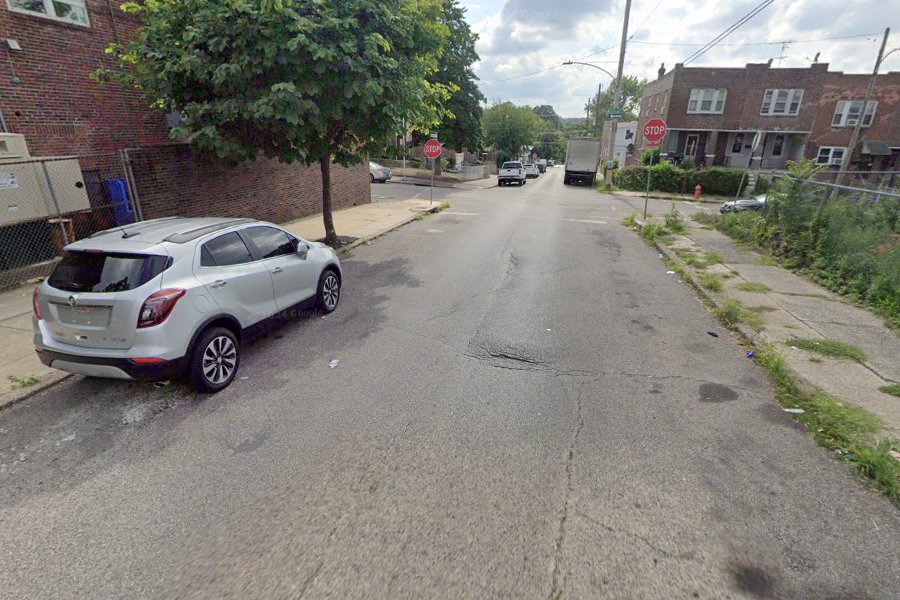
Picture 55 Buicks and two-tone Pontiacs. Here you have Suicide Hill. Stopping is optional

Suicide Hill (aka Media Street): Stopping is Optional, Dude. Photoshop in a ’55 tu-tone Buick and you are there. The Overbook IADC was to the left. Triangle Park and St Callistus are at the end of the line.

The Parcourse for Working Class Kids: A Stitch in Your Side is Better Than a Knife in Your Back

Let’s start with the round the block opposite way relay. Normally, this involved two kids who detested each other. The starting point was usually around 66th and Haverford, although it could be on Haverford Ave itself. Somebody with a cap gun was the starter. Bang! You’re off. Now, the two reprobates proceeded in the opposite direction, usually, stupidly, at full clip. The idea, of course, was to see who got back to the starting point first. Whoever lost got beat up. Now Media Street, if you observe the photo above, was a bit of a hill. So naturally, the kid running up 66th Street and hanging a left on Media got the benefit of the downhill. The other kid was screwed. Mostly, you picked the fat out of shape kid to get screwed so you could wack him when he lost. Nice, huh?

The run along Edgmore Road was flat, Democratic but absolutely disgusting. A good part of it ran behind the Overbook Italian American Club (no longer in existence, since they all became Republicans with Reagan). There were bocce courts up there, and the old Sicilians used throw their Di Nobili cigar stubs over the wall, where they came to rest as sort of turd-like objects. At the same time, every dog in Haddington used the same stretch as a toilet. And, finally, the club stacked its empty beer bottle cases out there behind a fence.

Now, you know, this delightful blend of stuff sat out there all day, just cooking away in the hot sun attracting flies. Man, even if you had gotten the downhill boost, you had to confront this stuff–no one ever thought to detour into the street, probably because you would have had to dodge traffic. Anyway, if you were the kid condemned to the uphill climb, you had to negotiate the picturesque wasteland of Edgemore Road. On a hot day, in the the Summer, in the evening, the stale beer, dogshit and Di Nobili cigar butts made for a cloud of gas hanging there that could have violated the Geneva Convention against the use of chemical weapons. You were running, so you couldn’t really hold your breath. And if you inhaled, well, you probably wanted to hurl because it stunk to Kingdom Come. So you’re running along, probably hot and sweating, with the urge to wretch, only to confront the uphill portion of Suicide Hill, where you’d probably get a stitch. Where you either stopped, cried, threw up, or continued down 66th Street to the finish line. There you were probably greeted by the other runners runner yelling “You lost, Suckah”. No shit. Then a hail of fists, rocks, dirt bombs and God only knows what else came raining down on you.

And you wonder why that neighborhood produced a lot of recruits to the Marine Corps? Even the winner had been lucky to survive, and if you were all having a great day, a Red Car cruising up Haverford Avenue (Philly’s finest) would slow down to observe the festivities, maybe hurl and insult or two, drive away laughing. Why would anyone do it? Look, you think you had a choice: if you lost you got beat up. If you refused, you got beat up. I always figured you got beat worse if the other hoodlums were fresh, although they could get pretty stoked waiting for the loser to appear. I must admit, I was the loser more than once. I knew what was coming and usually picked up a board or a bottle or something with which to defend myself until some adult came screaming out of one of our homes yelling we were all going to end up in Reform School. Right. In my case. Presentation BVM and Devon Prep. Bonnner and Tommy More were worse.

But the real “fun” began when we had “race day” on Suicide Hill. To this day, I have no idea how someone didn’t get killed or seriously injured–or if they did, I managed to miss it. Now, none of us had bikes, I think, but we had wagons, those scooter things with two wheels, and a few other cobbled together contraptions with wheels. You got up to the starting point at 66th and Media and aimed down toward Triangle Park. If you had surplus kids, you stationed them to do watch duty at the Stop Signs at Media and Edgemore, which would basically give you at shot at the Haddington LeMans race if they waved you through (there was this one homicidal kid who went to Dobbins Vo Tech who routinely tried to wave people into oncoming traffic. I remember hearing he didn’t make it though Nam, which didn’t exactly surprise me. He probably got fragged).

Honestly, I was usually too damn scared to race down Suicide Hill, but others weren’t. Oh. My. God.You either got shoved forward shoved at the top of the Hill or kicked off yourself and you were off down Media Street. Everyone screaming, kids running into each other (or into parked cars), or flipping when they hit a crack in the street (or a not-quite level manhole cover). Since the turn out for this was usually sort of akin to a pre-adolescent drag race, kids from as far as Lansdowne Avenue would come and watch. Join in, sometime halfway through the race. If you had to suddenly stop at the stop sign, chances are you got creamed, because you had to head for a curb or a car, or a hydrant or some damn immovable object. I do remember one occasion where a couple of the participants ended up in Saint Callistus Parish parking lot where I think they took out a couple of Knights of Columbus who retaliated rather swiftly. No sense of humor in a 1957 Catholic Pillar of the Church. I think I remember a bunch of kids getting in hot water for that particular misadventure, but since I just stood around and waited, eh….

Now, imagine trying to pull that off in 2025. This was nearly 70 years ago. No supervision. No safety equipment. No Neighborhood Watch. I know some kids got banged up sometimes, but I broke MY ARM playing football in grade school, not racing down Suicide Hill. Think about it. You were safer involved in disorganized city mayhem than you were in organized CYO football.

Are you surprised? It figures. We had our own skins in the game. The wannabe “NFL Coaches” didn’t. And, of course, the Catholic Church watched over us benignly.

Selling Off The Swamp and Other Nonsense

https://substack.com/home/post/p-159546801

Normally, I figure the best way to explain anything in economics is to reduce it to a level that I can understand. As I’ve been repeatedly reminded by former students, that’s generally not worth spending time on.

But my former colleague Shana McDermott has written a piece on this DOGE nonsense–at least the public goods aspect of it, that is so clear and compelling that I want to let her, as they say in Mexico, tener la palabra. This is from her substack site, and yeah, I hope the link to it works. I think it does. Because, honestly, it explains in plain English what I suspect most people, including many alumni of Econ 101 classes, don’t get from this dogmatic “let the market sort it out” stuff. Shana is, from what I could say, probably a bit more conservative than I am, but she’s certainly a Hell of a lot better trained, holding a PhD in Environmental Economics from Wyoming, which is an absolutely top program in the field. And it shows. Please, please spare fifteen minutes to read Shana’s piece. It is crystal clear and shows why this Trumponomics is tendentious nonsense–and typically an excuse to do something that has ABSOLUTELY NOTHING TO DO WITH EFFICIENCY.

This is the way it worked in the former Soviet Union, believe me–and to an extent it happened in Mexico as well. You want to reinforce the oligarchy, or just create one? Well, Trump is the blueprint with Musk. But I don’t think most Americans get it. And they are throwing away an enormous stock of physical and intellectual capital so that a few people can make a fortune off it. But you have to read her carefully, because she gets into the weeds. You know: how this really works.

So, if you cannot link to her site, write me, and I’ll get you the link. It’s that important, and that good. Professor McDermott has the floor.

Penn Wynne, Redux

Fly, Eagles, Fly!

Ok. Now that I got my daily dose of filiopatriotism out of the way, we can return to more serious stuff. My faithful readers (hello?) know that I am sort of hung up on the history of Haddington (West Philly) and Penn Wynne (Montgomery Country, just outside the city limits). I grew up there and, to a lesser degree, in South Philly, so even after 45 years’ absence–that’s just hard to believe–the pull is still strong. Every time I run into something new, an artifact that gets me to see something a bit differently, I sort of go crazy. So here we are again.

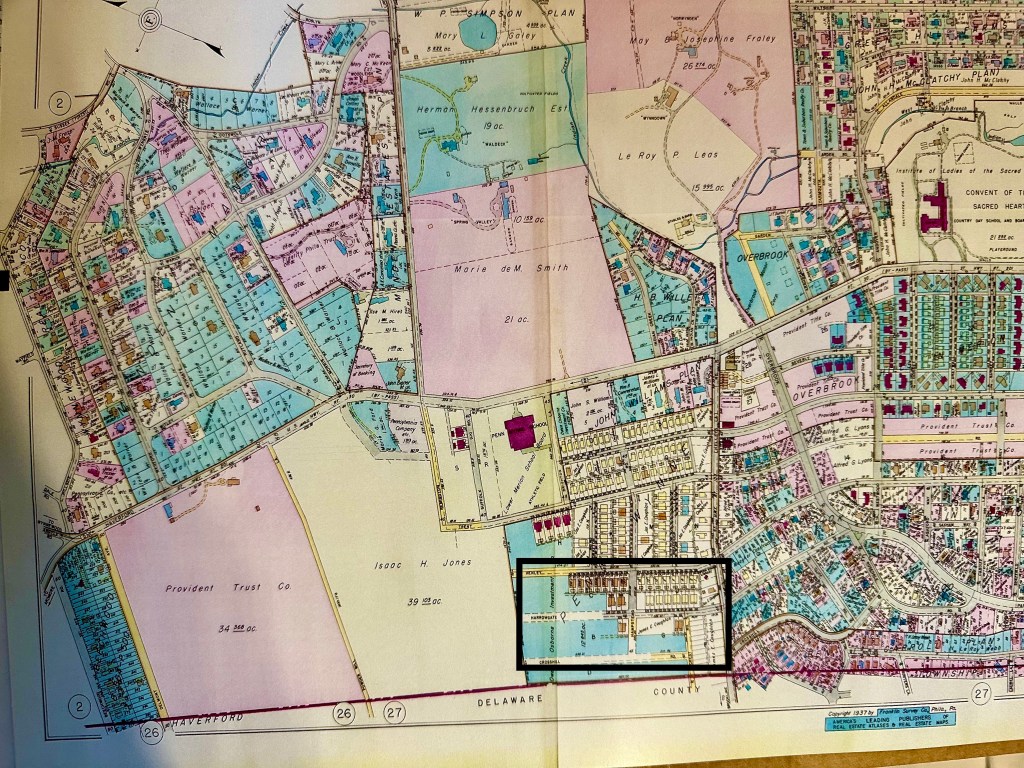
I recently found a 1937 atlas-map of Penn Wynne, very detailed, and, I think, not entirely accurate, but it made me realize that I hadn’t really understood how that particular streetcar suburb came to be. In all honestly, to do this right, I should be there, where I can look at deed books in Norristown and go bugging local institutions for stuff they have in their basements and attics (like Lower Merion township, but that isn’t going to happen today). Maybe someday someone will write a proper book using the new materials and techniques (like GIS) with which we are now blessed. But for now, another incremental contribution.

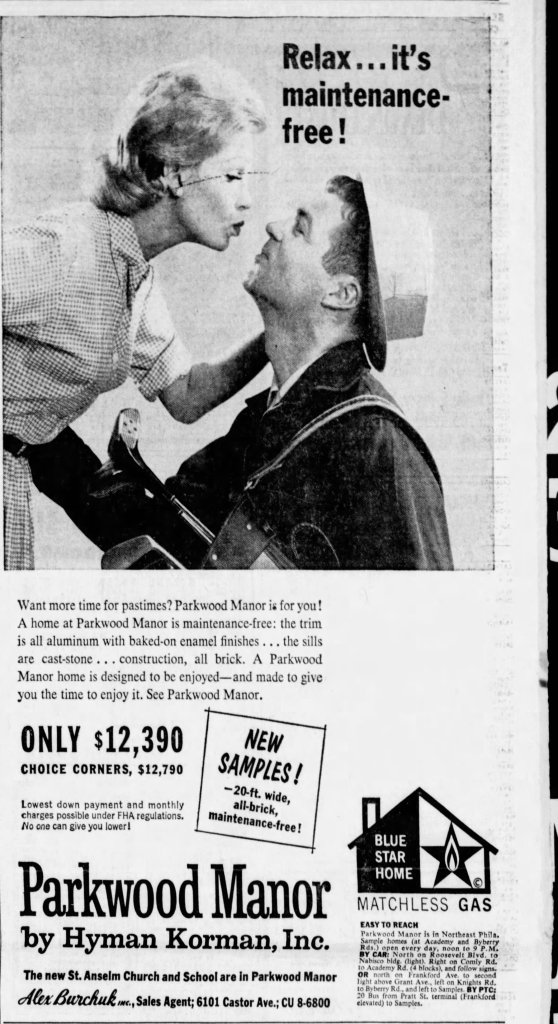
I of course knew that Penn Wynne-Overbrook Hills was carved out of what had once been farmland and substantial estates. All of Philadelphia, more or less, had developed that way. And even in my youth, I could see the process at work in Northeast Philadelphia, Elkins Park, Springfield, Broomall, and any number of other of postwar developments. My family visited many of them in the 1950s when we were just starting to move away from our extended family in West Philadelphia, and I remember tramping through model homes in muddy developments with garish real estate signs (SPANO, all yellow and red) or jingles (“Parkwood Homes you’ll agree are maintenance free, easy living for everyone”)

She’s Low Maintenance, Right?

I generally assumed a developer came in, bought up a chunk of land from whomever owned it, and built away, on suburb at a time. Well, in the 1950s and 1960s, that may have well been the case with Parkwood Manor or Levittown, PA, but it was not the case with those suburbs that started up in the 1910s and 1920s, developed piecemeal, and were interrupted by the Depression and World War II. Penn Wynne was one of those places. The first clue should have been the homes. They were not uniform. Some were brick, some were stone, and some were frame and masonry or shingle. And it often varied from block to block. They were different because they were built at different times. But to a kid living in what was an essential finished area (a few fallout shelters notwithstanding) in the 1960s, this was a fait accompli, and not a cause for reflection. Other people had history. You had a garage or a basement.

I apologize in advance for the amateurish graphics, but, as you’ll see, they serve a purpose. If you look to the black box at the bottom, that was basically what became the hood. Look above the box and you’ll see a purple box called Penn Wynne School, which was built in 1930. Go North and East down what is labelled the Route 30 bypass (aka Haverford Road) and you will see above purple box called Convent of the Sacred Heart, which went up in the early 1920s. Welcome to my Montgomery County in the 1960s–those were about the boundaries. If you wonder why I ever say “How did I end up in South Texas?” now you know.

Like most kids, I assumed that where I was had been there for ever. Which, of course, it was, albeit in considerably different form. Penn Wynne, well, I’ve done some digging, but the more you dig, the more you realize you really did not know. Most people will not care at all if I assumed that the neighborhood we were in had once been part of the estate of a certain Elizabeth Arnau. I now think that was wrong by half a mile or so, and, that around 1900 or so, the land belonged to the estate of a certain Hannah Russell. That’s a bit of a problem, because while I had managed to figure out a great deal about Ms Arnau, Ms Russell is a bit of a mystery. She clearly had a few bucks, because she shows up on excise tax lists as early as 1865, but that’s about it for now. And if you had an estate, like, who did not know you were rich?

What I had not suspected, to repeat, was piecemeal development, and the importance of a number of financial institutions in Philadelphia in it. Two that show up prominently on this map are Provident Trust and Provident Title (they were two sides of the same coin) and became Provident National Bank (PNB) which got merged out of independent existence in 1983. PNB was once famous for its colored weather forecasting sign on the downtown Philly skyline (old style), but its successor bank, PNC, took it down because it was aging dangerously. Right. Like me. But Penn Wynne was clearly a big part of the Provident Trust project. Provident Trust was an old Quaker bank that dated to the 1860s, and featured a long list of heavy WASP hitters on its various boards with names like Wistar and Longstreth as decoration. Now, what this tells an old Phildelphia hand was that Penn Wynne was part of an elite creation, sort of a poor man’s Main Line Annex, the Main Line being where the real money was. It’s hard to suppress the thought that the old money figured that you had to put the hoi polloi somewhere, especially the ones who were starting to staff the department stores, public schools, law offices, and other service sectors of Philadelphia’s then enormous industrial sector. Where better? It made sense at the time, although, as Richardson Dilworth, a progressive Philadelphia politician in the 1950s and charter member of the Social Register would say, the white suburbs would become a fiscal noose around the city. Honesty, as Dick learned, would get you booed out of office (he was particularly big in South Philly, which he thought of as a dumping ground for parking lots, stadia and other NIMBY-shit that my Italian relatives took big exception to). Anyway, if you know how to read the names and such, all of this makes a great deal of sense. And, as I said before, Penn Wynne fit the profile (https://thisgameisovercom.wordpress.com/wp-admin/post.php?post=1534&action=edit), eventually attracting even some of the less desirables to the area.

You’ll also notice “Overbrook Manor.” Heh. When I was a kid, this was the ritzy part of Penn Wynne, otherwise known as Greenhill Farms, or something similar, where the uber-cafone Italian Americans and Irish Americans lived and lorded it over the mere peasants on the other side of Haverford Road. Little did I know those folks were literally to the manor born, Overbrook Manor on this map. It was never intended to be for just us folks, see

Oh, yeah, decidedly more diverse, although I’d hate to tell you what I thought of the kids from the right side of the tracks. It’s actually kind of intriguing you know. Snobbery was baked into that area, although the original snobs would not have been real thrilled at the contractors and ambulance-chasers from Philly who succeeded them. I know I wasn’t. Dedicated steam company. Right. (the stuff in blue is from some modern tout)

Also notice if you will, the John H McClatchy plan in the far Northeast corner. Another big time developer, but this guy did his best work in Upper Darby, which is technically, I guess, where I was born. (https://sah-archipedia.org/buildings/PA-02-DE31) This guy, unbeknownst to me, had spread some of his joys on the other side of the Convent of the Sacred Heart, where you may recall I served mass and watched girls as an altar boy. That convent school was famous in those days, and the Mexican writer Elena Poniatowska actually went to school there–back when the Church was THE Church. I sort of wonder whether her family had anything to do with the Institute of Our Ladies of the Sacred Heart, which was also news to me. Turns out they got diversity now too, which was not the case when only blonde goddesses roamed the grounds, and the one Italian American girl I knew there was never quite in my league either. Sigh. My how the world has changed.

I know. You’re going to ask me if I think the world was a better place when Penn Wynne was mostly an investment for the trustafarian class of Philadelphia? All them Social Register types who thought they were slumming it when they stooped to admit refugee Italian-Americans from Penn Wynne into the Ivy Halls of Princeton and Penn? Or How ’bout Hermann Hessenbruch who had a 19 acre estate (“Waldeck” as in Weimar Germany) on what is now Remington Road. No, he was born here, silly, and he was a successful Philadelphia tycoon whose family gave generously to Lankenau Hospital (which used to be the grounds of the Philadelphia Country Club) and, yes, Princeton! To whom she donated a vacation home for use of the faculty! Damn! Who knew? Oh my, a rising tides lifts all boats, unless it’s the Titanic.

Check out the NYT link for details. It’s is to a 1962 obit, and I dearly hope you can access it. Makes me proud to have spent some time around Penn Wynne and its tonier environs. Waldeck included.

https://nyti.ms/4aROvUp

See. And you didn’t think that wealth ultimately had a trickle down effect in America. You know, land of the free and home of the brave? Where Anyone can grow up to be President!!! And does.

You just never thought Donald Trump would be the ANYONE who proved the rule. Nobody ever said Democracy was always going to be fun, did they? But then Andy Jackson came along…….

Fly Eagles Fly.

PS Thanks to James Maule, I have another graphic data point with which to work–around 1915. There was, of course, no Penn Wynne, and the land is marked as Continenal Trust and Title (Philadelphia). There is one farm shown as the “Heritage Farm” probably up around Remington and Haverford. No idea.

So Far, So Bad

This is really not so much of a blog post as the start of trying to work out why Mexican independence got off to such a shaky start in the 1820s and 1830s, although, really, it is mostly confined to thinking about what went on there in the mid-1820s. And, to be even more specific, it is a kind of draft of some observations on what happens when your former colonial master has his (or her) hands on your vitals–I’m being polite here. I’ll dispense with footnotes and stuff for a later version that I inflict on some “scholarly” journal. This is more in the line of why didn’t most of this occur to me before? Well, the honest answer was because I really wasn’t paying attention–and because history of this sort has fallen so far out of favor with my erstwhile professional associates that there are times you say, “Why bother?” Well, the reason for bothering is my own clarification,and if this does end up in the hands of a critic, friendly or no, so much the better.

I think it’s pretty much safe to say that the old kind of imperial history–the sort of thing that my teacher Stanley Stein did–is not so much in vogue any longer. In fact, when he published what was to be (unfortunately) the last volume of what could be loosely called the merchants and monarchs project in Spain and New Spain, the time had long passed when some of Stanley’s younger colleagues could be bothered to make much sense of it. I distinctly recall one reviewer in a major journal calling the volume “old fashioned.” I won’t say Stanley was hurt by this kind of offhanded dismissal (as some of my readers know, he could take care of himself) but he did tell me he felt “deflated.” Yeah. Falling out of fashion to some callow hotshot is never fun, particularly to one who clearly has not bothered to make much of an effort to understand what a scholar is doing. We’ll leave odium scolasticum to those who have nothing better to do. God knows, there appear to be more than a few of them around.

Ok. Here we go. I have been working on and off for years now on a group of people known as “The Lizardi Gang.” I am not a particularly fast worker anyway, and this project has been interrupted by a few other ill-advised adventures for which I have mostly myself to blame.In any event, it is story that begins in the mid to late eighteenth century with commercial and political upheaval in the Spanish empire and in the rest of the Atlantic world, events that would ultimately require more than a century (at least) to work themselves out. To the extent that they were part of the process of economic globalization, not a few people may think we are still working out their implications. Fine. Not my tempo, as Terence Fletcher said in Whiplash. Haven’t seen it? Grad school set to rhythm changes.

In ant event, the Lizardi Gang came to rest around the port of Veracruz on the Gulf of Mexico (yes, Virginia, the Gulf of Mexico), where they ultimately made large quantities of money through (among other activities) international trade, Spanish empire style. Because of the peculiarites of Spain’s relationship to Mexico, the tenets of mercantilism, and the economics of highly risky enterprise, a sort of select few were ultimately enabled by the powers that be to play this game. Veracruz was the single largest Atlantic port that was open to Spanish merchants trading to Mexico (not to say other flavors of merchants who wanted to trade with Mexico–French, Dutch, English, North American, what have you, whop managed to slip in) and given Mexico’s geography and topography, Veracruz became a kind of commercial chokepoint, or what the Spaniards called the garganta (the throat) of Ibero-Mexican trade. This is essential fact Number One. If you controlled the port of Veracruz, well, you had your hands on Mexico’s family jewels, because a lot, if not most, of the Atlantic trade moved through there. Now hold that thought. It was not exactly a straight shot from Veracruz into the core of New Spain, but it was the yellow brick road. And you followed it.

Around the same time that the French and the Anglo-Americans began to rethink their core ideas of popular sovereignty and political power, so too did the Spanish empire. The stupefying welter of details need not concern us–only that colonial revolution came to Mexico in 1810. And when it did, well, it was a doozy. Lots of violence, bloodshed, death and patriotic gore that lasted from 1810 into the early 1820s, and which ultimately severed the colonial bond between Spain and Mexico. But not all at once, and with lots of detours along the way. And Veracruz played a not insignificant role in the festivities.

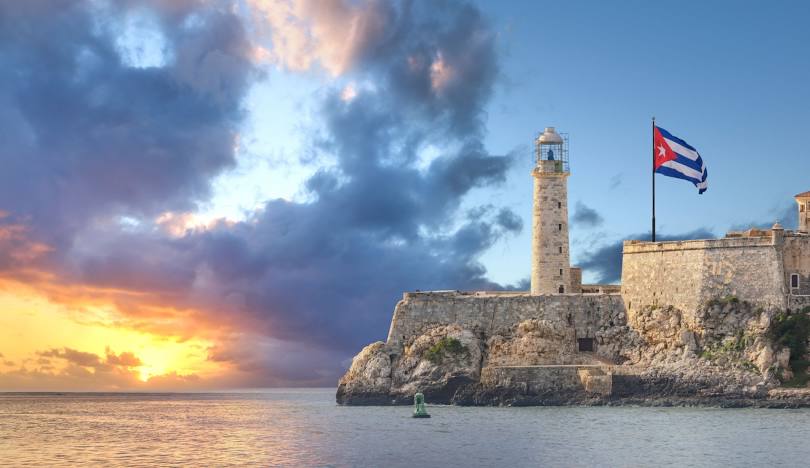
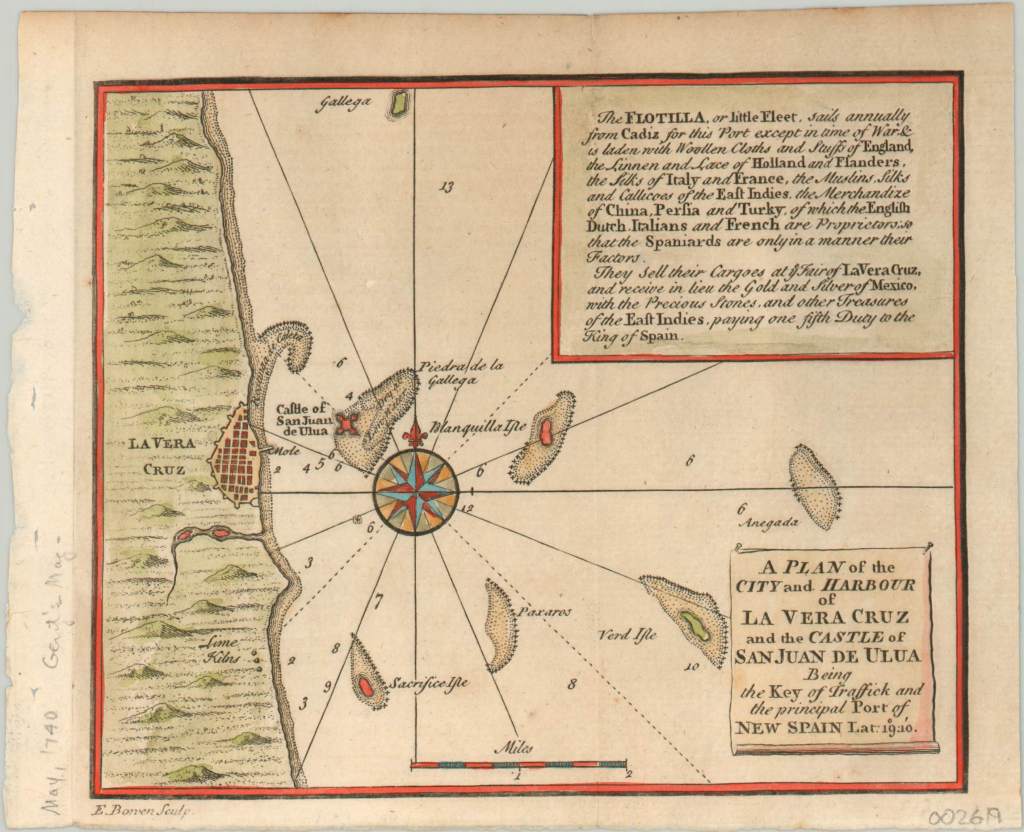
Veracruz had long been a fortified port (San Juan de Ulua), you know with one of them hulking castle-armories-barracks-naval facilities that are so impressive to modern eyes, like El Morro in Havana, Cuba. Here. Who in their right mind would attack these behemoths? Don’t ask. Plenty tried. Mexico on the left, Cuba on the right.

In the case of San Juan de Ulua, as the peninsular Spaniards (there were Mexican Spaniards who confusingly get called creoles) yes-and-no decamped from Mexico, a garrison under the former governor of the, well, province of Veracruz (there are other names and some different administrative limits assigned to it, going back to the colonial government), a guy named Garcia Davila, decided he wasn’t going anywhere. This was because, unfortunately, the government he recognized in the peninsula (up for grabs too, to make matters worse) did not recognize the independence of Mexico, which had been negotiated by a liberal viceroy (curiously named O’Donoju….yep) whose liberal government disappeared in Spain, and to make matters worse, who then died of pleurisy even as Mexico became a de facto independent state (excuse me, Empire) under Agustin Iturbide, Emperor, some wit (maybe Simon Bolivar) called “Emperor by Grace of God and Bayonets”). Anyway, Agustin I (Emperor to You) had a pretty rough ride in his new Realm and only lasted until 1823. He suffered a fate no worse than death (you can still see his bloody shirt in a Mexican archive, cause they wasted the guy–long story: they always are), but even as The First Empire in Mexico (yes, there would be a Second forty-some years later) ended, Spanish intransigence did not. As far as the King in Spain was concerned (Ferdinand VII, 1814-1833), Mexico was still not an independent country. Yeah, yeah, the United States recognized Mexico in 1822 and Great Britain in 1825, but Spain held out until 1837. And in San Juan de Ulua, for the time being, so did Garcia Davila and the garrison, which was resupplied from Cuba, which remained faithful to Spain because it was scared to death of its own people, many of whom were African slaves bent on slitting their masters throats. Confused yet? Just wait. It gets better. And don’t worry. I can’t keep it straight without reteaching myself this episode every damn time I run over it.

So, here you got this fortified Spanish garrison sitting sort of sitting there cheek by jowl with the city of Veracruz. So far from Spain, so near to Mexico. And not going anywhere.

Oh, it was armed. I’m not exactly certainly how many cannons San Juan de Ulua had (I need to look that up) but one was quite enough. And you can imagine that relations between the Spaniards holed up in the Castle, the troops loyal to Mexico that were in Veracruz, and the merchant community were not exactly cordial. A sort of uneasy truce held for a time, but by 1823, tempers were running short. The Mexican historian Juan Ortiz Escamilla who has waded through all the details of this mess–and believe me, it was a mess–has uncovered a lot of startling detail, none of which I’ll provide here. Suffice it to say that once the Castle began to shell the city of Veracruz, matters took a turn for the worse. From our perspective, a lot of this had to do with trade through Veracruz, which had all sorts of knock on effects.

Ok. Some dubiously Geek-like stuff that has to do with the budget of whatever you want to call Mexico’s newly emerging central (not state or local) government. It was strapped for cash. This was a self-inflicted wound, but when the Mexicans kicked out the Spaniards, they sort of wanted to make sure that that no central government, theirs or otherwise, could fiscally savage them the way the Bourbon Monarchy in Spain did (another long story that had to do with Spain’s complicated relation to France after the War of Spanish Succession ended in 1713). Oversimplifying to the point of caricature, the Mexicans cut taxes so much that they reduced the fiscal capacity of the state by more than 50 percent in nominal terms. You can’t run a country on love–or pay an army, which is bad when you are still at war with your former colonial masters. So where was the money going to come from? This was a big problem all over the former Spanish colonies, but Mexico really got a dose, so by 1823, funding the central government was an issue. Yup, oversimplified, but close enough for Mexican history.

The obvious candidate inevitably, is you tax trade–especially imports. In Mexico, they also tried to tax some exports as well, such as silver, which initial was subject to a 15 percent duty, but later reduced–I believe–to 5 percent. It didn’t matter whether the silver was coined or not. You could export ingots, and this was going on in 1824. The Lizardi (and their associated kin, such as the Echeverria) were actually sending silver to Madrid to be coined. That sort of gives you an idea that this was more or less capital flight, and it was obviously a big business. If you figure that liquid purchasing power was flowing out of the country in 1824, it will give you some idea of why there was a lot of complaining about lousy markets–amusing that the same merchants complained about both, you know, who me? Also, if silver was shipped out of Mexico to be coined, it paid no mint tax in Mexico, which was another source of government revenue. So there was a fiscal dimension to this outflow as well. Finally, the presence of the Spaniards holed up in Veracruz played holy Hell with normal import traffic, much of which had to be moved to outlying islands (at the port, such as Sacrificios in the map above) That was not efficient, obviously, and Heaven only knows how much “leaked” out of the revenue stream. So customs revenues dropped which meant that the central government had less to spend. And, in Veracruz, tobacco planters had been traditionally substantial recipients of government money for what was known as the “tobacco monopoly” which required (in theory) planters to sell their harvest to the government who then used it to make tobacco products (think of the opera Carmen!). Well, that. clearly loused up demand in the region as well, so if you guess that places like Veracruz were hurting big time and off to a very bad start as independent states or provinces, you are probably right (at least I think you are). And there was still a hangover of guerilla activity from the Insurgency of 1810, and if nothing else, it raised the risk to merchandise moving and sometimes blocked it all together. If you are beginning to get the impression that Mexico was off to a possibly shaky start as an independent country, well, join the club. You want numbers? Good luck. So do I. You take what you can get. My dif-in-dif colleague seem a bit obtuse when you raise the issue. So, generally, I don’t bother any longer. The historians don’t care and the economists get annoyed. Which is why doing the economic history of Mexico the right way is the wrong career move.

And if you don’t think this stuff was costly, well, guess again. Mexico, mostly out of sheer desperation, started borrowing in the London market between 1823 and 1825. The initial nominal total was about 6.4 million pounds sterling, but astoundingly, Ortiz Escamilla, who pays attention to these things, concludes that the explicit military costs of getting the Spaniards out of San Juan de Ulua actually exceeded what the Mexicans had borrowed on London. Think about that for a moment. The Mexican foreign debt was a very big deal in the nineteenth century, and this part of it was not settled until the 1880s. So Mexico’s ability to get into the capital markets–presumably one of the benefits of independence–was seriously impaired from the get go. The actual beneficiaries of the borrowed funds are pretty hard to figure out, if you try to get beyond the broker dealers, of whom my friends the Lizardi were a part. Yeah, they made a killing. But it was blood money. Sorry to spoil the fun, but sometimes, to end well, things have got to start out well. Believe me, in Mexico in the 1820s, this was far, far from the case. While the United States was out there making “internal improvements,” Mexico was getting its clock cleaned. Sorry, but that’s scarcely an exaggeration, even if it is an oversimplification. Economists call this “falling behind.” Yeah, this what happens when the hidden hand of the market delivers a sneaky punch (I think the economist Shane Hunt said that when I was a grad student at Princeton in the Dark Ages. Smart guy). Latin American economic history for dummies. Like me.

Economics is Everywhere

Economics is Everywhere. No. I didn’t invent the phrase. Daniel Hamermesh, a labor economist who I wish I had had as a colleague instead of the one I suffered with, is responsible for the useful observation (and accompanying textbook, which I assume, in a fifth edition, is doing very well). Actually, for years now, this has been my problem. I learned just enough mainstream econ to see the world as the econ do–the real econ, not the dogmatic, the minimum wage must be abolished because demand curves slope down types (again, a colleague I wish I had never laid eyes on). But that ain’t what this post is about.

On the road to Damascus, once more, I had a revelation. This came at the HEB. In Texas, pretty much, there is no other grocery store, although some other chains have been foolish enough to contest its dominance. HEB in Texas is like Yahweh. There is no other, so get over it. But if, God forbid, the Cowboys are America’s Team (check), HEB is America’s grocer. Even the closet socialists at Consumer Reports bestow their blessing on the HEB. All bow at the HEB’s corporate feet H-E-B took the top spot in Dunnhumby’s Retailer Preference Index for 2024 for the third year in a row, continuing the Texas retailer’s dominance of the annual predictive rankings of grocery chains based on their financial performance and shopper perceptions (this is from a grocery industry site, btw). So, you know you are at the Alamo of Grocery Stores. Gentlemen, remove yore hats.

Well, some other time we can talk about the HEB, but what we have here is merely an insight provided by economics at the expense of HEB. It is not, I confess, entirely original.

Years ago, when I lived in Philadelphia enjoying the charms of graduate school and trying to figure out my dissertation (I still am), my best friend was the radio, cause it never went to sleep either. There was–and is–an all-news station called KYW. It was dull then and awful now, but it did help pass the time. One of its features was a guy called “The Greengrocer: Joe Carcione.” (cue ethnic stereotypes). Joe passed on in 1988, but back in the late 1970s, he was a big deal, syndicated on over 80 television stations nationwide, and who knows how many radio stations. I loved Joe. He could tell you how to cook spaghetti squash, and how to properly ripen even mediocre tomatoes. And, having spent his life in the produce business, he knew what he was talking about. He took great pride in his work and in his industry. So, naturally, I was intrigued one day he hosted a call-in in which listeners could ask deep questions about grapes and stuff.

Joe was genial as Hell, right. He knew how to keep customers happy. So it was really cool to hear him lose his temper on the air when some insolent caller chose to teach him some supermarket econ. I think this guy was some kind of libertarian or neocon avant la lettre. Either that or an economist. Anyway, Joe had been explaining why presentation mattered so much, and that he was sometimes disappointed by what he was seeing at then contemporary grocery stores, especially where fruits and vegetables were concerned. You know, wilted lettuce, bruised pears, anemic endive–stuff like that. That, Joe said, should never be allowed to happen. Well, because it shouldn’t, and not just because it pissed customers off. You know, have some pride, right? I dug the ethic because that was how any good Italian boy was raised.

Well, what happened next was memorable. Some guy, very self-assured and patronizing, told Joe, basically, “It costs too much to assign a babysitter to keep the fruitsies and veggies happy all day, so that’s why it doesn’t happen. And it costs too much because of nasty things like the Retail Clerks Union.” Heh, heh. Optimizing economist, meet The Greengrocer. An epic exchange ensued. Joe, avuncular, paternal even, lost his cool. He didn’t swear or anything, but he raised his voice considerably and basically started shouting at this Neanderthal. Said caller just kept insisting this was all costs and benefits, you know? It cost too much to keep the stuff looking fresh all day. What you would lose in sales, goodwill and the rest hardly justified the attention, especially when the nasty unions were rent-seeking (he didn’t say that, but he was thinking it). Well, I distinctly recall a sudden station break and an announcer straight-voicedly intoning “We’ll get back to Greengrocer Joe in the next hour. So be sure to stay tuned.” I wish I had an aircheck. I think Joe had a stroke.

But even as I was laughing at this novel intrusion of market fundamentalism into the world of Joe Carcione, I was thinking “Dude–econ wannabe–has a point you know. There must be an optimal amount of funky veggies which, as we say, is determined at the relevant margin. I mean, this guy is a bit much, but I don’t think he’s completely wrong. Just a bit…..narrow minded.” Ho, boy. After spending 30 years around the Econ South of the Mason-Dixon line, I had no idea how much homo economicus I was going to contend with. Every. Damn. Day. Normally I tried to be a honest broker, but, you know, doing “on the one hand…..on the other” with some of these narrow-minded Philistines is an errand into the wilderness. Had I known that this was what was in store for America 35 years ago from the Econ 101 crowd maybe I would have gone somewhere else. Like anywhere. And that coming from a guy who thinks the Congestion Charge in London, UK, must be suboptimal because it took an Uber an hour to go 8 miles from Central London to Kew Gardens. So it’s not as if I’m not sympathetic to the idea that the price mechanism has some role to play in the efficient allocation of resources.

Well, ok. How does the prove that economics are (is) everywhere, especially in Texas at the HEB. You got a minute?

Today Linda and I made one of our frequent journeys to the HEB to stock up on crudites and comestibles, as Dr Oz says. It was, 40 degrees aside, like any other dreary trip to the HEB. Not fun. So while we’re there, wouldn’t you know Linda buys….blueberries, which are a part of her breakfast routine (mine is coffee and whatever is leftover from desert). Ok, big deal. So why is this earth-shaking? Well, we get to one of the check-out stations (one as yet staffed by a human being rather than some damn do-it-yourself scanner) and start the ritual of getting our stuff on the conveyor to get scanned out. All proceeds smoothly until Linda picks up the plastic carton of blueberries. Then disaster strikes. The carton really wasn’t secured properly shut. And you know what happens. Like a cartoon, right? With blueberries cascading all over the counter, the floor, to the next aisle, oh boy, don’t we look like the idiotic elderly couple exclaiming like Custer at Little Big Horn. Where did all those blueberries come from?

Not to worry! Da-da-da-dah!!! Front end manager-dude gets on the horn. As quickly as you can say “freakin’ blueberries” (that would be me), an employee appears in full HEB kit. He is armed with a broom, a kind of bin with a handle, and some other stuff to mop up the berries that have already gotten underfoot. It literally takes less than a minute. No fuss, no bother. And no charge either, as someone else is dispatched to get more blueberries–which we don’t get to spill. We apologize profusely, but you think HEB were at fault. Grin. Whaddya know? “Y’all have a blessed day!” I grin. “Damn right!” Manager-guy frowns at oath. This is a Christian store. Texas.

Since you must be running out of patience, you are wondering what the Hell this has to do with Economics, Joe Carcione, optimizing, anything? Well, I gotta tell you, I would guess a great deal. You want to know? Ready or not, Dr Science has an explanation: Economics is everywhere. Especially in Texas.

Since 1947, Texas has been a right-to-work state. I am not a lawyer, let alone a labor lawyer, so exactly how right-to-work laws work here is a bit above my pat grade. I can tell you that unions aren’t exactly welcome down here. I can tell you that the HEB is not unionized–as far as I know. Nor have I ever heard any suggestion that anyone wants to organize it (which would be amusing, if possible). But I can tell you one thing. Labor here (Bexar County) is cheaper on average than it is in the United States overall. See here. Now this is a complicated question for sure, but I’d guess that supermarket employees are not exactly minimum wage ($7.25/ hour), but, whatever Gov. Greg Abbott says (he is a congenital liar), it surely is no $29.00/ hour which Abbott trots out every time someone says how cheap labor is in Texas, especially the less skilled variety. You think baby-sitting asparagus takes much skill?

Ok. So what does this have to do with our blueberries on the floor? Linda observed on the way out that the HEB has a nasty habit of not securing their plastic containers, even with a bit of tape. We’ve spilled salads, olives and other stuff, so it isn’t just blueberries. Their shopping bags (paper) are cheap and spill all over the place too. Hmmm……Why not just get better bags, or just get someone to secure the plastic cartons more carefully? Tell you what? Even with relatively cheap labor, having someone working to seal up all those fresh-to-you containers for everything from blueberries to cherry tomatoes would be a shagload of work. And, it would have to be supervised, right? Isn’t it possible–even likely–that it’s easier to say “To Hell with it. Not worth it.” So what if you lose a few loads of blueberies a week? So what if the asparagus sits in a tub of ice water instead of ice? You can clean up something for a marginal cost of basically zero–the guy is already hanging around. And if customers don’t like soggy asparagus, well, tough. Where else you gonna go? HEB is, for all intents and purposes, a monopolist in a cheap labor state. The blueberries can spill and the asparagus can wilt. And Joe Carcione can spin in his leafy grave. You lose less by not providing the fancy package when the clean-up service that you do provide costs next to nothing. You know. Like the Italians say (in a very different context): Why buy the grapes when the wine is free? And believe me, nothing happens at the HEB by accident. The electronic surveillance in that particular store is Orwellian.

I ain’t saying this is some airtight explanation, but watching those blueberries hit the deck reminded me of Joe Carcione and his optimizing interlocutor from so many years ago. Actually, you might expect even better care of the veggies and fruits given labor costs here, but, ironically, it appears that cheap clean up is even more attractive. One thing I do know. Texas never ceases to amaze me. And, believe me, at bottom, economics is everywhere. Y’all don’t like it? Stay home. Like in California, if it’s still there.

From 84 Charing Cross to Mickey D’s: It’s Worse than Spengler Thought

This is London. I am seated in the cafetería at Marks and Spencer. My life is not at risk. I expect no sympathy. I expect even fewer readers. Vox clamans in deserto or no, it is Christmas season in a world capital. And not just any world capital. As Ed Murrow would say, “This is London.” His circumstances in 1940 and 1941 were considerably more fraught. Murrow risked his life at the hands of Goering’s bombers during the Blitz. I risk only getting chewed out by waitstaff who think my seat could be put to more productive use. They are, in fact, from their perspective, correct. My situation is, in fact, quite pleasant.

But the world is a mess. And even though all dressed up for Christmas, London is basically a tart. There is so much Russian money here that London has been called Londongrad. Money laundering run by Russians is a huge business. Property ownership in the UK by Russians has been conservatively estimated at over a billion pounds sterling. Some courier got busted with over 250 thousand pounds in cash in his car the other day, for God’s sake. And the evidence is everywhere. Westminster and the shopping districts are literally gleaming from rehab. There is construction activity all over London—it looks like Austin, Texas during the boom. New tunnels. New terminals. Consumer stores—top of the line—crowd the major streets—Oxford, Bond, Regent. And full of merchandise at eye-watering prices, jammed with polyglot crowds of tourists. Glitz galore. Walking through Westminster at night is an almost unending sensory overload of lights, displays, Christmas trees, shimmering blondes in designer clothes. I have been in uber rides in Teslas, Mercedes and, for God’s sake, a black Jaguar. And yet, you know beauty is only skin deep, and much of Britain is in trouble. Something like a quarter of London families cannot make ends meet. The National Health Service is in deep trouble, moribund if you like. 84 Charing Cross, already a loss to bibliophiles a half century ago, is now ignominiously reduced to a Mickey D’s. The World According to Donald Trump.

The reason why London seems like so much of the problem is because London is so much of the problem. The Financial Times’s chief data reporter, John Burn-Murdoch, recently highlighted how the UK compares on per-capita economic performance once London is removed. The answer? Worse than Mississippi, the US’s worst-performing state, because “removing London’s output and headcount would shave 14% off British living standards”. A Mickey-Mouse number? Sure. But it does give an outsider some sense of the God-awful in-your-facedness of at least parts of London. Basically, it had been 20 years since I last saw this place. It might as well have been a century. Talk about “rebranding.” The characteristic reserve of the British is well and truly gone. Brutish? Maybe. British? Not quite.

And the cause of all this? Well, I haven’t really been paying close attention for the intervening decades. Simon Wren-Lewis dates the decline part of things to not simply to Brexit in 2016, but more importantly, to the Tory government/’s reliance on austerity beginning in 2010. https://mainlymacro.blogspot.com/2022/05/how-austerity-created-brexit-and.html. In a sense, this ought to be a warning to USAmericans, because this little drama is coming your way courtesy of Trump, Musk and the rest of the idiots that my compatriots have chosen to entrust their fate to. We are headed down the same road, eyes wide shut, so check your pulse now if you are in the USA. You may not be able (or want to) in 18 to 24 months. Of course, Brexit itself was simply stupidity on steroids, particularly in light of Britain’s never adopting the Euro. I am still trying to figure out the logic behind what the Brits did in 2016, but I am also fully occupied trying to figure out what the Hell we have done in 2024. So knock yourself out. The next few years may be better experienced in a state of diminished consciousness anyway.

Of course, the thing I have mostly noticed is the transformation of (at least parts) of London into something that must be Donald Trump’s wet dream, a Palace of Laundered Money and Oligarchs, and that is not Brexit. It is my impression that the Tories decided that whoring out Britain was the most sensible way to profit from the collapse of the Berlin Wall and the failure of a democratic transition to stick under Boris Yeltsin in Russia. I only know what I can read about this, but there is plenty. Get a hold of Oliver Bullough’s Butler to the World (2022) if you have a strong stomach and start there. Again, maybe, just maybe, you’re in for a sneak peek on what’s going to happen in the Homeland under Trump and Tulsi, God forbid. Yeah, we have “guardrails.” (personally, I think of them as third rails, but that’s just me). In any event, the penetration of Russian influence and the looting of the former Soviet economy have transformed London. I can’t say that I much like it, but, Hell, it’s not my country and certainly not my favorite city anymore. Tant Pis. Anyway, if you like gauche, over-the-top commercial, and tasteless, you’ll like what some of London has become. Sorry, it isn’t for me. I preferred the old post-imperial sort of vaguely Cool Britannia version that people like Roy Jenkins and Ken Clarke presided over. No accounting for taste, I guess.

Ah, yes, one other thing. London’s traffic, congestion charge or no, is dreadful. Because the Tube was loused up (not unusual), an Uber out to Kew from our hotel on the West End (another experience, to be sure) took the better part of an hour in late morning. This was to get out to what I still call the PRO, but which the Brits insist on calling the National Archive. It was a very fruitful trip and the staff at the PRO are wonderfully helpful and blissfully reasonable about using cantankerous old Chancery Court rolls, stuff that I suspect would now require an armed guard in the Archivo General de la Nacion in Mexico (and gloves–and a mask–and….and….and….). But now I know I had damn well better look for lodging a lot closer to Kew for when I go back–and I will go back, since I know that further treasures of the Lizardi Boys will turn up (hint, hint–the firm’s books taken in bankruptcy?).

The people at the National Portrait Gallery archive were similarly helpful, so maybe in all this mess, the fellowship of the book and scholarship will see us through. Pretty to think so, right?

Memo to whoever is running London. Better raise the congestion charge. If what you got is equilibrium, I’d hate to see what happens on a bad day. Talk about excess demand.

And I am no longer sitting at M&S. But if I close with “This is San Antonio,” no one is likely to give a damn.

Gimme A Break, Muskrat

Originally published 11/17/2024. I told you so. Now try listening

We’re not even into Agent Orange’s Real-Life Redux, and already I’m sick of him. And, frankly, I know I’m not alone. While his cabinet choices of vile pigs, equally dubious semi-babes and other assorted deplorables may be truly disgusting, his Feckless Friends Without Portfolio are really a trip. Good, so many to choose from. But there is one whom I find truly entertaining.

Elon Musk.

Now, I’m not aware that Muskrat actually has or will have a formal position. I guess even that pasty-faced “First Lady” would have to submit to some kind of vetting and disclosure. Why do I think ole Elon don’t want to be subjected to Discovery? You know, sunlight is the best disinfectant and vermin somehow always seem to know that. So I guess we’re gonna have to be subject to this jackass who is and is not there, The Schroedinger’s cat of Trumpland. Oh, joy.

Now, Elon is a disruptor, you know. Ordinarily, disruptors are not exactly welcome because they tend not to play well with others. Muskrat, however, has turned his winning personality into big bucks. And, well, this is America. What else matters, right? Character? Ethics? Social Awareness? Common Decency? Nah. For that you’d have to find some cloistered nuns, assuming the Catholic Church has many or any left. And even….. well, forget it. The Church is not on my mind. For once. Although did you hear the one about the Archbishop of Canterbury?

No, we’re gonna stick to Elon and his Very Big Plans.

Elon is one of those Chainsaw Al kind of disrupters, you know. Let’s cut everything (except my compensation, of course). He’s also notoriously airy about keeping his promises–ask Mexico, for one, where he was saying until he was gonna build a great automobile slingshot into the US market, until he apparently lost interest. I suspect you could profitably look at some of his other commitments too, but it’s you dime, so do what you want. Personally, I want to talk about something much more interesting.

A two trillion dollar Federal budget cut. Let me make it clear from the outset. I am not gonna use some fancy budget simulation a la Wharton or CBO. Sufficient to them is the techno-wizardry thereto. Nor am I gonna muck around in the actual details of how this mighty deed of the Big Chopper might actually be carried out in the Real World. I mean, this is all some mouth-breather phantasy right? So let’s just play along using some very elementary textbook economics. Y’all remember Mr Circular Flow? That diagram you dismissed as just too silly to be of any use when some poor schlub who was trying to get you to think like a Econ put up a slide (there, even I can be modern, although I was a chalk and blackboard kind of guy myself). Yeah, you little snots from Engineering, Math and real subjects who wanted Differential Equations. Knock Yourself out. Waste of brain power, I fear. Overkill. Besides, trying to explain some brutal system of difference equations to a Trump Voter is really like try to teach the proverbial pig to sing. Really. You get frustrated and annoy the pig. Literally. Go try it on your neighbor……

Yup. Heh. Bring on the magic mushrooms, cause psilocybin is the least you’re gonna need to get through this exercise. Now, if you INSIST on some semblance of the real thing, use this. and don’t bother me further. This tells you right off the bat the old Elon is living in Muskrat world. It don’t work like, Muskrat walks into a room, and says “Out, damned budget.” But, Hell, let’s pretend it did. What do you’ll think would happen? Lol. Get ready.

(https://fiscaldata.treasury.gov/americas-finance-guide/federal-spending/#:~:text=Spending%20Trends%20Over%20Time%20and,the%20United%20States%20that%20year_

You know, that circular flow that you were daydreaming through (admit it: he or she across from you was hot) says one Big Thing. And that would be, perfesser? Well, My spending is your income. Period. Really? Swear to God? Yup. Where did you think it came from. Your Mommies and Daddies? Where did THEY get it, assuming they didn’t work for Enron and just sort of make it up as they went along. It’s gotta come from somewhere? Right? I know. The government!!!! Well, yeah, but if the government just creates money to spend and doesn’t create nothing to spend it on, well, it won’t be worth much very long. Like a microsecond, Ace. See, money is basically debt, a claim on something. A claim on nothing is worth nothing. Even in Texas. So you’re out of luck.

Try again. When you come down to it, money is basically a claim to productive activity–stuff, wizard–and the nice part of it is Uncle Sam (or Tio Huitzilopochtli) has fixed things so that these claims on stuff you produced can be exchanged for other stuff without your name being on it( dah, dah, legal tender). Cool, huh? So I make stuff, and then (use magic here) I get claims that I can use to get other stuff. Maybe, you know, you are making the other stuff in your garden. Grin. Nasty. I was thinking of tomatoes, not cannabis. But no matter. My claims become your income (and your stuff my stuff) and your income becomes….my income….and so on….and so on….Without limit? Well no, but we want to leave savings out of it, which, if you are an American, is close enough for government work. More or less, that it. Really. Well, yeah. Sorry to disappoint all you propeller heads who want unending complexity, but that’s basically it. Now go do you homework in someone else’s class.

But What About Muskrat and His Big Chopper? Ok. Why not. Federal spending is maybe a fifth of our Circular Flow. So, maybe, a two trillion dollar cut would actually cut about a third of annual Federal Spending. A third of a fifth is about 1/15, or 6 to 7 percent. No big deal right. Ah, wrong. Wrong on several levels. See that first cut, well, think hard. Suppose your BFF works for a grocer who sells to military dudes (make it simple–not really necessary). Now, those military dudes are, soon or later, gonna have less to spend when the cut affects them–and suppose Musk the Chopper decrees all must sweat equally (except Elon and his multiple offspring). So the grocer sells less, right, but then, hey, the grocer buys less, right. Ahhhhh…..I get the picture. A ripple effect. Right. Well, how much? It depends, friend, but even ” multiplying” 7 percent by small number, say 2…..well that sums to 14 percent of the Circular Flow once things settle down. Assuming nothing else happens. Which I guarantee you is wrong. You’re about to go over the cliff, but that’s ok, You ARE MAKING AMERICA GREAT AGAIN! MAGA!!!!

Dude. It’s been tried. It’s called Austerity, Big Time (Another name for a Depression if you are included). The British have tried it. Lolz. Why you think the UK is so screwed up? Because Mick Jagger is mortal? Well, that too. Don’t believe me. Here is something for you to chew. Simon Wren-Lewis, Lies We Were Told. It’s a book, yeah, but if you’re unemployed, the opportunity cost of your time is zero. So all you pay is the price of Wren-Lewis’ book, and once that’s done, it sunk cost.

https://www.cambridge.org/core/books/abs/lies-we-were-told/preface/19162B8AE9D1948872089026631A4546

Like you. Sunk by the Muskrat, Trump, and his revolting Minions.

Enjoy.

Morta Sotto Il Carro

Maybe she slipped and fell. Or maybe, in the early evening, just around sunset, she just didn’t see it coming. You know, little kids are always running around, playing, especially in groups. A group of children playing in a city street. Nothing unusual about that. Maybe tag. Maybe something else. It’s not as if it mattered. You can imagine, in your minds eye, a squealing group of little people tearing around a corner, maybe behind a parked wagon or something, yelling their heads off, not paying much attention other than to the moment. Kids are like that. In the moment. It’s not as if they have much else to think about–assuming they were a little lucky. Their awareness is is, not so much reflection. It’s why most of us remember being kids with some fondness. All we had to do was be a kid, and, especially in those days, there were no rules.

I imagine this little group of wild people was shouting in some amusing mixture of English and Italian. Some of them had been born over there. Some here. They probably all spoke Italian, somehow mutually intelligible, especially if their parents came from the South. Dialect you know, and barely comprehensible to us now. “Vieni qui!” Get over here! That much we would have understood. It is the categorical imperative of childhood. Works in church, school, at home, or playing. Anywhere a few were gathered. Laughter and love. And energy. Lots of it. Like small car, big engines.

Anyway, one of those kids was named Concetta Delia. She was eight years old (or maybe six, or maybe five), or so the newspaper said. And she would forever be. She, Concetta, was of another time. The Great War had not yet begun, so she was still part of the nineteenth century. Literally. Italy was still ruled by a King, Victor Emmanuel III. Italy, the nation-state, was barely half a century old. If Concetta knew anything about this stuff, she was in one of those odd moments when Kings and Presidents (and the occasional Emperor) decided the fate of some abstract nation, while little kids, as usual, played in the streets. But, now, increasingly city streets, which too were also an artifact of two centuries: a country lane meeting paving for the first time. A place for horses and manure now yielding quickly to automobiles, “power wagons” and grease stains. It happened slowly and then all at once. The race into the contemporary world had begun. And it claimed its casualties, as any race would. Concetta Delia was one of them.

Concetta’s parents were Pietro and Maddalena, then in their early thirties. I have no photos of them. I wish I did. They were my maternal great grandparents. I was fortunate to know them as an elderly couple when my Grandmother, Francis Villari, would take me to visit them at 809 Cross Street, “down the house,” as we always said, in South Philly.They were always very sweet to me–I was about 5 or 6 years old. Little did I know that Francis, my Grandmom, had a little sister, Concetta because, very confusingly, there was in the 1950s another Concetta, the only one I ever knew. She too was my Grandmom’s younger sister. There were two Concettas: one survived childhood. The other did not. Until this year, I had absolutely no idea. It’s funny. Italian families are inveterate talkers–communicative as songbirds–but they hide their secrets well. I learned that lesson as a kid. When to talk, and when to shut up. I don’t think I ever learned it well enough, but I got the idea. Some stuff you didn’t talk about. Concetta was obviously one of the things you never talked about. Never tell anyone outside the family, that sort of thing…….

It’s funny, you know. Because my Grandmother, Frances Villari, did sometimes let drop details about her childhood. I remember her telling me she had had scarlet fever. And I’m pretty sure she mentioned typhoid too. In Philly, that would have been during an outbreak in 1911 when the city’s water got polluted by a broken main in a pumping station and the city drew on the Schuylkill River, in which, upstream, God only knew what you toxic waste you got. Not for nothing did we call Philly Water “Schuylkill Punch” when I was a kid. . Anyway, Grandmom told me about this stuff, but of a dead little sister. Nothing. Maybe because I was just a little kid myself, and she didn’t want to frighten me. Hell, I was then no older than Concetta had been.

Concetta Delia

Article from May 9, 1914 Harrisburg Daily Independent (Harrisburg, Pennsylvania) <!— –>
https://www.newspapers.com/nextstatic/embed.js

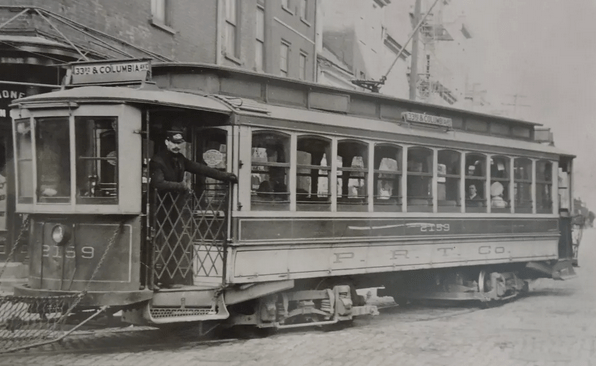
And if that wouldn’t frighten the Hell out of a little kid, what would. Especially one who had a trolley line running in front his West Philly home. Trolleys, albeit horse drawn, had been in that area since the 1870. In South Philly,electrified street cars had come in by the late 1890s. My guess is that they still probably looked something like this, maybe a little smaller.

You have to have some sense of what kind of neighborhood this part of South Philly was. It was sort of at the southern fringe of civilization. That doesn’t mean it was bad, but it was not exactly Parkside either. If you went about 3 miles South of 8th and Kimball, you would have hit an undeveloped part of the city known as The Neck. It was marshy, kind of ramshackle and home to Philadelphia’s resident colony of pig farmers, who made a living supplying the city’s 9th Street market with pork producer, including offal. It was not exactly a source of civic pride, even in 1914. It had the reputation as a place you went and got your ass kicked. So I’d guess Concetta lived in a place which was the bottom of the ladder of upward mobility for Italian immigrants, which her sister Frances certainly saw in her lifetime. Suburban Penfield, where Frances died at 94, was another world from pig farmers and The Neck. So these guys were one step up from The Neck. They were lucky to be there. Remember, they left Italy behind.

The Neck, a somewhat optimistic view

10th and Kimball, looking East. No, it isn’t a Hopper painting, but you see where he got the inspiration

Since the accident virtually happened on their doorstep, they would have known immediately. Probably a banging on the door, followed by screaming and shouting, in Italian, the neighbors. I can imagine Maddalena and Pietro running out into the street. And oh Lord, what did they see, Their child, Concetta, beneath the wheels of a trolley. It is almost obscene to try to imagine with a gathering crowd, people shouting, the driver frantic, my Great Grandmother and Grandfather in some frozen state of hysteria and shock. What do you do? I’m sure the trolley driver was petrified and would not move the car, because, as the story says, they called for a jack to raise the car off Concetta. God only knows how long it took for the jack to get there, to raise the car, and to extract the child’s lifeless, broken body. She was taken to Pennsylvania Hospital, at 8th and Spruce. That’s less than a mile, but it must have seemed like another planet. My guess is by motorized ambulance, but, really who knows? It could have been horse and wagon. My Lord, they may have physically carried her there, frantic. Only God knows now. I imagine the scene in different ways, each progressively more ghastly. Concetta was pronounced dead at Pennsylvania Hospital.

And now, I know almost nothing more. What I do know, from looking at the parish death register, is that little children died this way. Another three year old in February (1915?) “morto sotto un carro di transporto all’Ospedale Pennsylvania.” (dead under a transport cart, Pennsylvania Hospital) You can imagine the WASP doctors’ heads shaking. Why don’t they watch their children more carefully? Italians. What can you expect? You can fill in the mental blanks. They never change, do they? What can you expect from immigrants?

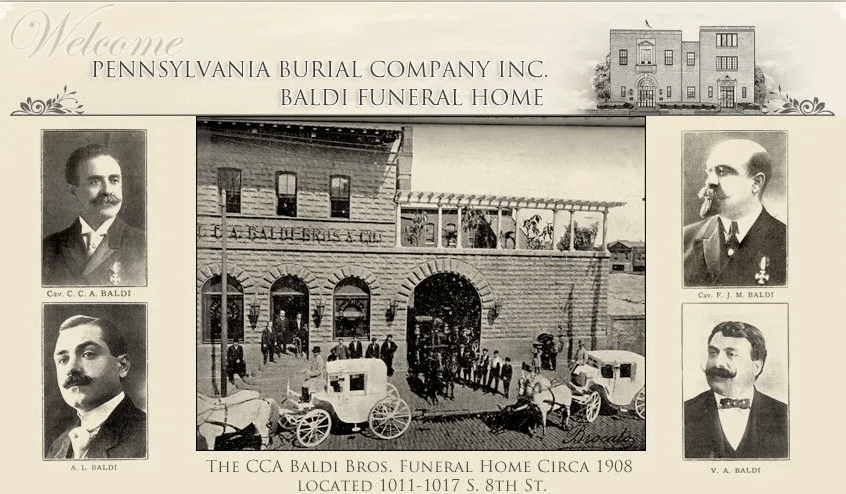
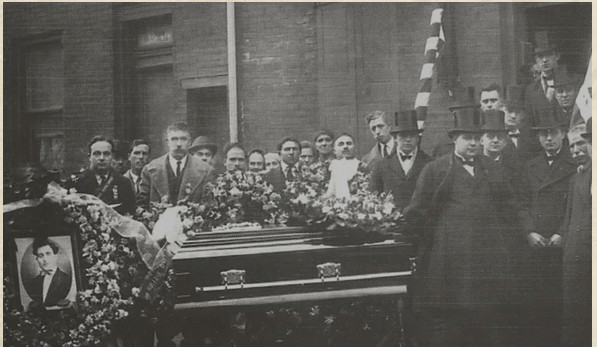
So a million questions run through my mind? Did anyone sleep for days after? Was there any kind of wake (did that even figure in death rituals in Italy then)? When was the funeral mass? There must have been one, no? How on Earth did they pay for it? How did they get the little girl to Holy Cross Cemetery in Yeadon? As the crow flies, it must be 6 or 7 miles, but you’d have to get across the Schuylkill River–in 1914, how or where where? There were ferries, true enough, and at least one bridge, but that was to West Philadelphia. Was there a procession, which even then was a tradition among Italians in America? Who bought the grave? Was there some kind of mutual aid among Immigrants there? You can see what Baldi Funeral Home looked like in 1908. I can’t imagine the child got that treatment, you know? High-end Edwardian. Probably a little more like the photo at the very bottom. How did they get out to Yeadon to visit the grave, because they must have. You know, Italians are not allergic to graves. How long did they mourn? She died on May 8 and was buried on May 11, which seems remarkably hurried. Or maybe it wasn’t.

My God, I know nothing about my own people. I don’t even know if I am asking sensible questions. I do know I have been thinking about this almost since I first ran across it. The story haunts me. My ignorance haunts me. The world as it was before I was haunts me. Draw your own conclusions. Who am I?

And speaking of haunting, the Delia ultimately moved to 913 Cross Street (https://thisgameisovercom.wordpress.com/wp-admin/post.php?post=1090&action=edit), again, nearby, less than a mile walking today. It was a bigger house and the family was growing. Another daughter, born in 1917, was again named Concetta, whom I knew as my Aunt Connie. And I am told by a church archivist in Philadelphia, Elissa Torre-Lewis, who has been of great help to me, that the practice of preserving the name this way was not uncommon. Another cousin, a Delia, told me she heard stories that Concetta lived upstairs on Cross Street, and occasionally came down to the first floor to make her ghostly presence known.

I never did see the second floor of that house in all the time I went down to South Philly to visit. Not once. Now I know why. But the next time I get out to Holy Cross, I’m going to find Concetta and leave a flower. Because I now know where she resides. In aeternum, amen.

Convergence, Big Time (with apologies to Lant Pritchett)

I have been trying to write this damn thing for a long time. I’ve started. Discarded. Started. Discarded. Started again. Ah, I say. What’s the use? This is above my pay grade. There is no sense publicly demonstrating you don’t know what you’re talking about. But then, like the Hound of Heaven, maybe the Hound of Hell, this damn thing keeps chasing me. And it really isn’t very profound. Things change. Whether it’s for the better or the worse is a matter of perspective, right? Where you started (or think you started) versus where you are (or think you are). And, face it. History is a measuring stick, but, alas, the measuring stick tends to change as well. And we change it, no? What was once acceptable no longer is, or vice versa–or we realize with the passage of time, that seemingly small changes may actually end up having big effects. Or seemingly big changes end up not meaning much in the long run, whatever the long run is. The older I get, the less certain I become. I thought it worked the other way, you know? All in know now is the smartest people I can read–people like Lampedusa, Newman, Keynes, Darwin, Emerson–they all say it’s about change and figuring out how to navigate it. Who am I to disagree? Only American politicians associate changing your view with something they call “flip flopping.” Which is bad, I gather. That’s not the company I want to keep. Sorry. So stop right here if you disagree. I won’t convince you anyway. And am not going to try.

I have the twin curse of being interested in both history and economics. I’m pretty sure I don’t know enough about either and understand even less. And that isn’t false modesty. In my business, you write something, and then your friendly fellow scholars tear you apart. Their motives may be honorable. Or they just may be miserable people. It doesn’t matter. “That’s how we learn,” you tell yourself. History is some great dialectical process, or some impressive-sounding crap you learned at the age of nineteen. One way or another, you try to learn something even from the evil mother******** in your midst. Or you end up being part of some sect that basically has members who tell themselves how smart they all are. Some of them may actually be just that. And some, well, not so much. Whatever gets you through the night.

In any event, history is complicated, and economics may affect the trappings of a science, but I’m not sure how many people–even economists–believe that. The sources of error, by omission or commission, are so numerous that it doesn’t bear much thinking about the fact they exist. I guess if you are certain, you are finally in the right church. I’m not. And that’s that.

Of course, since it’s the season of the witch, it stands to reason some of us are obsessing about this. You know, the lying bastards running for office trying to convince us of some thing or other, maybe true, maybe a total fabrication. Catch 22, right? The most gullible may well be the most persuadable, as PT Barnum well understood. You got to be crazy to believe it, but you got to be crazy to survive. Like Yosssarian said, that’s some Catch, that Catch 22. Yup. Sure is. Especially where history and economics are concerned.

Now one of the people running around trying to persuade us to elect him (or re-elect him, God forbid), wants us to believe that in some golden past, Things (whatever they are) were better. You know, Archie Bunker stuff: Boy the way Glenn Miller played….guys like us, we had it made….Girls were girls and men were men…Didn’t need no Welfare States…Gee our old LaSalle ran great.” Right. Whatever. Like Artie Shaw (no kin to Archie Bunker) once said, yeah, the Good Old Days of World War II, you know, that killed upwards of 40 million people? Them good old days.

Well, within the limits of very fallible theory and even more fallible statistics, I got to wondering about certain aspects of that theory. Nothing heavy duty, cause it’s not like I’m capable of that anyway. But I did want to go back a few years and see how much more unequal we have become in the United States, because, one way or another, the trope of unfairness is a pretty big one in this election. And not unreasonably. You can argue the merits of the case on way or another, but, please, if you happen to be my age (73), stuff sure feels different. Yeah, we could start with the climate, but then someone will be yelling that it was cooler in Hell (San Antonio, Texas) this Summer than last, so take that. Well, yeah. If your world is San Antonio, Texas, go for it. Mine is slightly broader. Oh, yeah. And stay away from western North Carolina.

Statisticians and economists, take my word for it (please) have always been trying to figure out how to measure this stuff in a way for even the least able among us to wrap their minds around it. Take my word for it, there is no uncontroversial, unambiguous, transparent, universally acceptable way of measuring the phenomenon. However, there has been plenty of interest in the idea. This little illustration I got here shows a nearly exponential increase in interest in the subject (inequality) as measured by published references in English to the subject since 2010. Hell, the rate of increase in interest in the subject exceeds even the rate of increase in interest in sex, analogously measured. See for yourself. It’s science. (Calm down, ok?)

If there is anything that will compete with someone’s interest in “How much sex am I getting relative to someone else?” it is “How much money am I getting relative to someone else?”

So, of course, there you have it. And no need to ask why? Is there?

Now, whatever I think my comparative advantage is, we’re not gonna assume it’s sex. Yeah, in my dreams. So let’s talk a little about income inequality. Yawn….. Believe me, if anything is more complicated than sex, it’s income inequality. One very crude summary measure that’s subject to about a zillion qualifications is something called a Gini Coefficient (named after it’s originator, Corrado Gini, not some other curvaceous Italian, like Gina Lollobrigida).

Corrado Gini, not Gina

To oversimplify it–like I oversimplify everything (I said it before you), The Gini Coefficient is a summary statistic that can be calculated. Conventionally, it ranges from 0 (perfectly even distribution: everybody gets the same everything) to 1 (perfectly unequal: everything goes to one claimant and to Hell with the rest). Sometimes you’ll see this in decimal form, sometimes someone will invert the significance of 0 to 1 (they better tell you first), but that’s basically it. Numbers closer to 0 mean more equal. Numbers closer to 1 mean less equal. A perfectly Orwellian Number. Yeah, I know, there are a zillion caveats. I’m just trying to make a point–eventually. There are other summary statistics, like the Theil Index https://utip.gov.utexas.edu but you rarely if ever see it.

Ok, here I’ve posted World Bank data for the Gini for Mexico and the United States. The World Bank stuff for Mexico only goes back to 1989, whereas the US goes back to the 1960s. I want to warn you again, don’t just be making unqualified pronouncements on the basis of this data–again for about zillion reasons, but if you just step back for a moment and admire the general drift of things, you notice One Big Thing: convergence. In plain English, the two series approach each other. Or to put it differently, inequality has increased in the US and decreased in Mexico. Big Time. Avoid the temptation to say anything other than there’s something going on here, because neither one of these findings is uncontroversial. And if you try some MAGA nonsense about this is what happens when you let “them” into “our wonderful country,” I will take the time out from my busy schedule to straighten you out. WHY this is happening is one thing. THAT it is happening is something else. And an awful lot of Ugly America these days can be usefully regarded as an artifact of this convergence: Mexico is not the enemy. How could it be? We are more like them in some respects than we have ever been. We have met the enemy, as Pogo said, and it is us. Pogo don’t ring a bell? Look it up. No. There are not 35,000 murderous illegals or whatever that idiot said.

See, my basic feeling–it isn’t a thought because it’s not developed enough–is that we’ve been doing a lot of really stupid things in the United States for a now not insignificant amount time. Admittedly, some of them are in reaction to changes in the world we have little control over–since the 1960s, at least–but we do have at least some choice in how we respond to things. And, sorry, by our own choices, I think we may have things a lot worse. For sure, no one was trying (at least as far as I am concerned) was deliberately trying to make stuff worse. Quite the contrary. At least in terms of economic theory, a lot (not all) of the stuff was going to make us better off, or so we thought. And so the Econ told us, or at least a lot of the “mainstream” Econ, to which, I must admit my guilt, I largely subscribed. But even I had started to notice stuff going sideways as early as the late 1970s. And I, as they said of the Virgin Mary, considered these things in my heart, even if I didn’t walk around talking about them. You know, if you have your doubts, you probably don’t advertise them. Unless you are a principled truth-teller, and pretty damn smart.

I’ll give you a sort of silly example, although it made a big impression on my at the time. When I got back home from living in Mexico in 1978, I had an urgent need to make a living–and thanks to an old teacher, Ed Mathis, was lucky enough to end up teaching principles of Economics at Villanova. And there I should have stayed, but that’s another story. Anyway, I was buying a car because I now had a job, and very alert then to the influx of foreign cars into the US, because, naturally enough, I had been living in a country where they were assembling Volkswagens (in Puebla, Mexico). I got to drive a Beetle in Mexico too, which was cool, so I knew they didn’t bite. But I also saw a lot of other foreign makes, some glamorous, some not. Living in the Philly suburbs I saw a certain amount of my folks who resided in Penn Wynne, just over City Line Avenue outside West Philly. It was–and is–a modest 1920s suburb. Living there when I did, I got to see what my neighbors drove. It was pretty standard US, you know, the Big Three. Yeah, there were some oddballs who drove a VW or an MG, but really, it was an Oldsmobile, Buick, Chevy kind of neighborhood. And not a fancy model sort of place either. One neighbor drove a Chevy Nova, which was hardly a hot car. Hell, his was even black. Talk about basic. My Dad drove Buicks and his move up in life was from a Century to a Skylark with AC and a leather (vinyl?) roof. That, my friend, was living.

But around 1978, I started to see foreign cars in Penn Wynne. Ok. Big deal. Everyone started seeing the impact of Japanese automobiles in the US market. But I noticed something else. There were a couple–maybe two, maybe three–BMWs. I barely knew what a BMW was other than a hopped-up VW. But I knew they cost a pretty penny and typically were out of reach for someone in Penn Wynne, assuming they’d even want one if they could afford it. Well, I was struck but the portentous appearance of the foreign invader in the hood, so I looked into it. Well, they were a bit expensive, to say the least. Hell. New, even a base model then cost more than what my Dad had paid for our home in 1960. Yeah.

Bingo.

Do you see where this is leading? The price of housing was starting to rise to the point that if you qualified for a mortgage in Penn Wynne, for God’s sake, you could afford a BMW. I will long think that a rise in the relative price of housing was inevitable given the size of the Baby Boom generation, which was, at that point, I’m certain, making its initial forays into the market. To some extent, it’s no one’s “fault”. But to deal with inflation, which was rising at least in part due rising oil prices–which were a consequence of a sustained fall in the dollar, which was at least in part a consequence of the Vietnam War, which was never properly financed, let alone declared (even the Tonkin Gulf Resolution had been repealed) and the deterioration of the United States external financial position……and so on and so forth, interest rates started to soar in 1979. By 1981, well, forget it. For want of a nail, you know. As early as 1964, there were people in Washington who saw Vietnam as a catastrophe in the making. Don’t think so? Read the Pentagon Papers. It’s all there. None of that stuff had to happen. But happen it did. Look in the index under “Ball, George.”

And it gets worse. Productivity growth in the US (called somewhat mysteriously, TFP or Total Factor Productivity) had risen from 1950 to 1973 at about 2 percent. From 1973 to 1990, it rose at less than 1 percent. Basically, the standard of living, which had been doubling every generation (35 years) would now require a lifetime (70 years more or less) to double. You don’t think that makes a Hell of a difference in people’s life chances, or their attitudes to their fellow human. Give me a break. You doubt it? There’s a nice little book called The Moral Consequences of Economic Growth by Benjamin (NOT MILTON) Friedman. It’s quite an eye-opener, especially when you’re accustomed to dealing with historians who have made a point of denying any such thing (in my experience, all of them, if they don’t think economkic growth is simply bad).

What’s particularly disturbing about the United States as we’ve become more unequal, our growth has stagnated. To be sure, economic growth in Mexico under President Lopez Obrador (AMLO) has been terrible–the worst sexenio performance since Miguel de la Madrid (1982-1988), when growth was basically zero. Still, a lot of people will tell you that, if nothing else, the growth of the Mexican economy under Lopez Obrador has been terrible, but at least inequality has diminished. Now I have openly expressed skepticism about whether this was smoke and mirrors, let alone sustainable, but for the sake of argument, let’s assume that AMLO has done what he set out to do. I can hear my former colleagues muttering some stuff about equal impoverishment–the standard Southern Economic Association line about, for instance, Cuba. And with Cuba, that would appear to be true. But while Mexico is still extremely unequal, it would, in the eyes of some, appear that at least some people are better off. Mybe quite a few. Maybe. Who the Hell is better off in the United States? Some infinitesimal share of all households, while the rest of us square off for a possible civil war? What an accomplishment. Forgive me if I say I’m not impressed. Chicago Booth Review reports (not exactly a left wing outlet) we could be talking fewer than a thousand families, the tenth of the top one percent. Yeah, you read that right. My Lord, there was a time when we talked about Nicaragua under Somoza that way, but the US of A? Welcome to the Third World. And you wonder why we have Third World problems?

I don’t know what you think, but I have a feeling we have made a very bad bargain in the United States. Really? With whom? Who do you think? Who yells tax cuts, tax cuts, and more tax cuts, even when it is not obvious that we can afford the ones we have had? Who still insists that tax cuts can pay for themselves? Who says tariffs and a weak dollar will make America Great Again? C’mon man. The Democrats are hardly blameless for the fix we find ourselves in, but can you say Ronald Reagan? It’s a measure of how far that benighted party has travelled since the days when Reagan called for tearing down a wall, while his political grandchildren will stake everything for the chance to build an even bigger one on the Southern Border.

I need to be sick. Hypocrisy of that magnitude does it all the time.

The End.