
I have been trying to write this damn thing for a long time. I’ve started. Discarded. Started. Discarded. Started again. Ah, I say. What’s the use? This is above my pay grade. There is no sense publicly demonstrating you don’t know what you’re talking about. But then, like the Hound of Heaven, maybe the Hound of Hell, this damn thing keeps chasing me. And it really isn’t very profound. Things change. Whether it’s for the better or the worse is a matter of perspective, right? Where you started (or think you started) versus where you are (or think you are). And, face it. History is a measuring stick, but, alas, the measuring stick tends to change as well. And we change it, no? What was once acceptable no longer is, or vice versa–or we realize with the passage of time, that seemingly small changes may actually end up having big effects. Or seemingly big changes end up not meaning much in the long run, whatever the long run is. The older I get, the less certain I become. I thought it worked the other way, you know? All in know now is the smartest people I can read–people like Lampedusa, Newman, Keynes, Darwin, Emerson–they all say it’s about change and figuring out how to navigate it. Who am I to disagree? Only American politicians associate changing your view with something they call “flip flopping.” Which is bad, I gather. That’s not the company I want to keep. Sorry. So stop right here if you disagree. I won’t convince you anyway. And am not going to try.
I have the twin curse of being interested in both history and economics. I’m pretty sure I don’t know enough about either and understand even less. And that isn’t false modesty. In my business, you write something, and then your friendly fellow scholars tear you apart. Their motives may be honorable. Or they just may be miserable people. It doesn’t matter. “That’s how we learn,” you tell yourself. History is some great dialectical process, or some impressive-sounding crap you learned at the age of nineteen. One way or another, you try to learn something even from the evil mother******** in your midst. Or you end up being part of some sect that basically has members who tell themselves how smart they all are. Some of them may actually be just that. And some, well, not so much. Whatever gets you through the night.
In any event, history is complicated, and economics may affect the trappings of a science, but I’m not sure how many people–even economists–believe that. The sources of error, by omission or commission, are so numerous that it doesn’t bear much thinking about the fact they exist. I guess if you are certain, you are finally in the right church. I’m not. And that’s that.
Of course, since it’s the season of the witch, it stands to reason some of us are obsessing about this. You know, the lying bastards running for office trying to convince us of some thing or other, maybe true, maybe a total fabrication. Catch 22, right? The most gullible may well be the most persuadable, as PT Barnum well understood. You got to be crazy to believe it, but you got to be crazy to survive. Like Yosssarian said, that’s some Catch, that Catch 22. Yup. Sure is. Especially where history and economics are concerned.
Now one of the people running around trying to persuade us to elect him (or re-elect him, God forbid), wants us to believe that in some golden past, Things (whatever they are) were better. You know, Archie Bunker stuff: Boy the way Glenn Miller played….guys like us, we had it made….Girls were girls and men were men…Didn’t need no Welfare States…Gee our old LaSalle ran great.” Right. Whatever. Like Artie Shaw (no kin to Archie Bunker) once said, yeah, the Good Old Days of World War II, you know, that killed upwards of 40 million people? Them good old days.
Well, within the limits of very fallible theory and even more fallible statistics, I got to wondering about certain aspects of that theory. Nothing heavy duty, cause it’s not like I’m capable of that anyway. But I did want to go back a few years and see how much more unequal we have become in the United States, because, one way or another, the trope of unfairness is a pretty big one in this election. And not unreasonably. You can argue the merits of the case on way or another, but, please, if you happen to be my age (73), stuff sure feels different. Yeah, we could start with the climate, but then someone will be yelling that it was cooler in Hell (San Antonio, Texas) this Summer than last, so take that. Well, yeah. If your world is San Antonio, Texas, go for it. Mine is slightly broader. Oh, yeah. And stay away from western North Carolina.
Statisticians and economists, take my word for it (please) have always been trying to figure out how to measure this stuff in a way for even the least able among us to wrap their minds around it. Take my word for it, there is no uncontroversial, unambiguous, transparent, universally acceptable way of measuring the phenomenon. However, there has been plenty of interest in the idea. This little illustration I got here shows a nearly exponential increase in interest in the subject (inequality) as measured by published references in English to the subject since 2010. Hell, the rate of increase in interest in the subject exceeds even the rate of increase in interest in sex, analogously measured. See for yourself. It’s science. (Calm down, ok?)
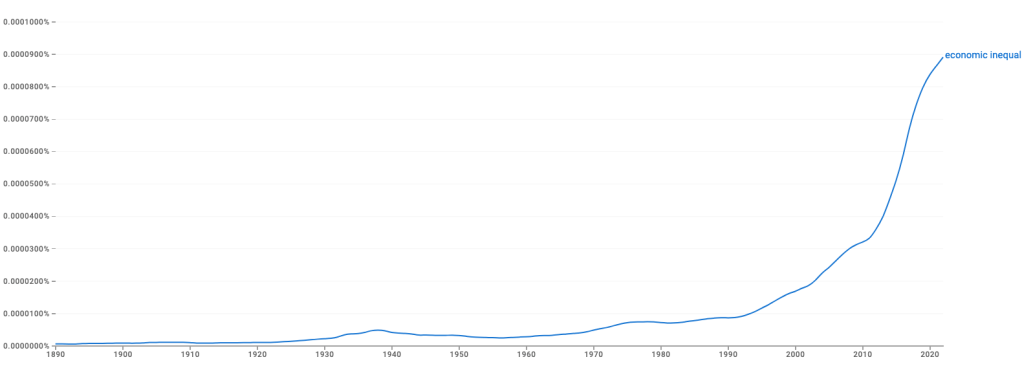
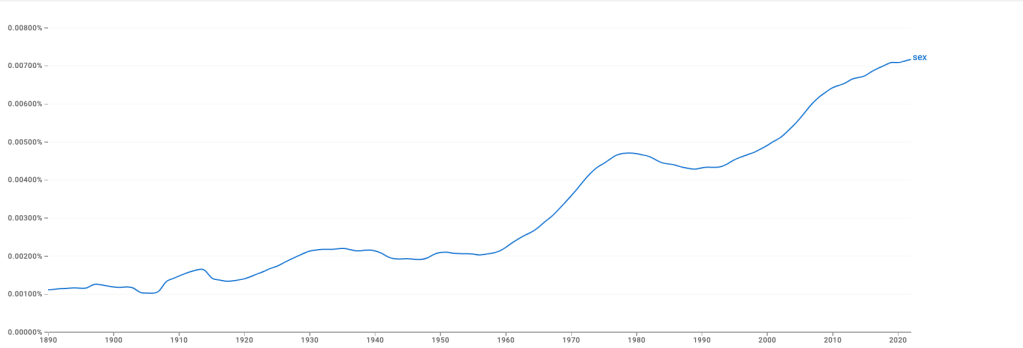
If there is anything that will compete with someone’s interest in “How much sex am I getting relative to someone else?” it is “How much money am I getting relative to someone else?”
So, of course, there you have it. And no need to ask why? Is there?
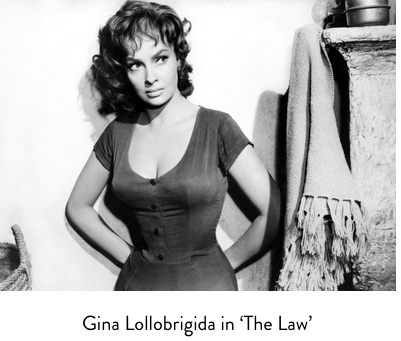
Now, whatever I think my comparative advantage is, we’re not gonna assume it’s sex. Yeah, in my dreams. So let’s talk a little about income inequality. Yawn….. Believe me, if anything is more complicated than sex, it’s income inequality. One very crude summary measure that’s subject to about a zillion qualifications is something called a Gini Coefficient (named after it’s originator, Corrado Gini, not some other curvaceous Italian, like Gina Lollobrigida).

To oversimplify it–like I oversimplify everything (I said it before you), The Gini Coefficient is a summary statistic that can be calculated. Conventionally, it ranges from 0 (perfectly even distribution: everybody gets the same everything) to 1 (perfectly unequal: everything goes to one claimant and to Hell with the rest). Sometimes you’ll see this in decimal form, sometimes someone will invert the significance of 0 to 1 (they better tell you first), but that’s basically it. Numbers closer to 0 mean more equal. Numbers closer to 1 mean less equal. A perfectly Orwellian Number. Yeah, I know, there are a zillion caveats. I’m just trying to make a point–eventually. There are other summary statistics, like the Theil Index https://utip.gov.utexas.edu but you rarely if ever see it.
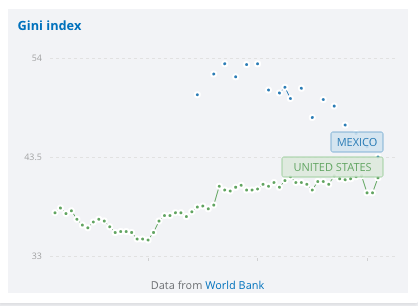
Ok, here I’ve posted World Bank data for the Gini for Mexico and the United States. The World Bank stuff for Mexico only goes back to 1989, whereas the US goes back to the 1960s. I want to warn you again, don’t just be making unqualified pronouncements on the basis of this data–again for about zillion reasons, but if you just step back for a moment and admire the general drift of things, you notice One Big Thing: convergence. In plain English, the two series approach each other. Or to put it differently, inequality has increased in the US and decreased in Mexico. Big Time. Avoid the temptation to say anything other than there’s something going on here, because neither one of these findings is uncontroversial. And if you try some MAGA nonsense about this is what happens when you let “them” into “our wonderful country,” I will take the time out from my busy schedule to straighten you out. WHY this is happening is one thing. THAT it is happening is something else. And an awful lot of Ugly America these days can be usefully regarded as an artifact of this convergence: Mexico is not the enemy. How could it be? We are more like them in some respects than we have ever been. We have met the enemy, as Pogo said, and it is us. Pogo don’t ring a bell? Look it up. No. There are not 35,000 murderous illegals or whatever that idiot said.
See, my basic feeling–it isn’t a thought because it’s not developed enough–is that we’ve been doing a lot of really stupid things in the United States for a now not insignificant amount time. Admittedly, some of them are in reaction to changes in the world we have little control over–since the 1960s, at least–but we do have at least some choice in how we respond to things. And, sorry, by our own choices, I think we may have things a lot worse. For sure, no one was trying (at least as far as I am concerned) was deliberately trying to make stuff worse. Quite the contrary. At least in terms of economic theory, a lot (not all) of the stuff was going to make us better off, or so we thought. And so the Econ told us, or at least a lot of the “mainstream” Econ, to which, I must admit my guilt, I largely subscribed. But even I had started to notice stuff going sideways as early as the late 1970s. And I, as they said of the Virgin Mary, considered these things in my heart, even if I didn’t walk around talking about them. You know, if you have your doubts, you probably don’t advertise them. Unless you are a principled truth-teller, and pretty damn smart.
I’ll give you a sort of silly example, although it made a big impression on my at the time. When I got back home from living in Mexico in 1978, I had an urgent need to make a living–and thanks to an old teacher, Ed Mathis, was lucky enough to end up teaching principles of Economics at Villanova. And there I should have stayed, but that’s another story. Anyway, I was buying a car because I now had a job, and very alert then to the influx of foreign cars into the US, because, naturally enough, I had been living in a country where they were assembling Volkswagens (in Puebla, Mexico). I got to drive a Beetle in Mexico too, which was cool, so I knew they didn’t bite. But I also saw a lot of other foreign makes, some glamorous, some not. Living in the Philly suburbs I saw a certain amount of my folks who resided in Penn Wynne, just over City Line Avenue outside West Philly. It was–and is–a modest 1920s suburb. Living there when I did, I got to see what my neighbors drove. It was pretty standard US, you know, the Big Three. Yeah, there were some oddballs who drove a VW or an MG, but really, it was an Oldsmobile, Buick, Chevy kind of neighborhood. And not a fancy model sort of place either. One neighbor drove a Chevy Nova, which was hardly a hot car. Hell, his was even black. Talk about basic. My Dad drove Buicks and his move up in life was from a Century to a Skylark with AC and a leather (vinyl?) roof. That, my friend, was living.
But around 1978, I started to see foreign cars in Penn Wynne. Ok. Big deal. Everyone started seeing the impact of Japanese automobiles in the US market. But I noticed something else. There were a couple–maybe two, maybe three–BMWs. I barely knew what a BMW was other than a hopped-up VW. But I knew they cost a pretty penny and typically were out of reach for someone in Penn Wynne, assuming they’d even want one if they could afford it. Well, I was struck but the portentous appearance of the foreign invader in the hood, so I looked into it. Well, they were a bit expensive, to say the least. Hell. New, even a base model then cost more than what my Dad had paid for our home in 1960. Yeah.
Bingo.
Do you see where this is leading? The price of housing was starting to rise to the point that if you qualified for a mortgage in Penn Wynne, for God’s sake, you could afford a BMW. I will long think that a rise in the relative price of housing was inevitable given the size of the Baby Boom generation, which was, at that point, I’m certain, making its initial forays into the market. To some extent, it’s no one’s “fault”. But to deal with inflation, which was rising at least in part due rising oil prices–which were a consequence of a sustained fall in the dollar, which was at least in part a consequence of the Vietnam War, which was never properly financed, let alone declared (even the Tonkin Gulf Resolution had been repealed) and the deterioration of the United States external financial position……and so on and so forth, interest rates started to soar in 1979. By 1981, well, forget it. For want of a nail, you know. As early as 1964, there were people in Washington who saw Vietnam as a catastrophe in the making. Don’t think so? Read the Pentagon Papers. It’s all there. None of that stuff had to happen. But happen it did. Look in the index under “Ball, George.”
And it gets worse. Productivity growth in the US (called somewhat mysteriously, TFP or Total Factor Productivity) had risen from 1950 to 1973 at about 2 percent. From 1973 to 1990, it rose at less than 1 percent. Basically, the standard of living, which had been doubling every generation (35 years) would now require a lifetime (70 years more or less) to double. You don’t think that makes a Hell of a difference in people’s life chances, or their attitudes to their fellow human. Give me a break. You doubt it? There’s a nice little book called The Moral Consequences of Economic Growth by Benjamin (NOT MILTON) Friedman. It’s quite an eye-opener, especially when you’re accustomed to dealing with historians who have made a point of denying any such thing (in my experience, all of them, if they don’t think economkic growth is simply bad).
What’s particularly disturbing about the United States as we’ve become more unequal, our growth has stagnated. To be sure, economic growth in Mexico under President Lopez Obrador (AMLO) has been terrible–the worst sexenio performance since Miguel de la Madrid (1982-1988), when growth was basically zero. Still, a lot of people will tell you that, if nothing else, the growth of the Mexican economy under Lopez Obrador has been terrible, but at least inequality has diminished. Now I have openly expressed skepticism about whether this was smoke and mirrors, let alone sustainable, but for the sake of argument, let’s assume that AMLO has done what he set out to do. I can hear my former colleagues muttering some stuff about equal impoverishment–the standard Southern Economic Association line about, for instance, Cuba. And with Cuba, that would appear to be true. But while Mexico is still extremely unequal, it would, in the eyes of some, appear that at least some people are better off. Mybe quite a few. Maybe. Who the Hell is better off in the United States? Some infinitesimal share of all households, while the rest of us square off for a possible civil war? What an accomplishment. Forgive me if I say I’m not impressed. Chicago Booth Review reports (not exactly a left wing outlet) we could be talking fewer than a thousand families, the tenth of the top one percent. Yeah, you read that right. My Lord, there was a time when we talked about Nicaragua under Somoza that way, but the US of A? Welcome to the Third World. And you wonder why we have Third World problems?
I don’t know what you think, but I have a feeling we have made a very bad bargain in the United States. Really? With whom? Who do you think? Who yells tax cuts, tax cuts, and more tax cuts, even when it is not obvious that we can afford the ones we have had? Who still insists that tax cuts can pay for themselves? Who says tariffs and a weak dollar will make America Great Again? C’mon man. The Democrats are hardly blameless for the fix we find ourselves in, but can you say Ronald Reagan? It’s a measure of how far that benighted party has travelled since the days when Reagan called for tearing down a wall, while his political grandchildren will stake everything for the chance to build an even bigger one on the Southern Border.
I need to be sick. Hypocrisy of that magnitude does it all the time.
The End.
 This Game Is Over, Salvucci Sez