
Ok, this one is strictly for jazz nuts–and a subset of them, known as trumpet players and aficionados. Not every one who likes jazz necessarily digs trumpet players. And those who do like jazz don’t necessarily agree on what constitutes a good trumpet player. Believe me, the sectarian difference would make an Anabaptist tremble with something, because this is a religion. To understand, you have to have had carnal relations with the Brass Beast, preferably over many years and at least 4 or 5 octaves. But, if not, that’s ok. Not all of us are as dim witted as to aspire to the ownership of a Martin Committee (Old Style). That’s a classic horn from the 1940s and 1950s. Just sort of wants to play jazz, a Mephisto horn. Well, let’s leave eroticism out of it–although, to be honest, it’s never really far from the surface with a trumpet.
This little piece is less about the trumpet itself (an inexhaustible subject from just about every angle from technique to mouthpieces and tongue position(!!)). It is about a guy who played trumpet about whom I know very little, but about which I wish I knew an awful lot more. His name was Enoch Thomas Sims, Jr., but I think everyone called him Tommy. He was clearly the best player I almost never heard. So gather ’round, friends, I’ll tell you what I know and why I think it matters.

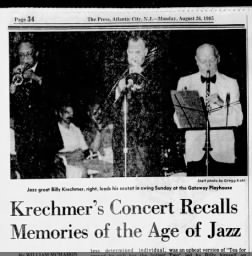
Right off the bat, I’ll clue you into a problem. This is about the best shot of Tommy Simms I have. Yes, he is the Black gentleman on trumpet, playing with a terrific Philadelphia clarinet player named Billy Krechmer. If you want to know more about Billy Krechmer, go to https://www.allaboutjazz.com/billy-krechmer-a-philadelphia-story-billy-krechmer-by-richard-j-salvucci. Yup. Yours truly wrote this, and yours truly is atypically proud of it. But this is not about me, or even about Billy. It is about Tommy Sims, and if this is the only decent picture I have of him, you’ll know I’m not exactly drowning in sources.
Sims (and first problem, it is sometimes spelled Simms, making tracking him an adventure) was born in 1922 in Washington, Georgia. By 1930, his family had moved to South Carolina and then, by 1935, to North Carolina. In 1940, young Tommie was living in Philadelphia. South Philadelphia on Reed Street. It looks to have been a typically South Philly brick row house, and not all that far from where the Delia branch of my Mom’s family lived on Cross Street. While that part of Reed Street was–in 1940–largely populated by Black families that had migrated North, Tommie’s neighbors two door away were a few of the Italian holdouts that remained as that part of South Philadelphia segregated along racial lines between the 1920s and 1940s. In any event, Tommie was already out of school and was working by 1942 when he registered for the draft. He did not, as some of his contemporaries were wont, give his occupation as musician.
I was about fourteen or so (ca. 1965) when I first heard the name Tommy Sims. As an aspiring trumpet player, I was pretty serious about practice. God knows I did enough of it and everyone in the neighborhood was a critic (my favorite evaluation: “Not much improvement is there?”), but most were encouraging and one or two were very supportive. A women down the street, a blowzy, frowzy type who enjoyed sunbathing in her backyard (not your typical Penn Wynne, PTA or Sodality of the BVM militant) stopped me one day while she was sunning herself (and probably drinking an adult beverage) to talk about music. Turns out she was a Harry James fan and had heard me blasting “You’re My Thrill” in the back room while I struggled with copying a solo that was hopelessly beyond me. She loved the tune–well, God only knows what was going on, but Mrs Robinson chastely left me alone and we talked about jazz and horn players. Here, just so you get into the right frame of mind. Do listen. I loved James and his band even more than I loved Woody Herman, which means I spent all my spare time trying to copy internal section parts (probably 4th trumpet) which I couldn’t handle either and this along with “Shiny Stockings” were generally enough to put me into some kind of trance.
Meanwhile, Tommy Sims’ long-running gig with Billy Krechmer was drawing to a closein 1966. I know Sims had been with Jimmy Lunceford’s band after Lunceford died (maybe poisoned by some racist, long-running speculation says) while it was being led by Eddie Wilcox. Fortunately for us, we have some idea of how Sims sounded because Krechmer did some recording and while the stuff is scarcer than Hen’s Teeth, God Bless Spotify. Billy has about 28 listeners a month and Sims has a bunch of solos on the album of his that they have (which may be Krechmer’s only album, on the Ranstead label). So if you have Spotify, spend a little time listening to this. And even if you don’t, you can sample it and know that the trumpet is Tommy Sims. He sounds great everywhere–not a bopper, but playing Dixieland. He had joined Krechmer in 1952. I suspect he was in Philly for another gig at something called the Web Cafe (not that web) and may have come over to Krechmer’s to sit in, maybe at Billy’s invitation. Billy obviously liked what he heard (and he had a tart tongue, from what I can tell, and not much tolerance for mediocrity), so Krechmer probably made Sims an offer he could not refuse. Or something like that. Remember, Tommy’s family was in Philadelphia and Sims had been “touring” as they call it previously. Man, show me a player who doesn’t want to get off the road, especially if he can live at home. My guess is that was that.
Anyway, Tommy is on display on this recording, and his playing is awesome. He’s obviously in another league from everyone other than Krechmer, but the problem is, he doesn’t get much space. Sometimes 8 bars, at most 16. You can tell he is awesome, but Geez, why on Earth didn’t someone get him a vehicle where he could stretch out some. I am on the trail of another recording he appears on, but we’ll have to see if it shows up before I “finish” this. Or maybe I won’t finish until I get it. You can’t always do what you want, but sometimes, you do what you can do. And Sims deserved this.
Now, sometime around 1956 or 1957, Mr. Sims made a big splash. I know this because I am about to show you the results of the Downbeat polls for those years. Downbeat was–and remains–the premier jazz magazine (they’ve never required my services, sniff) and back in the 1950s, it really seemed to be an outsized presence in the world of the music. Part of it was fanboy/fangirl stuff; some of it was pure publicists’ hype; some of it was companies pushing their horns (we made them in the US of A in those days in Elkhart, Indiana), and some of it–a very small part–was useful information, interviews, reviews (and these had to be read carefully, not least for the agendas), and, of course, polls. You know, who’s up and who’s down. Who has captured some nonrandom part of the public’s fancy? Who has made a record (vinyl) that reveals a hitherto unknown talent (sometimes for real). Who should you listen to so as to be part of the hip crowd? Hey, don’t laugh? You do want to be cool, don’t you? Why do you listen to jazz? See, said magazine, much altered, still exists, but notice “Critics Poll”. Some bad ideas never go away.

Now, if you know ANYTHING about trumpet players (if you don’t , I do), you will recognize this as a kind of Who’s Who of jazz players of various sorts in the 1950s and 1960s. Ok, with one or two exceptions. But CLIFFORD BROWN? Whoa. Hold on. We’re talking about a guy whom many considered the best improvisor of all time–maybe, had he lived–of any player since Louis Armstrong.
We are not talking small time players here. We are like talking gods. And there, in their midst, is Tommie Sims. WHO? Yeah, that Tommie Sims? The same one? Are you sure? Oh yeah, I am sure. I am sure because one Downbeat critic called him “a Philadelphia player” who was much better than any number of players with national reputations. Really? Yeah, really. Like up there with cats like Buck Clayton and Roy Eldridge. Trumpet royalty, dude. No exaggeration. And several critics said the same–you may not know who he is, but he is something else. Clearly one guy had dropped into Krechmer’s club and heard him there, because he raved about pianist at the club as well. So some people thought he was worth a trip to Philadelphia to see. Martin Williams, for one. Check out Martin Williams, jazz critic. As in the Martin Williams who wrote The Jazz Tradition, a canonical US book on the music. Yup. We’re not talking some anonymous guy in Texas raving. We’re talking Martin Williams. Good Lord. What was going on here?

Before I speculate much and tell you what I don’t know, I’ll show you a few other photos I dug up. My guess is that the one in the middle captures Sims at an intermediate point. The one on the bottom captures Sims and an older Krechmer after Billy had begun to play again. He didn’t have a club any longer, but he did give some performances around Philly, and, well, yeah, Tommy Sims was always there. Sims was always there because Sims was the best player and the only one really in Krechmer’s class–and Billy knew it. So if a=b and b=c, then a=c, right? The other guys in Billy’s house band were good, especially pianist Eddie Evans. But, like one politician once said to another, “You’re no Jack Kennedy.” Well, Tommy was.
Like other guys in Krechmer’s orbit–the famous Philly DJ Jack Pyle, most notoriously– Simms was a baseball fan. But Pyle lived and died with the Phillies (mostly died, since I think he was around for the Great Collapse of 1964). But I ran across this little snippet as well. Tommy was no fool. The 1950 Phillies had gotten into (and promptly lost) the World Series. Tommy, bless his heart, was a loyal Philadelphian. Aren’t we all?

But loyalty has its limits. Tommy was betting on the then New York Giants–sentiment only gets you so far in this world, my friend. Boy do I wonder who his friends on the then Brooklyn Dodgers were. My Philly imagination wonders if it wasn’t catcher Roy Campanella, the perennial All Star, who was the son of an Italian immigrant father and a black American mother–and, of course, from Philadelphia, but not South Philly. Still, Sims lived pretty close by Italians in South Philly, was married to a white woman (about whom I know nothing right now) and lived in Powelton Village, which was kind of an experiment in integration in West Philly for a long time. Believe me, I have no idea if any of this is so, but as Jake Barnes says in The Sun Also Rises,”Isn’t it pretty to think so?” Of course, it could have been Carl Furillo or Duke Snider on the Dodgers, but I somehow think that was less likely.
Anyway, what more do I really know about Sims? Well. He never quit his day job, because he worked for the Pennsylvania Liquor Control Board , which we fondly called The State Store. That’s a whole ‘nother story, best left for a different post. After Krechmer closed his club in 1966, Tommy did not want for work. In fact, I’d have to say he probably could have worked as much as he wanted in Philly. Because he did. In the 1970s alone, and limiting my search to Philadelphia, I found well over 100 mentions of Simms, typically in club adverts, usually saying “Featuring Tommy Simms.” I’m sure he had a rhythm section with him, but people clearly were coming out to hear Sims. That corresponds to exactly what I heard. “Go hear Tommy Sims, kid.” Problem is I was typically underage, and by the time I was in college, I knew I wasn’t playing for a living. THat was not a mistake, but missing Sims was, believe me.
Now, as far as I know, these weren’t glamour jobs–a working musician gets to play a lot of crap, you see. A wry sense of humor helps, and Sims had one. As a practical joke, I was told he was heading home from a gig in South Jersey with a few other guys. Ft. Dix–the land of basic training for so many unfortunates–was on the way. Fun loving musicians stopped their car at 3AM somewhere outside the base. And, Tommy Sims proceeded to blow Reveille at the top of his formidable lungs, thereupon waking up a large part of the base. They did not stick around to sample the results of their experiment, but, believe me, the story is believable and pure trumpet player humor, I’m sure I will eventually pick up other stories, because jazz history is oral history–I come from the generation where you still didn’t likely go to school to play, but learned on the job. Anytime anyone said anything nice about my playing, it was because I was doing it wrong. Truth. Originality is largely a mistake.
Tommy did record another record with the Ed Ashley Jazz Band, with whom he gigged a lot. It is Dixieland, and the band is, well, ok. Tommy, on the other hand, is superb. In A couple of places, he got to cut loose, so you could hear what he could do. You won’t find this stuff on the internet, but believe me, it’s just another indication of what he could do. Trust me. He was well beyond a solid player. Or a journeyman, a term one jazz writer is infatuated with. He never got bigger because he never left Philadelphia. That was his choice, because he could play.
You also got to remember that being a Black free lancer in those days presented plenty of problems. Don’t kid yourself. Being in the North helped, for sure, but Miles Davis gottbeat up in New York City and Roy Eldridge got jumped in York, Pennsylvania. Philly was not conspicuously progressive, believe me. Ask anyone about Dick Allen’s first years with the Phillies. Not a pretty story.
Tommy Sims passed away in 1986 in Philadelphia. I never heard him live. I’d have to say that aside from never hearing Coltrane live, it is the biggest regret of my experience with music. For real. Sims is buried out near West Chester, PA, and one of these days, I’ll go pay my respects. The least I can do.
 This Game Is Over, Salvucci Sez